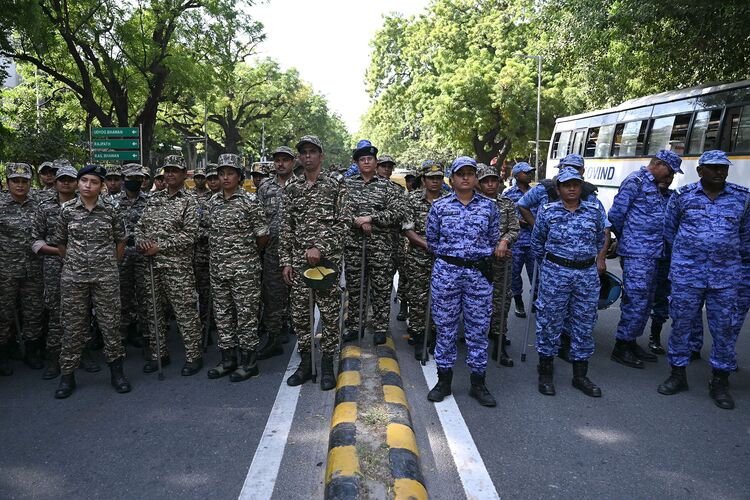
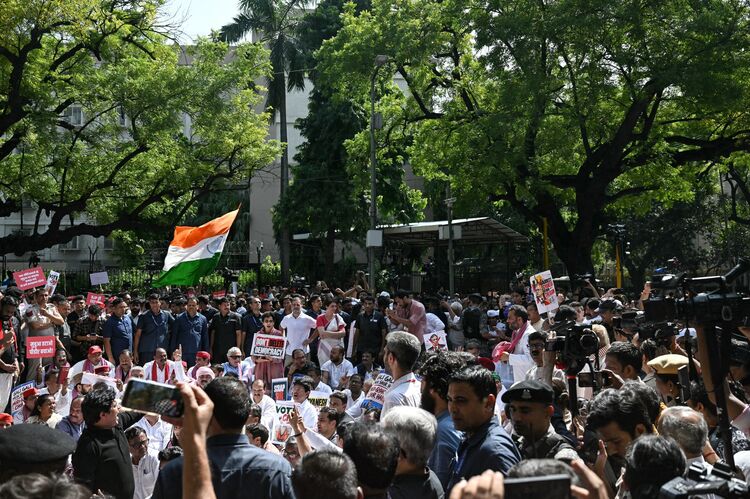
Police in India’s capital New Delhi detained key opposition leader Rahul Gandhi to end an almost nine-hour standoff during a protest seeking the resignation of the chief election official over a contentious revision of voter rolls.
Gandhi and his sibling Priyanka Gandhi Vadra of the Indian National Congress were escorted by the police toward a bus from the premises of the public radio broadcaster, after they were barred by hundreds of cops from marching to the election office earlier in the day.
Opposition leaders are seeking the ouster of the Chief Election Commissioner Gyanesh Kumar and the scrapping of a controversial overhaul of the voter list. More than 130 million names have been removed from the electoral rolls in a process that opposition groups say have unfairly favored Prime Minister Narendra Modi’s ruling party. The commission and Modi’s Bharatiya Janata Party have denied the claims.
Riot police equipped with body cameras, batons and tear-gas launchers outnumbered the protesters on the streets near the parliament and along the route to the Election Commission of India. Water-cannon vehicles were also stationed in the area.
The protests are the latest challenge for Modi’s government after thousands of angry students took to the streets in July over exam irregularities, forcing the education minister to resign. The police faced criticism at the time for their heavy-handed methods in breaking up the student demonstrations.
On Tuesday, the Gandhi siblings slipped through the police cordon in an attempt to reach the election body’s office, but were prevented from doing so. Some party workers were pushed back by police after trying to follow Gandhi. Samajwadi Party leader, Akhilesh Yadav, was separately detained after police blocked the protesters’ route.
“We represent the voice of the people,” Gandhi told reporters at the state broadcaster’s office, where he and his sister continued a sit-in. “I fail to understand why the elected representatives aren’t being allowed to protest and go to the Election Commission.”
Why India’s Voter Roll Overhaul Is So Controversial: Explainer
Kumar has come under fire following a media report last month that said the election panel’s two other commissioners had repeatedly objected to decisions under his leadership on the voter roll revisions. The Election Commission has said such differences were part of the normal decision-making process and that its final decisions were unanimous.
Tensions over the voter rolls come ahead of a series of key state elections, including in Uttar Pradesh, the country’s most populous state, early next year. Modi’s BJP won a surprise landslide victory in West Bengal earlier this year after the state underwent a voter-roll revision, though the extent to which the exercise influenced the outcome remains unclear.
Removing Kumar, however, would be difficult. The chief election commissioner can be ousted only with the support of a large majority in both houses of Parliament, making public and political pressure a more immediate tool for opponents seeking to force his resignation.
“Peaceful protests and legal recourse are the only ways out in a democracy,” Saugata Roy, another opposition lawmaker, said.
The dispute comes at a challenging time for the economy when the government is seeking to bolster investor confidence and boost growth. Indian equities have slumped, while the rupee is one of the worst performing currencies in Asia this year.
India’s Supreme Court on Monday questioned some of the steps taken by the Election Commission in the voter roll revisions. Prashant Bhushan, a prominent Supreme Court public interest lawyer and activist, said he expects authorities to “relent in about two-three weeks when public pressure becomes irresistible.”
Leaders of the Cockroach Janta Party, which led the student protests in July, have backed demands for the chief election commissioner to resign, and plan to hold a march in New Delhi on Oct. 10.