Prime Minister Pedro Sánchez’s government approved new housing measures meant to address Spain’s affordability crisis in a bid to quell nationwide protests and salvage legislation that was struck down by parliament last week.
The failure to pass the bills on Friday prompted Sánchez to dissolve parliament and call a new election, which will be held Nov. 29. Sánchez said the new plan, which is similar to the previous one, was necessary because of the urgency of the housing situation.
“There are many Spaniards waiting for solutions,” Sánchez told reporters in Madrid Tuesday. “Many millions of citizens expect their institutions to have the courage to stand up to the powerful.”
The legislation will need to be approved by lawmakers. With parliament dissolved, the measures will be taken up by a caretaker body where the government faces more favorable voting arithmetic, a move criticized by groups opposed to the measures.
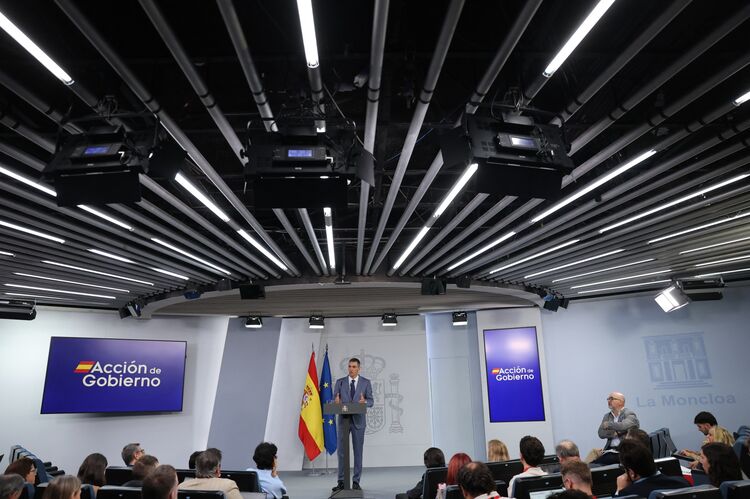
When the government is dissolved in Spain, 69 of the 350 members of the so-called House of Deputies form a caretaker function to ensure that decrees issues by the government can be passed. Currently, the composition of the House of Deputies gives Sánchez and his allies a majority that they didn’t have in parliament, meaning he should be able to pass the legislation.
The new plan includes a ban on evictions of vulnerable people, a freeze on rent prices, extensions of tenants’ contracts and new tax incentives.
Sánchez decided Monday to bring forward elections that had been due in July next year. The 54-year-old Socialist premier is seeking to capitalize on anger sweeping the country over housing, punish the opposition and defy most polls, which suggest he has little chance of winning another term.
Sánchez has a record of wrong-footing opponents by seizing on pivotal moments. But his political position has deteriorated over the years. The center-right People’s Party has led recent polls, garnering 31.6% support in a 40dB poll conducted Sept. 25-28 with 2,000 respondents. The PP’s leader, Alberto Núñez Feijóo, has indicated his party could govern with the radical-right Vox, which had 18.4% in the survey. Sánchez’s Socialists polled at 27.4%.
Sánchez’s government has faced multiple crises, including the arrival this summer of 80,000 migrants in Ceuta, the Spanish exclave in Africa, helping make migration one of the central issues in Spanish politics.
On top of those problems, Sánchez faces corruption cases affecting his party, including the conviction of one of his associates, as well as cases involving his family, with his brother barred from public office and his wife sent to trial.
“Parliament may have decided to turn its back on the people,” Sánchez said. “This government never will.”