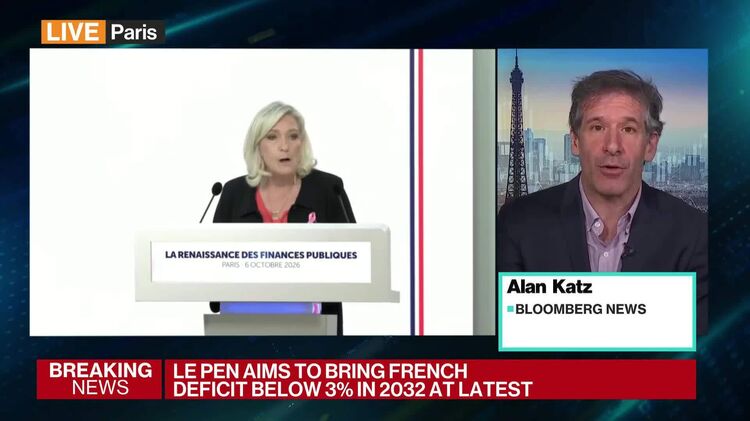
Far-right French presidential candidate Marine Le Pen proposed a sharp deficit reduction and called on the European Central Bank to intervene to bring down surging debt costs as she seeks to assure investors of her financial credentials ahead of the election next year.
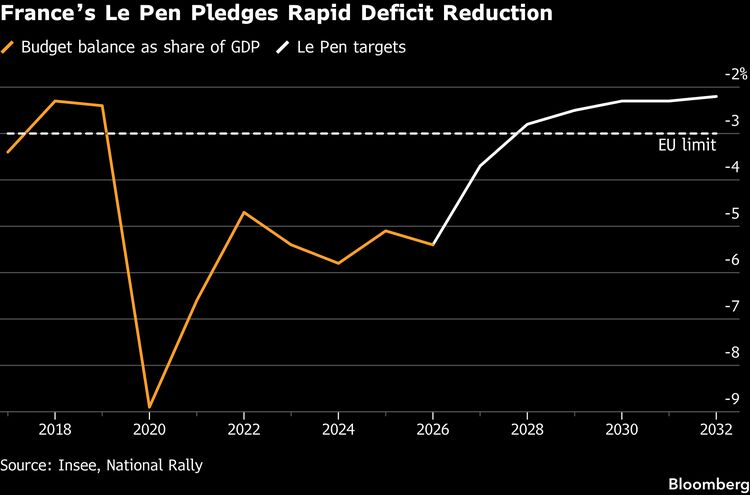
The National Rally leader on Tuesday set out proposals to close the deficit gap to 3.7% of economic output next year while the government’s budget aims for 5%. According to her plan — presented as a scenario if her party wins the upcoming presidential election — the gap will narrow to 2.2% in 2032.
“This radical effort is a deliberate choice — to send an unequivocal signal that the deterioration in public finances is over, and markets can once again regard France as a reliable partner,” Le Pen said at a presentation in Paris.
The proposed reduction in the deficit would far outstrip any effort France has made in the recent past and relies on measures she did not fully detail, including large savings on immigration policy and the “rationalization” of spending. The austere approach to public finances also risks being a hard sell to the voters Le Pen previously sought to appeal to with increased welfare spending.
In a stark reminder of those pressures, her presentation came on the same day as hundreds of high schools in France were shut, with students leading protests in Paris and around the country over a lack of funding in education.
What Bloomberg Economics Says...
“Le Pen has unveiled a shadow budget and long-term fiscal plan to burnish her deficit-cutting credentials — but we don’t find it very credible. It would involve new spending of at least €50 billion ($56.3 billion) a year, while relying on measures that would deliver uncertain savings. It also includes flagship measures targeting the financial sector, wealthy individuals and large corporations.”
—Jean Dalbard and Antonio Barroso. For full React, click here
As the far-right leader spoke, far-left presidential candidate Jean-Luc Mélenchon wrote on social media that Le Pen was trying to win the approval of speculators and that her plan would “paralyze the economy and worsen the deficit and debt.”
But such abrupt retrenchment, according to the far-right leader, would restore France’s credibility and allow her to negotiate with the monetary authorities: “The ECB must intervene so that euro-area countries can free up the financial room to maneuver needed to invest in our sovereignty, namely defense and catching up technologically.”
Aside from the political and fiscal feasibility of the platform, Le Pen’s call for ECB intervention is likely to meet with a push back as the institution is prohibited from financing governments and has strict criteria for intervening on debt markets.
“Bringing public expenditure down from 57.3% to below 50% of GDP in 2032 would represent an exceptionally large adjustment and would inevitably have consequences for growth,” ING Senior Economist Charlotte de Montpellier said. “The fact that she is also calling on the ECB to intervene underlines that the underlying financing pressures have not been resolved.”
Le Pen is seeking to reassure investors as concerns over the country’s political outlook and spiraling debt fuel turmoil in the bond markets.
France is grappling with a punitive selloff in bond markets that has rapidly driven up its borrowing costs compared to European peers. The yield-premium on French bonds over German equivalents rose above 150 basis last week for the first time since the euro-area debt crisis.
Investors are increasingly concerned about the outlook for France’s public finances as the minority government has missed its deficit reduction target by a wide margin and lacks the political support to quickly take corrective measures.
French bonds were rallying Tuesday, part of broader gains across the European government bond market. The 10-year yield spread over German bonds was three basis points tighter at 133 basis points, down from a recent peak near 160 as the selloff starts to tempt investors back.
Beyond the short-term uncertainty over whether Prime Minister Sébastien Lecornu can survive the budget debate in parliament, presidential elections in less than seven months are raising concerns over the country’s long-term debt challenges.
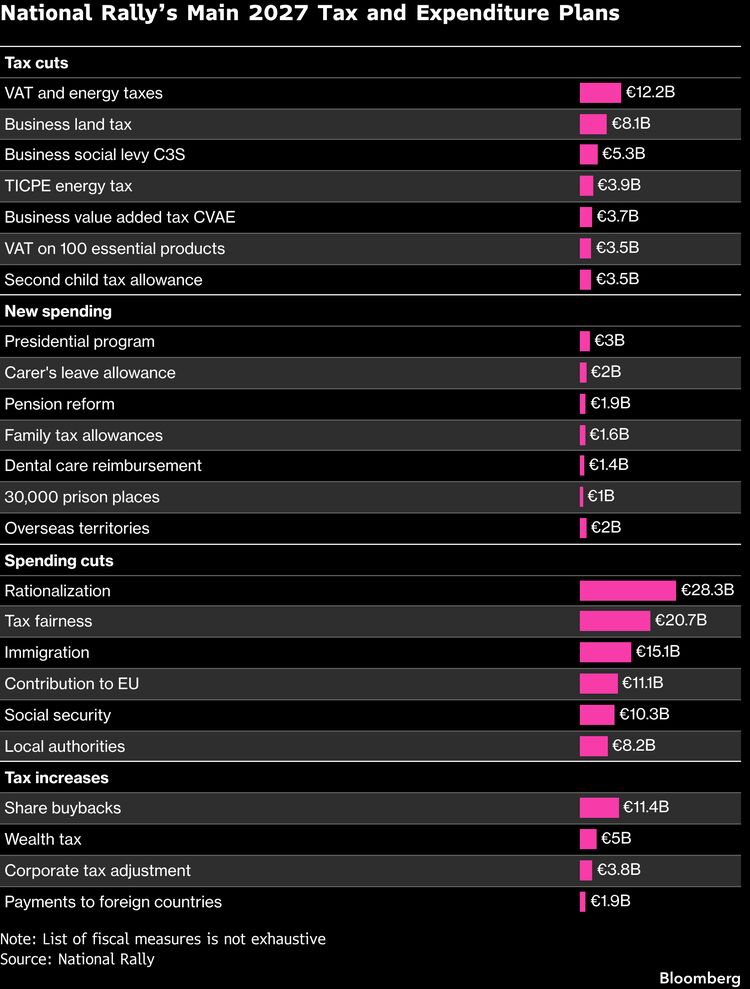
Le Pen, who has a strong lead in polls for the first round of voting in April, said her multi-year plan would amount to a €140 billion cut in public spending, front-loaded with a vast effort in 2027.
Meanwhile, the National Rally’s 2027 plan also includes €53.2 billion of tax cuts — notably on fuel and industry — and tax increases, including on share buy-backs and changes to levies on wealth.
The far-right party said in its presentation that their policies would “mechanically” reduce the spread over German bonds to around 50 basis points.
“If French people don’t chose a political reset, France is heading toward a default,” Le Pen said. “If our creditors will only lend at exorbitant rates, our state and our social model will collapse.”
Le Pen’s past attempts to run for president spooked investors as she proposed radical policies, including pulling France from the euro. She has since softened her approach and last week outlined plans for a “ golden rule ” to force governments to propose budgets to allow for debt reduction
But she still maintains costly core promises, including tax cuts on fuel and a pledge to ensure a retirement age as young as 60 for some workers. Le Pen said the changes to pensions would be entirely financed by €15 billion to €20 billion of savings from an overhaul of the public system that she will detail in the coming weeks.
Last week the government presented €43 billion of new measures in next year’s finance bill to pare the deficit to 5% of economic output in 2027 from 5.4% this year. Combined with other steps taken recently, the total effort in 2027 would amount to €54 billion.
The approach takes aim at sensitive outlays including pensions, welfare, state-financed sick leave, and public-sector wages and headcount.
The National Rally said it would reject the government’s proposed reduction in pension spending and also the partial extension of a tax on large companies. But Le Pen repeated indications she would refrain from toppling the government in order to be able to quickly make fiscal adjustments if she is elected in May.
“As imperfect as the budget is, we consider that the state of the public finances, and notably this bond pressure, is such that we can’t allow ourselves today to set out, how should I say, bans or prohibitions,” Le Pen said.