Samsung Electronics Co.’s earnings will test whether it can convince investors of its long-term outlook, an increasingly critical task as record profits have failed to reinvigorate the stock.
The South Korean tech giant is expected to report its largest-ever quarterly profit on Thursday, but blowout numbers alone may not be enough to reassure investors that memory-chip demand is durable and high product prices can be locked in through long-term contracts.
“It’s really about durability versus magnitude of that earnings,” said Rob Li, managing partner at the New York-based hedge fund Amont Partners, adding that the market now cares less about quarterly figures and more about the 2027 and 2028 outlook.
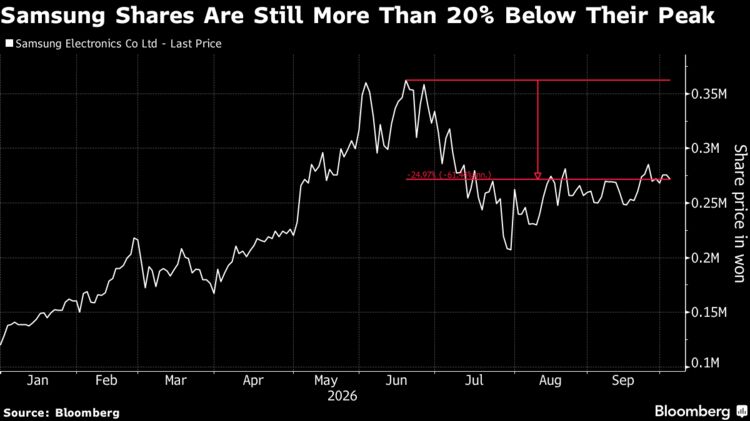
Samsung’s shares remain about 25% below their June peak even after the company reported record-breaking results in July. The upcoming preliminary report, and details due later in the month, offer a crucial opportunity for Samsung to reignite what has been a lukewarm memory trade.
Samsung and fellow memory-chip leaders SK Hynix Inc. and Micron Technology Inc. ranked among the hottest AI trades earlier in the year. Yet, they lagged behind the broader US tech rebound in the third quarter, even with more favorable valuations.
“While investors appreciate ongoing demand and price strength, they are not convinced about how long these conditions can persist given the industry’s history of volatile returns,” said Sanjeev Rana, an analyst at CLSA Securities Korea. “Although suppliers argue that earnings are protected by long-term agreements with pre-defined pricing frameworks, investors remain skeptical.”
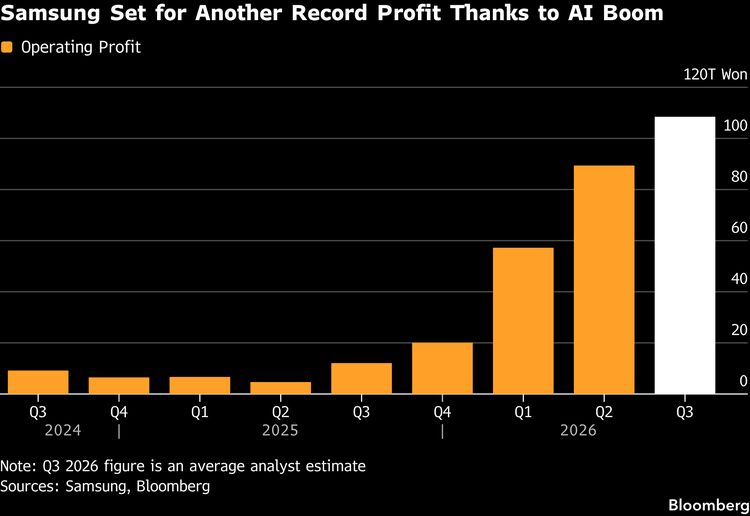
Citing currency headwinds, Morgan Stanley and Citigroup have recently revised down their earnings estimates for Samsung. Still, the world’s largest memory chipmaker is projected to report preliminary operating profit of 108.5 trillion won ($80.8 billion) for the quarter ended September on Thursday, according to analysts’ estimates compiled by Bloomberg.
That would mark a nearly ninefold increase from a year ago. Revenue is forecast to surge about 134% to a record 201.3 trillion won.
Its chip division is expected to post operating profit of 110 trillion won, offsetting losses at its electronics unit, according to analyst estimates. Samsung is set to release a full financial statement around the end of the month.
Thursday might bring further volatility as several semiconductor exchange-traded funds face rebalancing, adding mechanical selling pressure, according to Goldman Sachs Group Inc.’s sales and trading desk.
Not Buying It
Investor skepticism over the memory industry’s notoriously boom-and-bust cycle and profit durability resurfaced following Micron’s latest earnings . Despite management’s bullish outlook that supply conditions will remain tight for next year, the stock has been little changed since last week’s report.
“Clearly the market is not buying that view,” said Li, referring to Micron’s forecast. “So I’ll be curious to see if the Samsung management will also talk about the situations in calendar 2027 and 2028.”
Getting the market to come around on that view is especially urgent as Samsung prepares to wrap up its 15 trillion won stock buyback for employee compensation that had provided steady demand for the shares since late August.
Adding to the pressure on Korea’s chip sector is a growing consensus that the memory price growth peak will slow the broader market’s earnings trajectory.
After a more than 300% surge in earnings growth for 2026, analysts expect that pace to slow sharply to 36% in 2027 and just 6% in 2028, according to Societe Generale SA.
Next Generation Chips
Despite the cautious outlook, Samsung is not without some catalysts. While it has lagged chief rival SK Hynix for years in high-bandwidth memory chips, Samsung’s push to capture market share and boost long-term competitiveness through next-generation HBM4e chips is beginning to turn heads.
“The expectations that Samsung will be expanding its HBM4e market share is gaining more traction,” said Kim Minji, a portfolio manager at Must Asset Management in Seoul. “I do think Samsung has some advantages.”
Samsung shares have bounced back roughly 30% from its July trough, though part of it due to the buyback.
Market expectations for Samsung has been lowered, leaving room for upside surprise, said Jung In Yun, chief executive officer at Fibonacci Asset Management Global.
“But a sustained share-price recovery would require confidence that earnings momentum can carry into next year,” he added.
Top Tech Stories
- SpaceX is in talks with banks and investors to raise $40 billion · to buy chips from Nvidia Corp., people familiar with the matter said, in what would be among the biggest-ever debt financings for the AI buildout.
- Intel Corp. · will continue to work with Elon Musk on Terafab, an audacious attempt by the trillionaire to break into the production of cutting-edge chips, according to Chief Executive Officer Lip-Bu Tan.
- Apple Inc.’s upcoming push into smart home · devices will include a doorbell, thermostat and other accessories developed through an unusual partnership with LG Electronics Inc.
- Advanced Micro Devices Inc.’s chief executive officer plans to meet with the head of Samsung Electronics Co.’s semiconductor business on Wednesday, the latest in-person catchup · between two of the AI industry’s key figures.