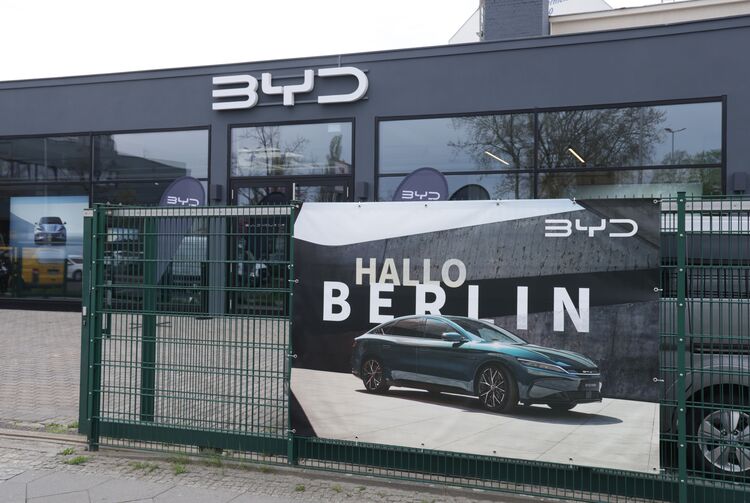
With Europe and China on the brink of a trade war, Beijing has a stark choice: offer a concession to defuse tension or fan the flames . It should opt for the former, and phasing out an incentive that rewards its carmakers for selling more vehicles overseas is a good place to start.
Eliminating a tax rebate that has supported Chinese exporters for decades won’t unilaterally resolve all of the European Union’s complaints . But it would begin to address one of the biggest sources of friction — a trade deficit with China that now exceeds $1 billion a day. More importantly, such a move would be a tangible gesture that Beijing is willing to compromise.
There’s another compelling reason. China is trying to curb a price war and the excess factory capacity that’s plaguing its auto industry. Scaling down and eventually ending the value-added tax export rebate of 13% for electric vehicles would put more pressure on weaker manufacturers to downsize or fold, while leaving the strongest exporters to compete on their own merits.
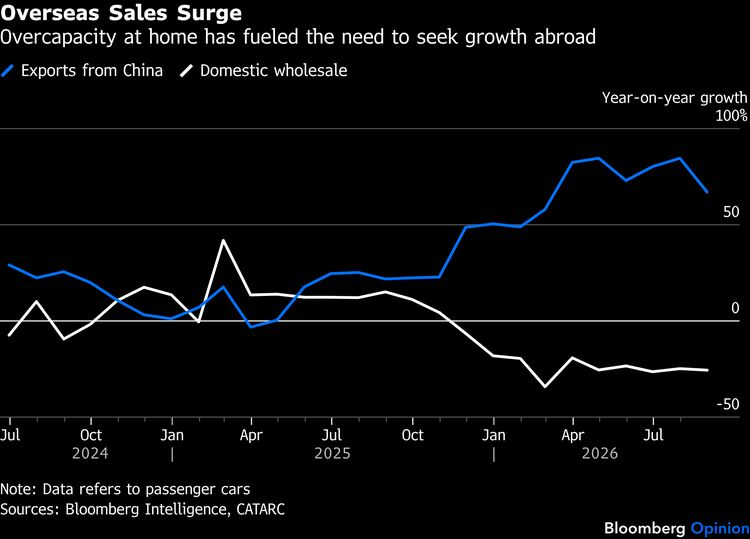
Rebates date back to 1985, when China was eager to earn foreign exchange and build its manufacturing capability. Such incentives are common globally. They allow exporters to recover taxes paid on the raw materials used to make goods sold overseas. In 2021, Beijing began cutting payments for industries such as steel, aluminum, copper, solar products and batteries that had matured enough to no longer need them.
EVs are now ready to join that list. Even though Chinese carmakers have been selling abroad for more than 20 years , they only began cementing their position as the world’s top exporters of clean-energy cars recently. They’re expected to sell more than 12 million vehicles overseas this year — including passenger cars, buses and trucks — up 44% from 8.3 million in 2025, the China Passenger Car Association estimated recently . In Europe, Chinese marques went from being virtually unknown five years ago to outselling South Korean and Japanese rivals.
But winning market share isn’t the problem. What concerns European policymakers is the impact of those gains on jobs. Carmaking remains one of the continent’s most important industries, supporting millions of workers directly and through supplier networks. Germany’s largest union warned of a labor dispute last week after Volkswagen AG terminated a number of wage deals, explicitly citing intensifying price pressure from Chinese manufacturers. The German giant has already announced 100,000 job cuts, while BMW AG plans to eliminate up to 8,000 positions .
The pressure helps explain why Beijing needs to offer something beyond the threat of retaliation when EU Trade Commissioner Maros Sefcovic sits down with his Chinese counterpart Wang Wentao on Thursday. Phasing out the export rebate would narrow the cost advantage enjoyed by Chinese manufacturers without resorting to quotas or other restrictions on where they can sell.
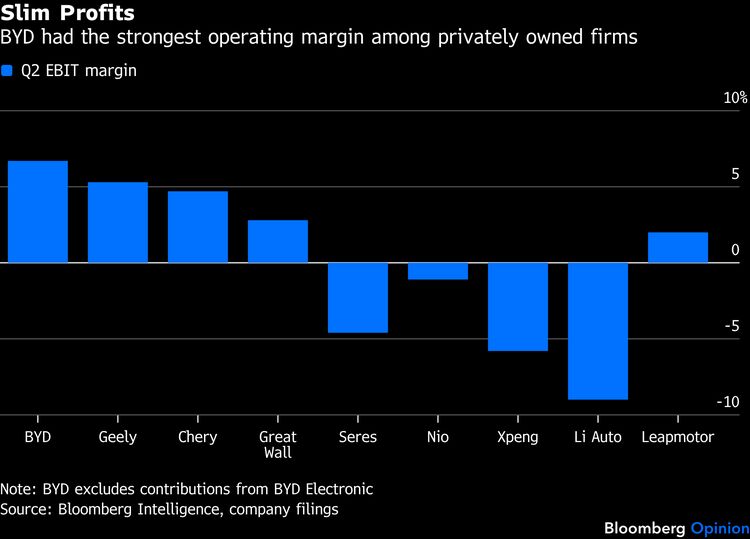
Removing the rebate would be no small matter. Years of price competition have left much of the car industry operating on thin margins, making it particularly valuable. Last year, payments totaled $318 billion. Taking it away would force manufacturers to raise prices, find further cost savings or just absorb the hit. My back-of-the-envelope estimate based on BYD Co.’s overseas automotive revenue and sales volume suggests the tax break could have been worth as much as 16.8 billion yuan ($2.5 billion) in the first half of the year. That’s more than the company’s 12.3 billion yuan net profit in the same period.
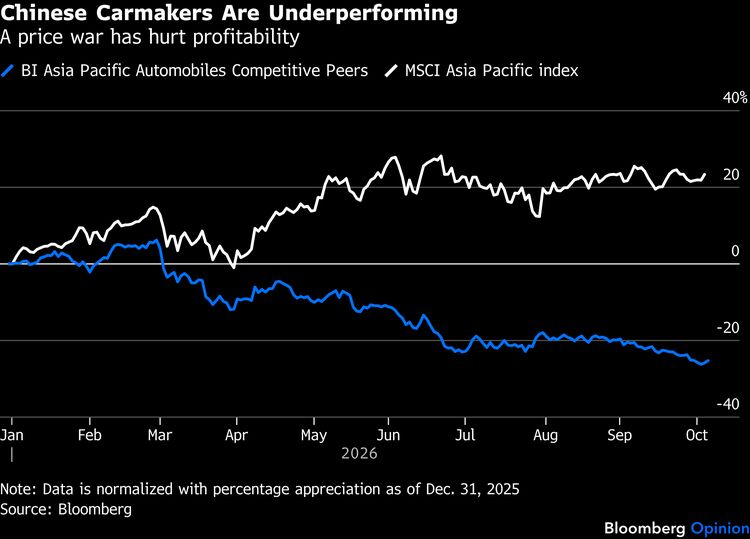
Still, it’s worth scrapping the rebate gradually over the course of a year or more. The tax benefit is well understood by car dealers and other overseas partners who have already started to incorporate the incentive into their pricing expectations and extracted concessions from Chinese exporters.
Beijing has spent the past two years trying to rein in the cutthroat competition that has pushed prices and profits lower. Phasing out the incentive would support that goal. Manufacturers with scale and stronger balance sheets would be better placed to shoulder the deficit, while weaker players would come under even greater pressure to cut their losses.
The goal of China’s industrial policy was to build globally competitive EV manufacturers. Now that the objective has been achieved, the most successful carmakers need to demonstrate that they can win overseas without taxpayers footing the bill. Ending the rebate would give Europe and other markets a break, while forcing the overcrowded auto industry to finally grow up.
More from Bloomberg Opinion:
- BYD’s $34,000 SUVs Are Stirring Up German Angst : Chris Bryant
- Bashing Ford’s China Ties Is Path to Obsolescence : Liam Denning
- Aston Martin Should Lift Hood for Bondholders : Chris Hughes
Want more from Bloomberg Opinion? OPIN <GO> . Or subscribe to our daily newsletter .