US Treasuries were ending the day mixed after a strong auction of 10-year notes signaled that yields at multi-decade highs were fueling investor appetite.
Long-term bond yields pared their rise on Wednesday after the US Treasury Department’s $39 billion sale of 10-year notes was awarded at 5.3%, well below the prevailing yield seen before the auction — an indication of solid demand.
“This is showing that finally the deeper-pocketed guys find these levels appealing,” said Monty Gandhi, rates strategist at SMBC. “Around 5%, we heard some of these larger players mention that they were unwinding their shorts, and my guess would be slowly they are getting back in.”
Ten-year yields were little changed at 5.28%, down from as high as 5.36% earlier in the session, a level last seen in 2002. The 30-year yields were up just one basis point at 5.67% after earlier climbing on a run-up in oil prices. Two-year notes outperformed, with yields falling about three basis points to 4.76%.
The global bond market has been hammered in recent weeks as elevated energy prices fueled concerns about faster inflation and further central-bank rate increases, while corporations compete with governments for capital to fund the artificial-intelligence build-out. Brent crude briefly topped $102 a barrel Wednesday after fresh Iranian attacks on vessels in the Strait of Hormuz.
“We continue to think the market remains caught between attractive outright yield levels and an oil story that refuses to fade,” said Evelyne Gomez-Liechti, a multi-asset strategist at Mizuho International Plc.
Treasury Secretary Scott Bessent reiterated his talking points about the rise in yields during an event at the White House Wednesday — describing them as a “global phenomenon.”
“For the US unlike the other countries, it’s a real-rate issue,” he said — in other words, rather than an inflation-driven issue. “It’s because of growth. Growth here is strong.” Bessent also reiterated that, once the Iran conflict subsides, energy costs will drop and interest rates will decline across the curve.
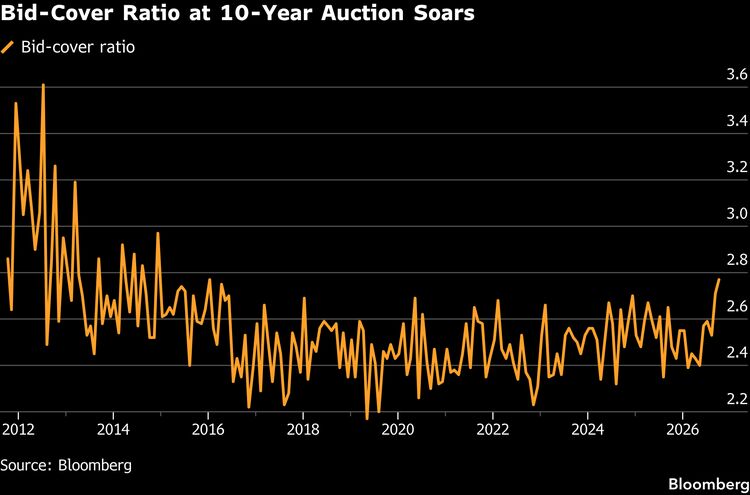
But a closely watched auction showed that yields at these levels are already starting to entice buyers. The bid-to-cover jumped to 2.77%, the most since 2016. Non-dealer investors took down a record 97.5% of the auction.
The robust result comes ahead of a $22 billion 30-year bond auction Thursday, which is on course to offer the highest yield since 2000. That sale will be followed by a buyback in which the Treasury will purchase as much as $6 billion of bonds maturing in 20 to 30 years, the fourth such operation since the department expanded the program as long-term yields surged to multiyear highs.
The reversal in long-term yields followed some stabilization at the front end of the curve after softer-than-expected inflation and labor-market data last week and dovish comments from central bankers helped pare expectations for Federal Reserve tightening.
All 19 Fed officials backed the decision · in September to raise interest rates, with many supporting the move to guard against the risk of intensifying inflation pressures. Swaps now imply roughly a one-in-four chance of a Fed rate increase this month, with a hike fully priced by year-end.
“There have been some signs the market is trying to hold in over the last week, especially the front-end,” said John Briggs, head of US rates strategy at Natixis Corporate & Investment Banking. “Now the back end is at least showing signs of demand. I think it’s too early to declare victory on that front, but it’s a start.”