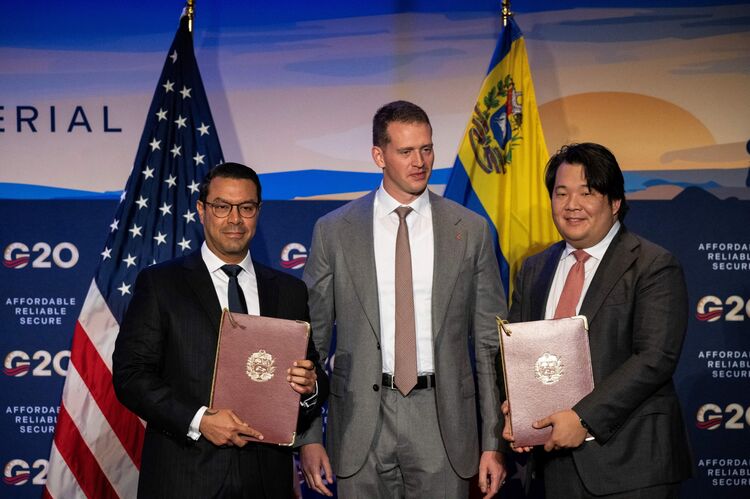
At a port near New Orleans on Monday, Interior Secretary Doug Burgum welcomed the first shipment of Venezuelan aluminum to the US in nearly a decade.
The roughly 15,000-ton cargo , sourced from the country’s largest aluminum smelter, marked an early milestone in the Trump administration’s push to secure Venezuela’s vast mineral resources for American supply chains.
Standing next to Burgum were the founders of Heeney Capital, an investment firm that has partnered with Swiss trading giant Mercuria Energy Group to ship aluminum from Venezuela’s state producer Venalum and sell it to US manufacturers.
Even in the relatively small world of the mining and metals industry, few have heard of New York-based Heeney Capital. The closely held company, whose website is restricted to registered investors describes itself as an investor in early-stage mining projects. In a matter of months, its co-founders Henry Heeney, who is 38 years old, and Sean Pi, who is 36, have gone from giving elevator pitches to Trump Administration officials to playing a central role in Washington’s efforts to revive American mining investment in Venezuela.
“They’re a very small and relatively unknown firm,” said Alexis Harmon, an associate director at the Atlantic Council’s Global Energy Center. “But the portfolio they’re talking about is huge.”
Heeney’s rapid emergence reflects a feature of Washington’s push to reopen Venezuela’s commodities sectors to US investment. Since the Trump administration captured former president Nicolas Maduro, smaller and independent firms like Pacific Coast Energy Co. , Augusta Capital and Gold Reserve Ltd. have rushed in to seize opportunities that many larger companies leery of economic and political risks have so far avoided.
Heeney and Pi met while working as analysts in New York for Evercore Inc. The pair went into business together after leaving the investment bank and amassed a portfolio of early-stage mineral deposits through acquisitions, while co-founding companies like Mayfair Gold, which owns a deposit in Canada, and Siguiri Gold in Guinea.
Pi and Heeney did not respond to requests for comment.
Pi was a last-minute addition to a US delegation to Caracas in March that was meant to spur metals deals in Venezuela but struggled to rope in major US mining companies. Alcoa Corp., the top US aluminum producer, declined an invitation to attend the delegation, according to people familiar with the matter. A company spokesperson declined to comment on the March trip.
Pi met with US officials including Jarrod Agen, head of the White House’s National Energy Dominance Council, and David Copley, a former Newmont executive who has emerged as one of the administration’s principal officials on mining investments.
Alongside the shipping deals, Heeney is trying to secure operational control of Venezuela’s Venalum aluminum smelter, the largest plant in the country. The co-founders also unveiled a deal in September to invest as much as $1 billion to develop and operate Venezuela’s Choco gold mine over the next 30 years. Heeney estimates it could produce as much as 200,000 ounces a year, worth roughly $820 million at today’s prices.
Venezuela’s Venalum and the government’s Information ministry did not immediately reply to a request for comment.
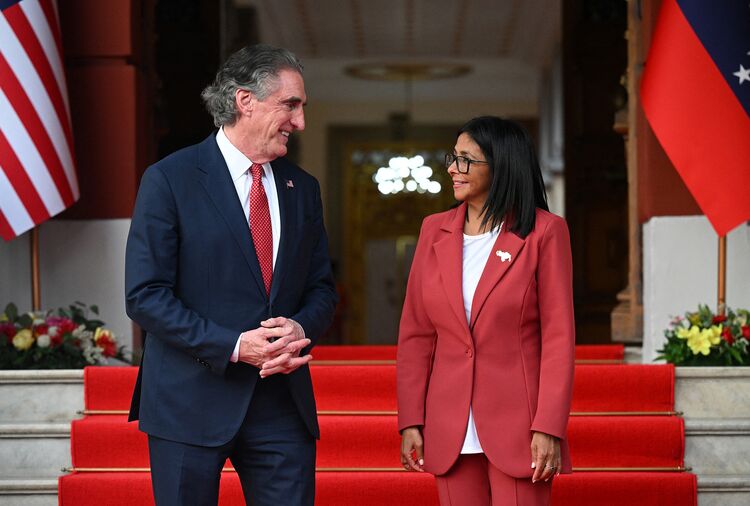
Heeney is also exploring arrangements for other minerals such as coal and has ambitions through the Venezuela deals to build a US-based trading house for metals, the people said.
Should Heeney secure access to Venalum, the site will need about $500 million to restore it to full capacity of 430,000 aluminum tons per year, according to people familiar with the asset. Restoration could take five to seven years, while the smelter is currently operating at only a small fraction of its capacity.
Little is publicly known about Heeney’s finances or its access to funding. According to a public filing from March, Heeney controls at least one private fund with a gross asset value of $20 million. In testimony to the US House of Representatives in February, Heeney’s co-founder Pi said the firm supports a portfolio of roughly $1.2 billion of assets, comprising nine mining projects in six countries outside the US. Those projects include a steel and vanadium project in Trinidad and Tobago and an iron ore project in the Republic of the Congo.
Unlike the oil and gas sector, which has seen a flurry of deals in recent months, Venezuela’s mining sector remains largely underdeveloped. The country sits on extensive deposits of gold, bauxite, iron ore and coal, but years of economic turmoil and isolation have left much of Venezuela’s formal mining and metals industry diminished. There is also little independent data on the extent of the country’s mineral resources, which makes investing in the country a risky play.
Private companies like Heeney have more liberty to take on Venezuelan assets without drawing the ire of institutional shareholders or meeting the internal due-diligence requirements of giant mining companies. But they still have to contend with Venezuela’s political uncertainty.
The Choco gold mine is particularly fraught. Gold-mining areas around El Callao, where Choco is located, have long been dominated by criminal organizations that control mines and enforce their rules with violence. Venezuela’s government, under acting president Delcy Rodríguez, has tried to wrest mining areas from criminal groups, sending troops and armed helicopters into the region in June. But analysts say the state has yet to establish lasting control over the territory.
“The big veterans of the mining world – Newmont, Barrick Mining Corp. or BHP Group – are not going into the smoking ruins of Venezuela to pick up somebody else’s assets,” said Christopher Ecclestone, a strategist at Hallgarten & Company, an advisory firm specializing in mining. “They know that there lies trouble.”
Newmont and Barrick declined to comment. BHP didn’t respond to requests for comment.
A White House spokesman said US investments will stabilize Venezuela’s mining industry.
“For years, Venezuela’s mining industry has been stolen from the Venezuelan people and has been used to prop up dangerous gangs and support bad actors around the globe,” White House spokesperson Taylor Rogers said in a statement. “The United States is helping solve this long-standing problem. We are cleaning up Venezuela’s mining industry. Western companies are improving and legitimizing it.”
Read More: Oil Mogul’s Hunt for Venezuela Riches Began Years Before US Raid
Miners now looking to enter Venezuela are focused initially on so-called brownfield assets that are now run by Venezuela’s state-owned enterprises. The existing legacy infrastructure offers a quicker path to production and lowers the investment risk.
Pi described his firm’s approach to risky jurisdictions like Venezuela at an industry panel in June.
“The struggle with our industry is we have to go where the rocks are — we can’t really discriminate,” he said. “This means going to jurisdictions that, I would say, investors in the west go, ‘Well, that’s outside of our mandate.’”