For years, regional US banks lent money to commodities clients, only to watch them take their lucrative hedging activity to Wall Street. Now the regionals want to grab more of a booming business.
At least three mid-sized regional banks — Texas Capital Bancshares Inc., Bank OZK and Flagstar Bank NA — have either added commodities hedging desks, launched new products or are planning expansions this year.
The trend began with market shocks unleashed by the global pandemic and the Ukraine war, but supply turmoil and price swings triggered by this year’s Middle East conflict have ramped up demand for risk-management services, the market for which has typically been dominated by the national banks.
“Given the recent volatility in the marketplace, we’re keen to get something in place as soon as possible,” Sean Ryker, head of capital markets at Flagstar, said in an interview.
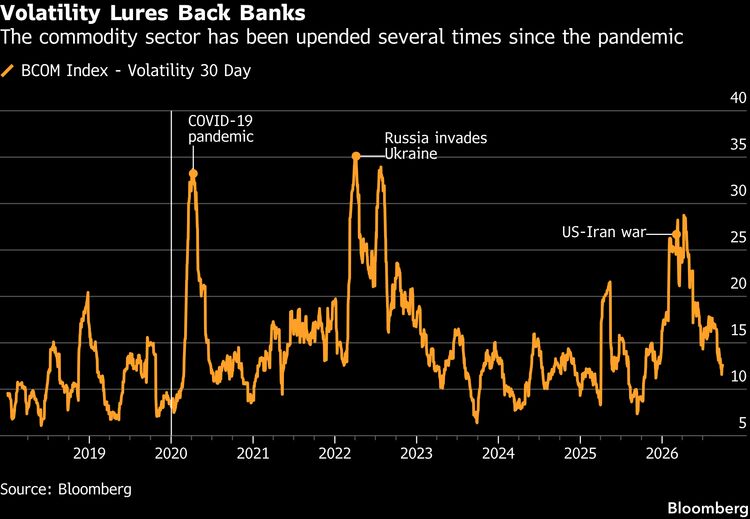
The Bloomberg Spot Index, which tracks 25 energy and commodity products, has this year seen a third major spike of volatility since 2000 as the Iran war sent crude soaring above $100 a barrel, while fuel, power and metals prices also saw major swings.
Soaring volatility means that traders, producers and buyers have greater appetite for hedging, in which derivatives are used to protect against adverse price moves. There’s also been a wider return to commodities across the banking industry, while regional banks that have reached a certain scale are looking to diversify.
Texas Capital Bancshares opened its commodity hedging desk in April, while Bank OZK’s executed its first trade in early September. Flagstar Bank NA aims to launch an offering by year-end. Other regional banks are also building out their offerings, industry sources said.
Higher Margins
The regionals have traditionally lent money to commodity firms, but they lacked the infrastructure or staff to run a derivatives desk. If a client wanted to hedge oil prices, the regional bank might foot the loan and then the client would tap an outside counterparty — typically a giant investment bank or trading house — to handle the transaction.
By offering hedging, the regionals can become more of a full-service provider, while boosting their own revenues.
“It’s natural for the lender to offer a mutually beneficial service,” said Steve Sinos, who leads OZK’s commodities hedging desk from Houston.
Hedging can be a higher-margin business for banks than conventional lending, especially when they act as market-makers or put together complex deals. Revenue can come from pocketing the spread between the buy and sell price of derivatives. Still, it also means taking on more complex and capital-intensive risks, and requires specialist expertise.
Derivatives and related risk management activities have generated more than 60% of revenues for commodity trading desks at the leading global banks over the past 5 years, according to Angad Chhatwal, head of fixed income, currencies and commodities at financial services analytics provider Coalition Greenwich.
Read More: Oil Hedging Desks Dizzy From Record-Breaking Week Brace for More
At least one regional bank lost several lending deals due to insufficient commodities capabilities, according to one of the people familiar, prompting a build-out. The current volatile market climate also expedited efforts to launch a hedging product, the person said.
Commodities Comeback
The trend is also the latest manifestation of the banking industry’s push back into commodities after a years-long retreat spurred by the post-2008 regulatory crackdown. Deutsche Bank AG is rebuilding its energy trading business more than a decade after it largely exited the commodities sector.
Greater commodities activity can give regional banks another way to make money beyond lending. Mid-sized banks are also eager to differentiate themselves, as ongoing consolidation is creating larger, more competitive rivals and make it harder to compete on lending alone.
There’s been low double-digit revenue growth in recent years for commodities-focused risk management software utilized by regional banks, according to management consultancy Oliver Wyman. Some vendors focused on oil and gas have seen growth top 20%, the firm said.
While regionals present some competition for larger banks, they can also serve as counterparties. For example, a regional bank may offer hedging to a long-term client, but the bank still needs to place some of that exposure with a larger dealer. A producer can also spread their hedging program across different banks.
“On one level, these different entities compete with each other for client business,” said Pete Clarke, Oliver Wyman’s head of corporate and institutional banking in the Americas. “On another level, they lay-off risk to each other.”