By Michael Nienaber | Updated on Oct 07, 2026 at 03:41 PM
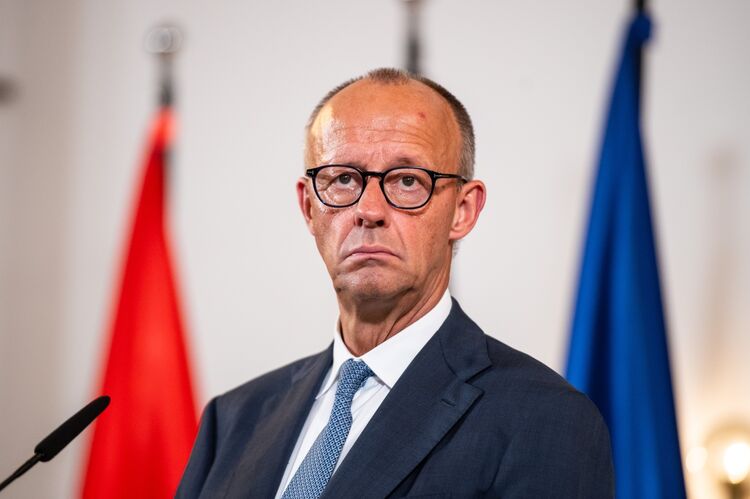
Chancellor Friedrich Merz said he’ll aim to steady his fractious coalition to move ahead on reforms as his conservative party faced fresh scrutiny over whether its lawmakers helped a far-right candidate into a top state parliamentary post this week.
Merz on Wednesday hosts leaders from his Christian Democratic-led bloc and the Social Democrats in Berlin to overcome deepening divisions over a raft of reforms seeking to overhaul Germany’s pension system and long-term care and implement an income-tax cut. He said the comprehensive pension changes will be debated in parliament into next year and be finalized by spring as the government struggles to push it forward.
“We see that time and again in this coalition — finding a common path that I can still support is a constant and extremely demanding task,” Merz told a conference in Berlin. He said he would seek “the path of compromise” at the crucial coalition meeting in the Federal Chancellery, scheduled to begin at 5 p.m. local time.
The German leader’s support has cratered as his government fails to gain traction with the public and a series of state elections last month showed stunning gains for the far right . Merz is trying to hold his coalition together and gain trust through a series of legislative projects designed to shore up Germany’s social welfare state and lift the country out of years of economic stagnation.
Tension between the governing parties was compounded after the far-right Alternative for Germany secured a majority for a parliamentary speaker post in the eastern state of Saxony-Anhalt on Tuesday with a handful of votes from outside its fold. The Social Democrats have said Merz’s party needs to explain the parliamentary maneuvering amid indications that CDU lawmakers supported the AfD parliamentary speaker.
Merz asserted that the secret ballot made it impossible to know who the defectors were, saying the voting may be part of a “false flag” operation. But he said any support for the far right is “incompatible with the values of the CDU.”
“Anyone who votes for a lawmaker from a far-right party to become president of the state parliament has to reconcile that with their own conscience,” Merz said at the conference hosted by Germany’s Handelsblatt newspaper . “Anyone who gives their vote to the AfD is playing the extremists’ games and destroying credibility.”
The Alternative for Germany, which scored a stunning victory in Saxony-Anhalt last month that put it just short of controlling an outright majority in parliament, installed its candidate as the assembly’s speaker with a bigger-than-expected majority. The result of the secret ballot showed four more lawmakers supported the AfD’s Tobias Rausch than had publicly pledged support before the opening session.
The vote startled the political establishment, triggering concern that the so-called firewall erected to isolate the AfD was cracking. The party will seek a vote in December to elect its candidate, Ulrich Siegmund, as state premier, setting up the first far-right government of a German region in the country’s post-World War II history.
Merz’s Social Democratic allies expressed outrage. At a meeting of lawmakers in Berlin on Tuesday hours after the ballot, Defense Minister Boris Pistorius led a group to march through the capital’s iconic Brandenburg Gate to a square that was the site of an infamous 1933 book burning by the Nazi party.
“What we witnessed today is an unprecedented breach of a taboo in parliamentary democracy, one we haven’t seen in this form for more than 90 years,” Pistorius, a heavyweight in the SPD, said at the rally as lawmakers waved copies of Germany’s postwar Basic Law, the country’s constitution. “Democrats served as stepping stones for right-wing extremists and fascists.”
The episode adds to pressure on Merz, whose authority has dwindled as his popularity and the fortunes of the CDU spiral. He staved off a mounting rebellion last month after the loss in Saxony-Anhalt and in the eastern state of Mecklenburg-Western Pomerania, where the conservatives were knocked out of a state parliament for the first time in their party’s history.
That’s left Merz redoubling promises that he’ll follow through with a reform blueprint negotiated with the SPD in July, the centerpiece of which is a pension overhaul that involves establishing a new capital-market fund designed to shore up the system’s financing.
“I will open this afternoon’s and this evening’s talks by stating that I assume the agreements in the coalition deal and the agreements we reached on July 1 at our last coalition committee meeting will remain the unaltered basis for the coalition’s work,” Merz told the conference. “I expect to get a clear and unambiguous answer on this point.”