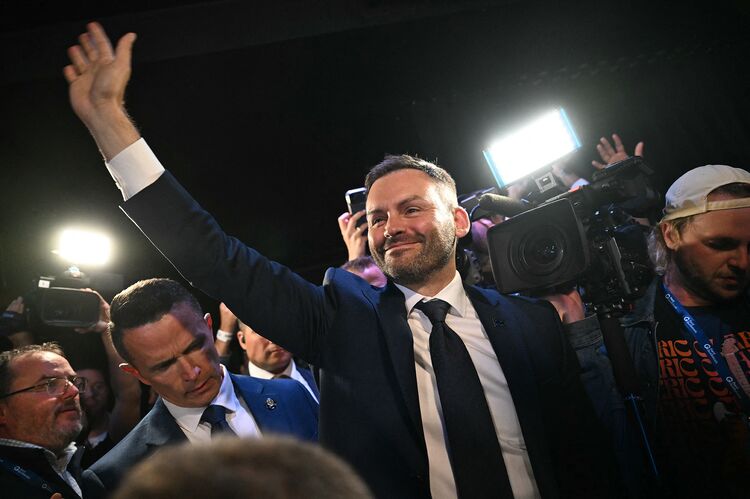
Quebec’s new leader, Paul St-Pierre Plamondon , says he won’t back down on his pledge to hold an independence referendum by 2030, despite polling that suggests most Quebecers aren’t on board.
With about 70% of residents opposed to breaking away from Canada, the promise of a referendum is drawing little enthusiasm and likely cost the Parti Québécois some seats in Monday’s election, depriving it of a majority in the French-speaking province’s legislature.
St-Pierre Plamondon will govern after capturing the lowest popular vote share ever recorded for a winning party in the province: 28%. At 59 seats, the PQ is five short of a majority, and will need the support of other parties to pass laws and remain in power. Québec Solidaire, also a separatist party, won nine seats.
The PQ plans to hold an independence referendum only after President Donald Trump leaves office in January 2029, to avoid having him be a distraction in the debate. US tariffs are already impacting many industries in Quebec. A minority government might not even last until the end of Trump’s term.
“We’ll not forget our commitment to consult Quebecers on their future,” St-Pierre Plamondon said in a victory speech Monday night. “What’s the point of being in politics if you can’t look the people in the eye, and tell them we believe this is in Quebec’s best interest and that it’s necessary for our collective future?”

The 49-year-old former lawyer, educated at McGill University and the University of Oxford, voted “yes” in Quebec’s second secession referendum in 1995, when he was 18. He then turned federalist, before gradually becoming sovereigntist again.
St-Pierre Plamondon started his career as an Air Canada flight attendant, and was a lawyer at Stikeman Elliott LLP from 2002 to 2009. Along with others, including Canadian Industry Minister Melanie Joly, he co-founded in 2007 the non-partisan think tank Génération d’idées, aimed at creating a discussion space for young professionals. He also worked at the boutique law firm Delegatus Legal Services Inc.
He initially tried his hand at running for the PQ leadership in 2016. He lost, but won the 2020 race with the promise to hold a referendum in a first four-year mandate.
In the 2022 election, the PQ only elected three members in the legislature. Then momentum started to pick up as the separatist party began to most embody change amid the collapse in popularity of the Coalition Avenir Québec government.
“We will be a government with a unique character — a character that tells it like it is, speaks with great candor and authenticity, and has the courage to take the initiative and make changes regardless of the poll of the day,” St-Pierre Plamondon said in his Monday speech.
All eyes are now on the relationship he will build with Prime Minister Mark Carney, who is already grappling with the trade war with the US.
St-Pierre Plamondon said the independence project his party is promoting is not “directed against” Canada. “Quebec will always be a partner in good faith, open to collaboration,” he said — as long as this collaboration is in Quebec’s best interests.
Carney, who polls better in Quebec than St-Pierre Plamondon himself, sidestepped reporters’ questions about a potential referendum. “We must build a strong Quebec within a strong Canada,” he said Tuesday. “It’s about Canada’s sovereignty, Canada’s independence and Canada’s resilience, so that we can live the way we want to live.”
Read More: Quebec Bonds Tighten as Separatist Party Falls Short of Majority
St-Pierre Plamondon has emphasized that Quebec must have greater control over its language, culture, immigration and finances to protect its identity. That may exacerbate tensions with the federal government. In August, for example, he criticized Carney for failing to consult Quebec before announcing counter-tariffs on US imports.
The Carney government’s high-speed rail project between Toronto and Quebec City, led by a consortium that includes Caisse de Depot et Placement du Quebec, is also at risk. The PQ wants to withdraw from the project estimated at potentially more than C$100 billion ($70.3 billion), and has called for the funds earmarked for the Quebec portion to be paid out as compensation for its aging infrastructure.
Economic Policy
Quebec’s new premier-designate has promised, in his first 100 days in office, to unlock funds to address homelessness, eliminate taxes on used goods and lower a gas tax.
The party released a four-year fiscal plan that forecasts annual expenditure growth of only 1.9% on average — below inflation — in an attempt to reach fiscal balance by the end of the decade. And it still has a shortfall of C$1.85 billion to make up to get there.
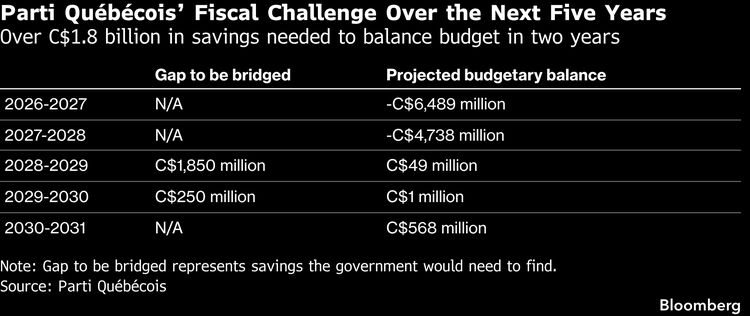
“The PQ campaigned on the least costly platform of the three main parties,” Jimmy Jean, chief economist at Desjardins Group, said in a report. But he noted that expected administrative savings “will be difficult to achieve without affecting public services.”
The PQ’s plan includes the layoff of thousands of civil servants representing 2.5% of the government’s payroll, and a gradual reduction in the corporate income tax rate to 9.5% from 11.5%, offset by a reduction in grants for businesses.
Temporary immigration is expected to be cut in half and permanent immigration will be lowered, fueling worries across Quebec businesses.
“As a minority government, the PQ will need opposition support to pass each budget, though its alignment with the Parti Conservateur du Québec on spending restraint should make this easier than is typical for a minority,” Jean said, referring to the conservative party that won 19 seats in the election.