
The higher the wall of worry, the faster US stocks have climbed it, clocking its first record since August on Tuesday. But to Jim Paulsen, the cumulative pressure from $100 oil prices, 5% Treasury yields and an elevated dollar is yet to be felt in a major way.
Paulsen, a closely followed investment industry veteran, says prior instances when the three factors simultaneously weighed on the S&P 500 Index have preceded a drop of as much as 15% in the next three to five months. The development would send the index down for the year for the first time since 2022.
The scenario will deal a blow to bulls positioning for the stock market’s record-setting momentum to last. To Paulsen, while blockbuster earnings and enthusiasm around artificial intelligence keep supporting the S&P 500 at current levels, investors will be able to feel the negative impact of rising yields, dollar and oil prices soon.
“We’re going to have a good little gut check,” Paulsen said. “Gravity may soon bring its undefeated reputation to both the economy and the stock market.”
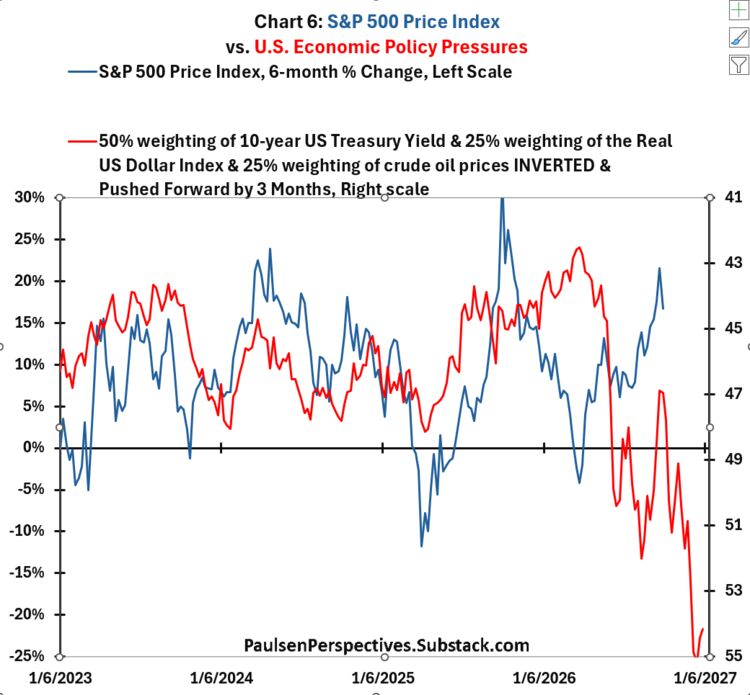
Paulsen, author of the “Paulsen Perspectives” newsletter, found a strong correlation between the S&P 500 and a so-called “economic and policy pressures” basket, which is 50% invested in the 10-year Treasury yield and 25% weighted to the US dollar and crude oil prices. When the policy pressures index was this high in the past, a decline of between 20% and 25% for the S&P 500 followed suit.
However, Paulsen said that seven of the index’s 11 sectors have been range-bound for so long they will likely avoid that kind of sharp drop. Still, he’s expecting a 20% fall for the tech sector.
The “modest seven,” as he calls them, “might well save our bacon.”
Already, Wall Street strategists are seeing some yield-driven strains in the stock market. Banks are trading in a technical correction and industrials briefly fell below that level last month as high rates and record diesel prices weighed on activity. Financials are under pressure as a result of elevated yields, expectations of more interest-rate hikes and the potential for AI-related disruption from products like Meta Platforms Inc.’s Muse.
| Read more: |
|---|
|
US Yields Fall From 2002 High as Oil Dips, Bessent Vows On Debt Growth-Stock Index Rallying Past Resistance as Downtrend Snaps Morgan Stanley’s Wilson Sees Earnings-Led Upturn in Industrials |
Ned Davis, senior advisor and co-founder of Ned Davis Research Inc., called the resent advance in interest rates a “threat to stocks and the economy, as debt and deficits need to be financed.”
Only three of the 10 daily indicators he tracks that precede stock market peaks and troughs are currently bullish. The bearish indicators include a downtrend in the advance-decline line, which measures the number of rising stocks against those falling. To Davis, the decline in the indicator has been exacerbated by the rise in yields, driving a selloff in financials.
Market breadth is serving a related warning to equity bulls. Just 43% of stocks in the S&P 500 are trading above their 200-day moving average while the US stocks benchmark is sitting near a record high. Even fewer are trading above their 100-day, and 50-day averages.
Read more: Deteriorating Breadth Sends a Warning Sign for US Equity Bulls
“This is extremely low and quite rare to have such poor breadth with the index just shy of its highs,” Craig Basinger, chief strategist at Purpose Investments, wrote in a Monday note to clients. “If history is to be a guide, this type of setup typically resolves itself with prices moving down to breadth rather than breadth catching up to price.”
And yet, stocks have managed to hit new highs even as oil priced have hovered near $100 a barrel since hostilities in the Middle East began in March. And some on Wall Street see stocks and the economy holding up in spite of higher Treasury yields. The S&P 500 rose 0.7% on Tuesday to reach its first intraday record since mid-August.
“Maybe the economy is just much less rate sensitive than we thought,” Stephanie Roth, chief economist at Wolfe Research, wrote in a Monday note. She noted that equities “have been resilient at the index level, despite pain for the most rate sensitive parts of the market.”
| Take our US midterm election Markets Pulse survey |
|---|
| What would be the biggest market consequence of a prolonged fight over raising the debt ceiling in 2027? Let us know . |
Still, Paulsen said that investors who in the spring looked past elevated oil prices now need learn to live with a cohort of pressure points acting together. None of them should be ignored for too long, he said.
“If I go back to the 1970s and look at major oil price spikes, the damage that is ultimately done to the economy and the stock market doesn’t generally occur right away,” Paulsen said. Still, he said, those pressures are now catching up with the stock market, which is in for a “rough patch” that may last “at least until early next year.”