A few years ago, I embarked on a gonzo journalism experiment where I tried to rely solely on the public toilets of New York City during my waking hours. This was in 2024, when the city released a Google Maps layer pinpointing publicly accessible restrooms.
I’d imagined trying to go a whole week, but only made it around 72 hours. Even that was a stretch. Finding an unlocked restroom after dusk was practically impossible.
My personal tribulations reflected both a local and national reality: In New York, as in much of the US, lavatory infrastructure is sorely lacking. The city has about 1,000 operational public restrooms citywide, or only one for every 9,000-ish residents, according to its city council , and even fewer if you count tourists and daytime workers. Only eight are available 24/7.
In September, Mayor Zohran Mamdani announced an effort to improve the city’s toilet-to-resident ratio. The city is contracting with a company called Throne Labs to install and operate 17 modular public toilets across its five boroughs. The $4 million pilot will run for a year, and the facilities will be free to the public and open every day from 7 a.m. until 10 p.m.
It’s a drop in the bucket, toilet-wise, but Mamdani hinted at a larger vision: The city is in the process of drafting plans to double its bathroom capacity over the next decade (though it’s behind deadline). “Too many New Yorkers know what it’s like to have nowhere to go while they’re on the go,” Mamdani said in a statement.
It wasn’t always this way. America’s first government-funded toilet opened at New York City’s Astor Place in 1869 . By 1950, the subway system alone had more than 1,600 restrooms. But one by one, most of those options disappeared.
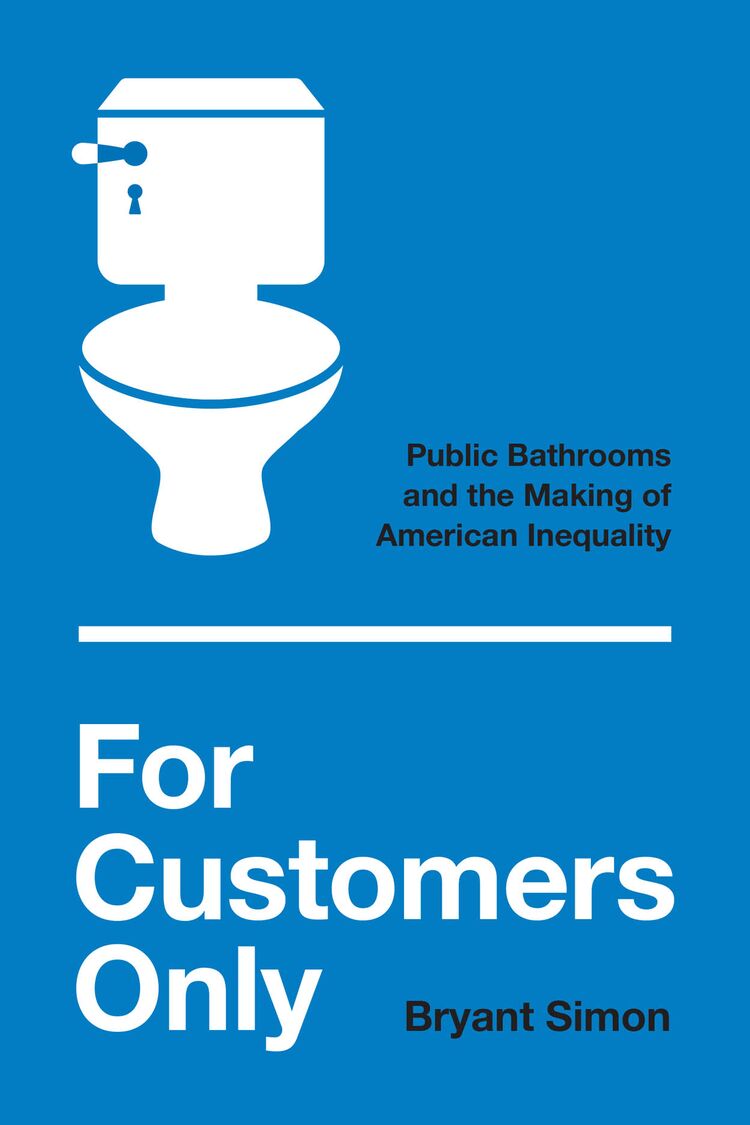
A new book, For Customers Only: Public Bathrooms and the Making of American Inequality (University of Chicago Press), explains how the city’s — and the nation’s — public bathroom situation got so dire. In it, Temple University history professor Bryant Simon argues that “no other infrastructure has been as fraught as the public bathroom.”
Almost from the moment public restrooms appeared in US cities, they were contested. “Every protest in the 20th century found its way to the bathroom door,” Simon told me. “The gay rights movement, the Civil Rights movement, the women’s movement, the movement for rights for the unhoused, and obviously, in the 21st century, trans rights.”
Indeed, tensions over who these accommodations are for, and how best to provide them, are running higher than ever: Efforts to open public facilities often face pushback from those who see them as magnets for poverty and disorder, and 19 states have passed anti-transgender “bathroom bills” that use toilet access to police gender.
In this environment, bringing bathrooms back to the American city will take money, creativity and political will, Simon says. It will also take learning from the mistakes of the past.
Nowhere To Go
Simon starts with the brief golden age of the public restroom, at the dawn of the 20th century. Cities were growing, and middle-class people were out and about more, which meant they had to find somewhere to pee. Women, especially, lacked good options. Using the facilities at a bar or restaurant usually meant buying something, which provoked moral outrage from the era’s reformers: If going to the bathroom was contingent on grabbing a beer, the thinking went, innocents could be turned into drunks. Local officials and government advocates saw an opportunity to assert civic power by meeting a basic need better than the private sector could.
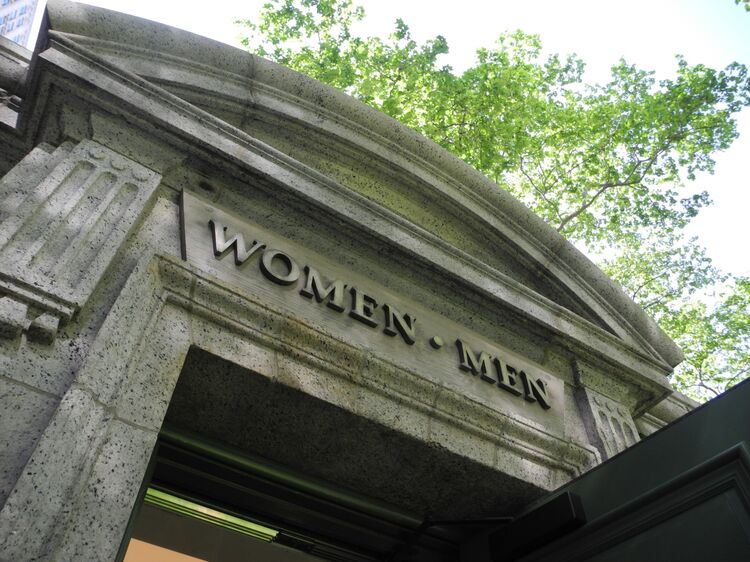
So cities started investing in “comfort stations.” By 1920, Simon writes, they’d cropped up in more than 160 cities — “from sprawling metropoles to quieter places with compact Main Streets.” Often sited in transit hubs and near city halls, these municipally financed porcelain thrones helped people expand their “mental maps” of the city, Simon writes, and “became the critical entry point to the freedom and movement of the bustling turn-of-the-century nation.”
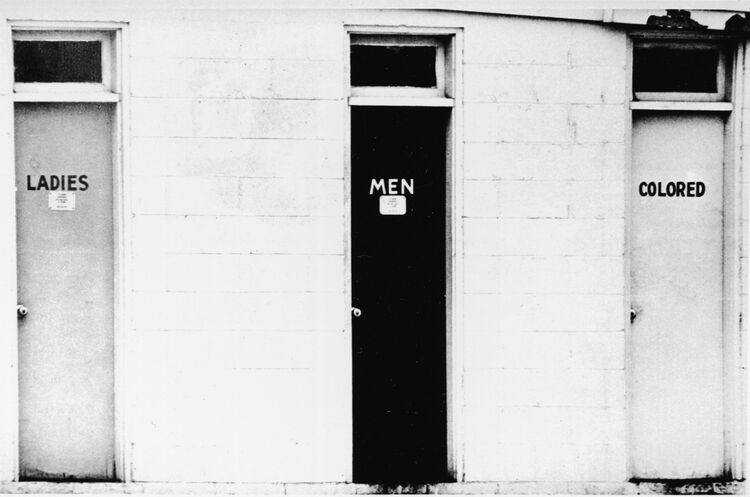
But public bathrooms were never truly distributed equally: During Jim Crow, for example, Black patrons’ segregated bathrooms tended to be isolated, smaller, and poorly tended. And toilets weren’t a point of civic pride for long, instead becoming symbols of urban disorder and vice. Police monitored the spaces to catch people using bathrooms for illicit sex — particularly gay men.
A turning point, Simon writes, was the 1936 strangling of a man named Edgar Eckert in a Times Square restroom. The murder was cast as a robbery gone wrong at the time, but Simon connects the incident to a broader crackdown on public bathrooms for their perceived role in facilitating “perversion.” Transit officials responded to the crime by closing several subway bathrooms, first at night, then altogether, Simon writes: “Locking bathroom doors, they vowed, was the only way to protect some people, even if it disadvantaged others.”
This would be the end of the public toilet honeymoon period, Simon writes. By the 1940s, even Fiorello La Guardia — the New York City mayor famed for promoting public works projects like housing, schools and parks — had soured on city-run restrooms. And by the ’50s, enthusiasm around the government’s role in providing “public privacy” was waning nationwide. Often, this disinvestment was targeted: Local officials neglected public restrooms in Black neighborhoods and poor neighborhoods and then used the neglect as an excuse for further disinvestment. But public toilets were vilified pretty much everywhere.
When the public sector pulled back, the private sector stepped in, with mixed results. In mid-century America, US cities had a vast network of locked pay toilets in places like airports, train stations and courthouses. The city and the private companies who built the toilets split the fees people paid to unlock them. The goal wasn’t only to generate revenue. “It’s deliberately seen as kind of like a filter,” says Simon. Nik-O-Lok, which brought in $30 million from pay toilets in 1960, said the quiet part out loud in a 1973 brochure: “Coin locks keep out trash.”
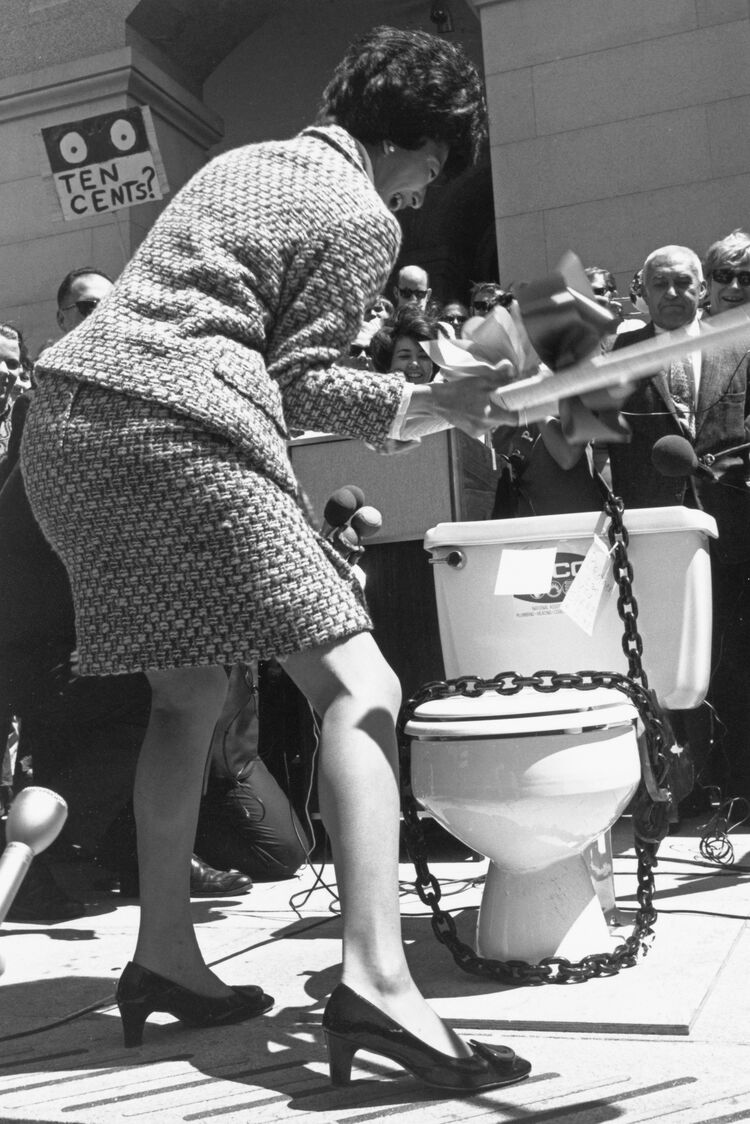
But the model sparked protests in the 1960s and ’70s on the grounds it discriminated against low-income residents and women. (Men could use urinals for free.) In 1969, California assemblywoman March Fong Eu smashed a toilet with a sledgehammer on the steps of the California state capitol to raise awareness about the issue. In some ways, Simon writes, the protests worked: 12 states, including New York and California, passed pay toilet restrictions. But the backlash didn’t inspire public investment in more equitable replacements. Bathrooms just kept disappearing. “What do local governments do if they’re not going to make any money?” says Simon. “They get out of the game.”
Pay toilet bans are still on the books in cities like New York. And Simon argues what they’ve been left with is an even costlier, and less equal, bathroom access paradigm. Coffee shops, hotels and restaurants typically allow patrons to go, but those rights can always be revoked. Simon, who’s also written a book about Starbucks Corp. , points to what happened after two young Black men tried to use the bathroom at a Starbucks outlet in Philadelphia in 2018 without buying anything and were arrested on suspicion of trespassing . The incident set off an internal reckoning at the company, which ended up opening its bathrooms to all, “no questions asked,” Simon writes.
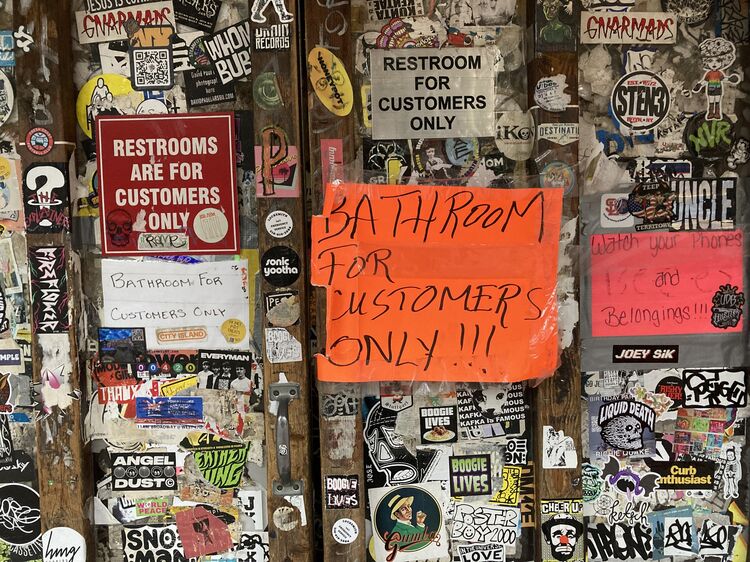
But that meant the company was now tasked with providing services to society’s most vulnerable, including those who were dealing with problems like homelessness and drug addiction. A few years later, as complaints mounted from customers and workers who “weren’t paid enough to serve as both caffeine suppliers and social workers,” Starbucks started locking their bathroom doors again, Simon writes, leaving toilet deserts in their wake.
Toilet Troubles
Some city leaders now see that abandoning public restrooms has exposed and exacerbated other problems. Residents who are pregnant or who have kids or health issues struggle to navigate a public realm that doesn’t meet their needs; those with nowhere else to go are forced to defecate and urinate on the streets.
But efforts to rebuild public bathroom infrastructure in the US often face a new foe: regulation.
In the 1990s, for example, New York City tried to adopt a self-cleaning toilet model popular in Europe, maintained by the French company JCDecaux in exchange for advertising space. In Paris, these Sanisettes are everywhere; the company says it operates 2,500 across 28 countries, including 25 in San Francisco . But efforts to bring them to New York City floundered because of Byzantine bureaucracy and concerns from disability advocates. (Some opponents were also displeased by the prospect of dedicating more public space to marketing materials.) After a brief pilot in 1992, which included a few accessible alternatives, the city kept dithering , and JCDecaux pulled out.
The idea that proceduralism had killed the effort initially resonated with Simon. “I had a little bit of Ezra Klein ringing in my head,” he says. “But then the ability activists come to this really arresting language of ‘separate and unequal.’ And I’m like, yeah, that makes sense. And then you’re left with nothing.”
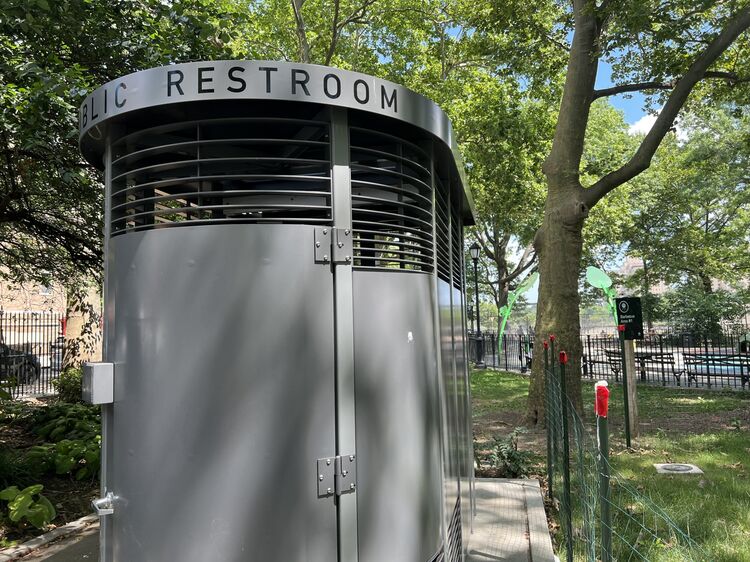
New York City did manage to install seven automated toilets in the early 2000s, and last year it bought five prefabricated Portland Loos , which are marketed as easy-to-clean and outfitted with anti-vice features like graffiti-resistant walls. But it wasn’t cheap: While Portland Loos cost only about $185,000 each , the city reportedly ended up spending about $1 million a pop to make them comply with city rules. In 2024, San Francisco’s $1.7 million toilet became a national symbol of liberal overreach, though it only ended up costing around $300,000 in the end.
Simon mostly limits his analysis to the US, where bathroom policy has long followed a familiar pattern: public investment followed by neglect, followed by imperfect outsourcing to the private sector. Many other peer countries have managed to avoid this. If you’ve visited Paris, Berlin or London you’ve probably noticed that Sanisettes , pissoirs, urinals, and pay toilets abound, sometimes monitored by attendants; Switzerland, Germany, Finland and Australia all boast superior public bathroom coverage .
Can US cities ever join them? Simon isn’t optimistic. “I don’t think any of us can imagine a kind of robust public-bathroom-building boom like the late 19th and early 20th century,” he says. “Solving the toilet problem — partly because we tore apart an infrastructure that already existed — is really costly.”
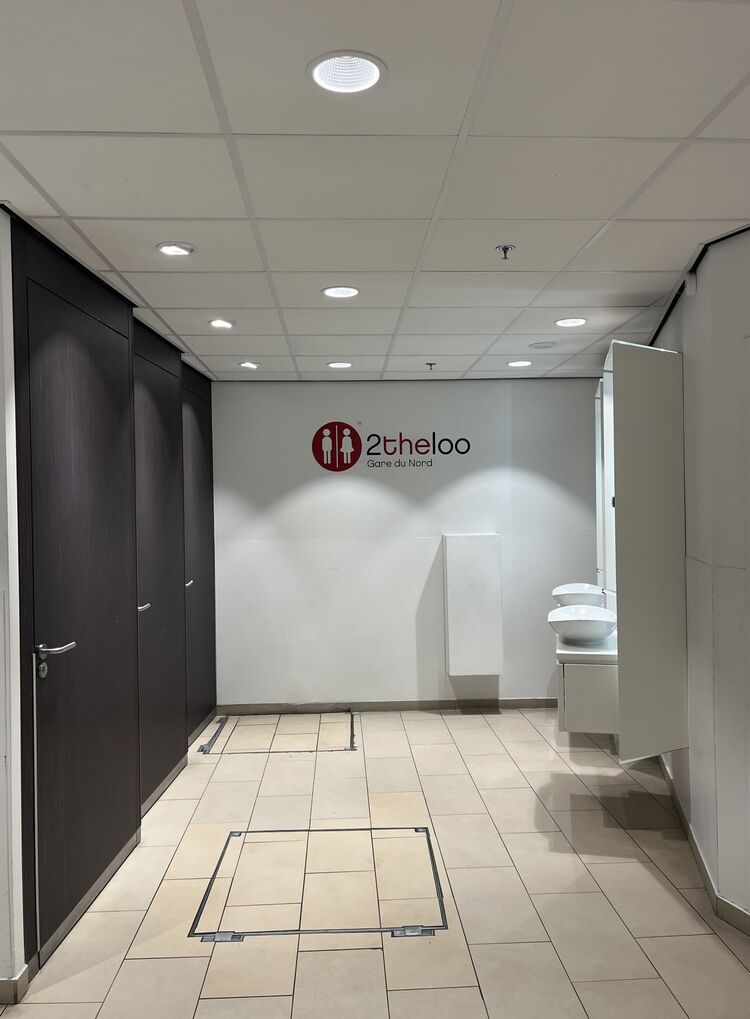
Overturning pay toilet bans and reimagining the model for the 21st century is one of Simon’s pitches. He’s intrigued by a company called 2theLoo , which charges small fees for “almost McDonaldized” bathrooms in locations across England and the European Union.
In our conversation, Simon avoided endorsing the idea outright — accessibility caveats from the ’60s still stand — but it seems to work in Europe, and “it’s easier to imagine than the alternative.” The alternative being local governments willing and able to invest in a public good; a reorientation toward toilet socialism . Simon’s most forceful plea is for unisex bathrooms and single-user stalls, ending the government’s role in enforcing the gender binary.
New York City’s new free-toilet pilot offers a version of that vision, one that also attempts to tackle the issues of costs, codes and conduct. The modular restrooms aren’t hooked up to sewer and water systems, which means they’re easy to move and relatively cheap to set up.
Read more: Where Did All the Bathrooms Go?
The co-founder of Throne Labs, which will clean and maintain the facilities, told Inc . earlier this year that most units cost less than $100,000 a year in fees; a spokesperson for the mayor’s office told me that in New York, each Throne unit will cost up to $270,000, compared to the $3.5 million it takes to build a new restroom from scratch. They’ll be sited in parks and plazas in busy neighborhoods, not just central business districts, a choice Simon applauds. The toilets run on solar panels, feature accessibility ramps, and are designed to open automatically after 10 minutes to deter people from sleeping or using drugs in there. (There are obvious downsides for the pants-down absent-minded.)
But a one-year pilot does not a bathroom renaissance make. “Then what?” said Simon in an email. “Will the city hire attendants? Who will clean? Will the city council keep up allocations? Will these structures last — in the absence of other public options for toilets?” Even if the program succeeds, Simon wonders if partnering with a private company to fill such a critical need is a “tacit admission that the public sector can only do so much … to build and maintain intimate infrastructures.”
New York’s Free to Pee Coalition, which includes homelessness advocates, has also shared access concerns : Since the Thrones are unlocked by text message, app and QR code, those without phones must use a tap card disbursed by local organizations. It seems inevitable that some of the most vulnerable will be left out.
That tension has always been embedded in these spaces, where public and private life collide. Even New York City’s first comfort station, at Astor Place, failed in part because it hadn’t been designed with women’s privacy in mind. Simon doesn’t quite resolve it. “Bathrooms are better at making inequality than at fixing deep-seated social maladies,” he concludes. But he also argues that if cities can get their toilet problem under control, maybe they can rebuild faith in government in the process. That seems to be Mamdani’s goal, too. “This is also what it looks like for a city government being responsive,” he said in a recent press conference.
Fixing civic trust is a tall order for a bathroom. Then again, we’ve always asked a lot of them.