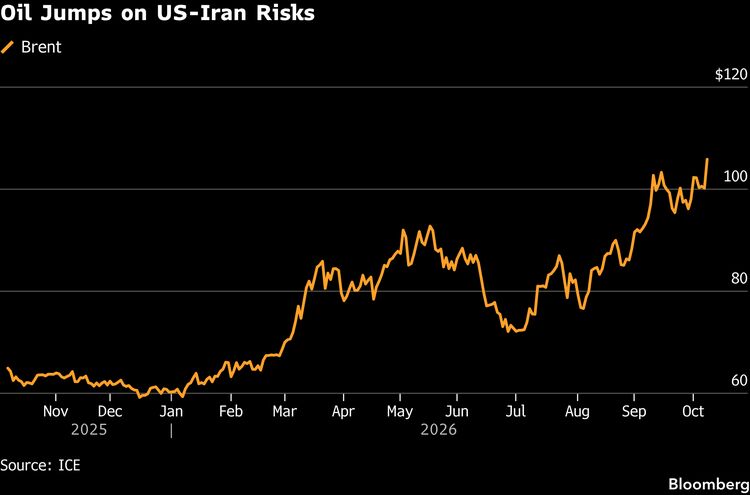
A rally in oil prices rippled through global markets, sending stocks lower and whipsawing bonds on worries that higher energy costs will fuel inflation and force the Federal Reserve to boost rates.
Brent crude topped $105 as fresh tanker attacks by Iran threatened to curtail an uptick in flows. Worries about an escalation of the Middle East conflict lifted short-term yields on bets the Fed will hike again in 2026. Thirty-year bonds bounced before a $22 billion sale. The S&P 500 fell for a second straight day, with gauge dragged down by losses in chipmakers.
While shipments through the Strait of Hormuz have risen in recent weeks, the pace of strikes on tankers in the waterway has increased. Oil has also been bolstered by production cuts because of the first Atlantic hurricane of the year in the US Gulf.
“The renewed rise in oil prices is intensifying inflation concerns and adding to upward pressure on bond yields,” said Fawad Razaqzada at Forex.com. “With depleted inventories supporting the case for sustained replenishment demand, the long-term direction of oil prices will remain tilted to the upside.”
He also noted that it would take some positive developments toward a potential US-Iran deal to bring some relief, but that seems unlikely judging by recent headlines.
Stocks can withstand higher yields, but the margin for error is narrowing, according to Bret Kenwell at eToro. Elevated borrowing costs can pressure valuations and raise the bar for companies to deliver solid results, particularly after the market’s recent advance, he added.
“With stocks being supported by strong earnings growth, companies will need to deliver another solid quarter as macro risks continue to accumulate,” Kenwell noted. “Interest rates, Treasury yields and inflation are all becoming more prominent market concerns, shifting the burden of proof back to the bulls to keep the rally going.”
Meantime, Fed Governor Christopher Waller said further rate hikes will likely be needed to slow inflation, though officials have some flexibility on timing and don’t need to tighten at consecutive policy meetings.
“If the economic data continue to come in as expected, I anticipate additional hikes to support a timelier return of inflation to our 2% goal,” Waller said. “But there is some flexibility about when those hikes will occur. The hikes do not need to come at consecutive meetings, but they should be in place in an acceptable period of time.”
The latest reading on the labor market showed US jobless claims eased last week to the lowest level since July, showing layoffs remain limited.
Corporate Highlights:
- The Trump administration said it would suspend an immigration program for multiple tech firms, including Microsoft Corp. · , alleging widespread abuse of a worker visa system.
- Broadcom Inc. has held early discussions to arrange financing to help OpenAI purchase the custom artificial-intelligence chips the pair is developing together, according to people familiar with the matter.
- Alphabet Inc. · ’s Google announced a Gemini agent for the workplace, ramping up competition with OpenAI, Anthropic PBC and Microsoft Corp. for corporate customers.
- Chipotle Mexican Grill Inc. · jumped after the Financial Times reported that Starbucks Corp. has worked with advisers in recent months on a takeover proposal for the burrito chain.
- PepsiCo Inc. · sounded the alarm over its North American soda business — a fresh concern for a company that’s also working to turn around its snack sales.
| Key Events This Week |
|---|
| For a list, click here. |
| Take our Markets Pulse survey |
|---|
| What will the outcome of midterm elections mean for US stocks and Treasury yields? Let us know . |
What Bloomberg Strategists say...
“Contrary to popular belief that stocks have shrugged off higher rates, plenty of damage has already been done. Nowhere is the strain more visible than in small caps.”
—Tatiana Darie, Macro Strategist, Markets Live. For the full analysis, click here.
Some of the main moves in markets:
Stocks
- The S&P 500 fell 0.4% as of 12 p.m. New York time
- The Nasdaq 100 fell 0.7%
- The Dow Jones Industrial Average fell 0.4%
- The Stoxx Europe 600 fell 0.8%
- The MSCI World Index fell 0.5%
Currencies
- The Bloomberg Dollar Spot Index rose 0.2%
- The euro was little changed at $1.1191
- The British pound was little changed at $1.3208
- The Japanese yen fell 0.2% to 158.33 per dollar
Cryptocurrencies
- Bitcoin fell 2.9% to $80,958.46
- Ether fell 5.5% to $2,431.67
Bonds
- The yield on 10-year Treasuries was little changed at 5.29%
- Germany’s 10-year yield advanced two basis points to 3.49%
- Britain’s 10-year yield advanced four basis points to 5.48%
- The yield on 2-year Treasuries advanced four basis points to 4.80%
- The yield on 30-year Treasuries declined one basis point to 5.66%
Commodities
- West Texas Intermediate crude rose 5% to $92.66 a barrel
- Spot gold was little changed