Two years ago, when Japan embarked on its path toward policy normalization, I asked whether the country was ready for a “world with interest.” It was a question many were asking as the Asian nation rediscovered inflation and non-zero interest rates after decades without either.
Perhaps the question we should have asked was: Is the world ready for a Japan with interest?
Just look at the selloff in French bonds. Many have pointed the finger at Japanese investors, as my colleague Shuli Ren noted this week. With risk-free rates at home starting to look attractive compared with hedged French debt amid mounting political uncertainty, the incentive to keep money overseas is diminishing. Japan has largely been overweight France for years, but it’s far from the only destination the country’s money poured into over the last quarter-century as yields at home hovered near zero.
That is not to say that all that money is coming home. But domestic investors are becoming more discerning – and the rest of the world will have to pay attention. For years, everyone worried about whether the nation could withstand higher interest rates. Far fewer asked what would happen to the world once Japan no longer had the incentive to lend its money.
France might just be the first casualty. Which other borrowers could Japanese investors suddenly decide look a little too expensive compared with what they can get at home?
The US is an obvious place to look. Political realities, not least Tokyo’s reliance on Washington’s security umbrella, make Treasury Secretary Scott Bessent’s nightmare scenario of a wholesale Japanese selloff of Treasuries unlikely. Even so, local investors sold a net ¥4.45 trillion ($28 billion) of US long-term government bonds in the six months through June, the first half-year of net selling since 2022.
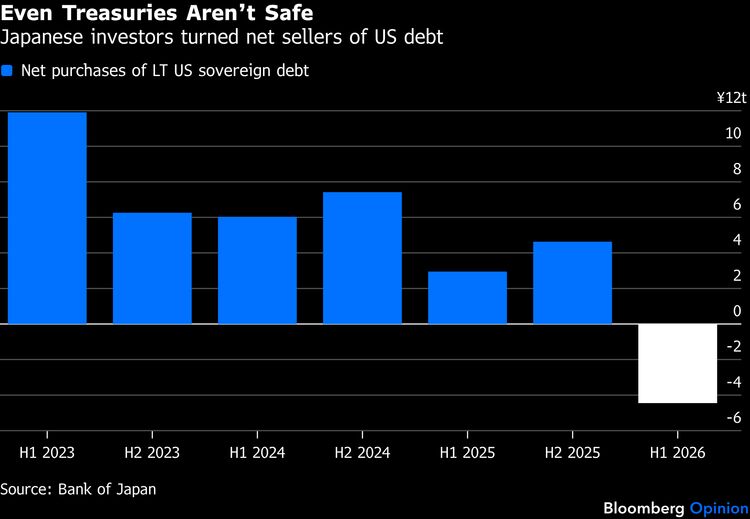
Japan doesn’t have to dump its foreign sovereign bond holdings to make borrowing more expensive for the rest of the world. Simply buying less will do. And local institutions and households are increasingly investing that money somewhere else: home.
The Government Pension Investment Fund may or may not undertake a change in its target allocation, but it already bought ¥5.7 trillion in the second quarter, more than twice what it purchased on average in the same period over the past five years, according to an estimate from Daiichi Life Research Institute Co. Public pensions as a whole bought ¥6.8 trillion, with banks and insurers also net buyers of domestic government bonds in recent months.
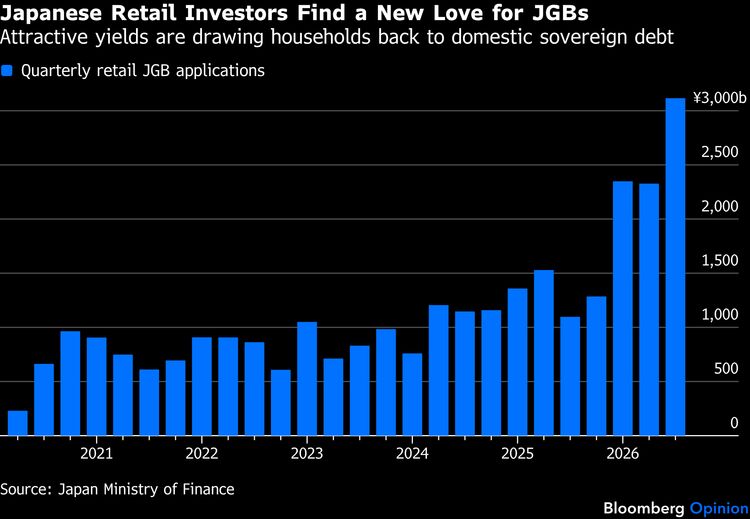
Meanwhile, the hottest vehicle for individual investors has suddenly become retail bonds. Bids passed ¥1 trillion in July for the first time since the current sales format began in 2014, and stayed above that mark each month since. Japan is rebuilding an entire domestic fixed-income culture that all but disappeared during decades of zero or negative rates, when the Bank of Japan dominated the market. Now as the central bank retreats, higher yields are restoring the domestic base that extraordinary easing destroyed. That’s going to have an impact beyond France. Japan’s financial system was so unusual for so long that much of the world has forgotten what happens when its investors can afford to be choosy.
In the world of consumer products, a common misconception for many years was that the Japanese shunned foreign goods, and only bought things made domestically. That was never correct. What was true was that the nation’s consumers were famously exacting. The same is increasingly true of capital: Whether buying cars, phones, televisions or bonds, Japan can afford to be selective.
Investors have retreated from debt in France, the US and Australia, but they were still net buyers of German, Italian and UK bonds in the first half of the year. Nor are they abandoning foreign assets altogether. Demand for overseas equities remains robust, with retail investors in particular continuing to pour trillions of yen into foreign stock funds.
The nation has been an exception to the global bond selloff of recent weeks. Its enormous debt pile was supposed to make it especially vulnerable to a world with higher rates. Instead, the latest concerns about mounting sovereign debt and the impact of oil have almost skipped a country entirely dependent on imported energy and saddled with the highest gross debt-to-gross domestic product ratio of any major economy. The 10-year government bond yield rose the least of any large peer in the third quarter.
Japan is hardly invulnerable to this new world. But it has relatively stable politics, a well-funded pension system, and more importantly, time on its side: As of the end of March, its government debt carried an average coupon of just under 1% and a maturity of nearly 10 years, meaning higher rates will feed into the public finances only gradually.
Still, that breathing room shouldn’t be taken lightly. Prime Minister Sanae Takaichi already appears to be choosing her words more carefully, placing a marked emphasis on reassuring markets in her speech opening the current session of parliament this week.
Japanese money isn’t retreating from the world. But after decades of taking it for granted, the world will now have to compete with the domestic market for that capital. Discerning Japanese consumers have long been willing to pay a premium for French handbags and other luxury goods. Now, French debt — and everyone else’s — will have to offer them a premium in return.
More From Bloomberg Opinion:
- Japan’s Massive Bond Rotation Is France’s Nightmare : Shuli Ren
- The Bond Market’s Balancing Act Is Perfectly Normal: Nir Kaissar
- FROGS Is the Name of Europe’s Latest Debt Crisis: Lionel Laurent
Want more Bloomberg Opinion? OPIN <GO> . Or you can subscribe to our daily newsletter .