
When the same party controls both the US presidency and Congress, ambitious legislation can happen. Look at the Affordable Care Act, known as Obamacare, passed under Democrats in 2010, or the tax-cut measures that congressional Republicans enacted in 2017 and 2025.
Strong public disapproval of President Donald Trump’s job performance could bring one-party Republican government to a crashing halt in the Nov. 3 election — and potentially spell all sorts of problems for Trump in his final two years in the White House — if it’s a “wave election” that breaks in favor of the Democrats.

What’s a wave election?
There’s no precise definition , but the term is used to describe when a political party makes major gains in the House of Representatives, the Senate, or both. Generally speaking, congressional wave elections have occurred at the midpoint of a president’s four-year term — when the president isn’t on the ballot — and have usually benefited the party that doesn’t occupy the White House, which right now is the Democratic Party. And in a wave election, the closest races can break one way.
How many seats are being contested this year?
All 435 House of Representatives seats and 35 of the 100 Senate seats. Republicans hold a 218 to 214 edge in the House. (There is also one independent, Representative Kevin Kiley of California, who aligns himself with Republicans for his committee assignments.) There are two vacant seats in the House .
In the Senate, Republicans have a 53-to-47 advantage. All 35 races are for full six-year terms except for special elections in Florida and Ohio to serve out terms that will expire at the end of 2028.
Can Democrats win control?
The Democrats are better positioned to win control of the House than the Senate. Democrats need a net gain of just three seats for a majority in the House and have overperformed in special elections held since Trump returned to the presidency in January 2025. Polls show Democrats leading Republicans in voter enthusiasm and in a generic congressional ballot question that asks voters which party they support in the upcoming election.
The Senate poses a steeper challenge . Democrats need a net gain of four seats for a 51-seat outright majority because Vice President JD Vance could break any 50-50 split in favor of Republicans.
Democrats would likely have to retain all or almost all of their 13 current seats that are being contested, including in the politically competitive states of Michigan , Georgia, and New Hampshire. Of the 22 states with Republican-held seats on the ballot, all but Maine and North Carolina favored Trump by more than 10 percentage points in the 2024 election. Democrats would need to flip at least two of those double-digit Trump states. That looked unlikely at the start of the campaign cycle but is more realistic now. Strong candidate recruitment and an anti-Trump political environment have made Democrats highly competitive in a raft of traditionally Republican-leaning states such as Alaska, Iowa, Kansas, Ohio, and Texas.
Why do waves happen?
One theory is that anger energizes citizens, so those opposed to the president and his policies are more motivated to turn out at the polls than those happy with the status quo. The backlash can be severe: Since the end of World War II, the president’s party on average has suffered a net loss of about 25 House seats and 3.5 Senate seats in midterm elections.
What are polls saying?
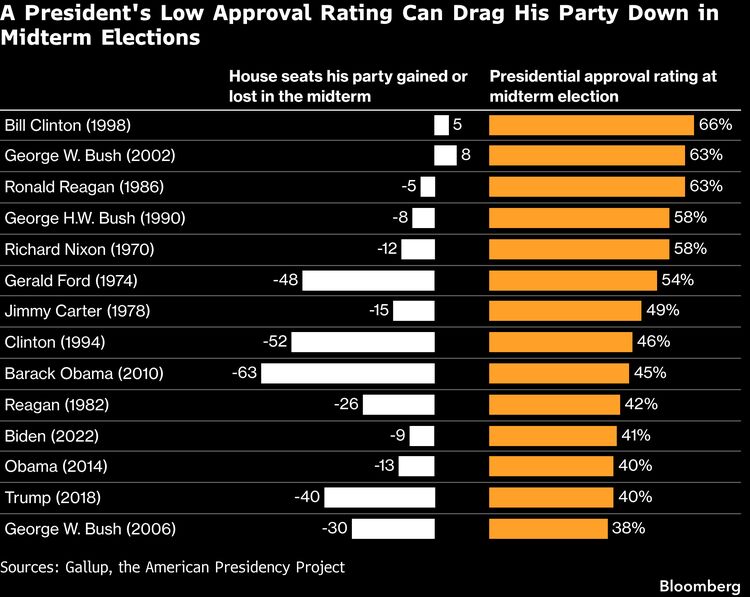
Polls suggest most of the public is deeply dissatisfied with the direction of the country and with the president. Trump’s approval rating — 37% in the New York Times average of daily polls as of Oct. 6 — is one of the lowest of any president since World War II and comparable to Republican George W. Bush’s 38% approval rating in a Gallup Poll on Election Day 2006, when Democrats won majorities in both the House and Senate for the final two years of Bush’s presidency. The less popular the president, the more seats his party tends to lose.
What’s at stake?
Potentially a great deal. Even if only one chamber flips to the Democrats, Trump’s ability to get major legislation passed would likely be thwarted, and his administration would likely face new or re-energized investigations, perhaps including subpoenas, by congressional committees that would switch to Democratic control. A Democratic-run Senate could stall or block Trump’s judicial and executive nominees, including any new Supreme Court appointments.
A Congress run by Democrats could pursue a third impeachment of Trump. But even if they make significant gains in the Senate, they’re unlikely to successfully remove Trump from office because the chamber requires a two-thirds majority vote to secure a conviction following a presidential impeachment. In any case, party leaders have downplayed an impeachment scenario during the 2026 election and urged their candidates to run on a campaign platform of lowering everyday costs and easing economic burdens for working families struggling with an affordability crisis .
Are Republicans worried about losing their majorities?
Yes, though party leaders rarely convey worry publicly because they don’t want to dispirit their voters and donors. Speaker of the House Mike Johnson, a Republican, has repeatedly said his party will “defy history” and keep control of the chamber. Senator Tim Scott, who leads the Senate Republicans’ campaign organization, told reporters on Sept. 30 that “we will hold the Senate majority without question,” though he said there are a “record number” of tossup Senate races and acknowledged tight races in traditionally Republican-leaning states such as Kansas and Nebraska. Trump, in a rare acknowledgement of his weak standing with voters, said on Sept. 30 he’s “done a very bad job of explaining how good the country is doing.”

Senator Thom Tillis, a North Carolina Republican who’s not seeking reelection, said in his book released Oct. 6 that he expected a “bloodbath” for his party on Nov. 3. Republican super political action committees are spending much more to defend their own states and districts, many of which strongly favored Trump in the 2024 election, than they are on contesting Democratic-held seats. In early October, the leading super-PAC defending the Senate Republican majority pulled out of North Carolina, where Democrats are likely to win a seat from Republicans, and instead shifted resources to the race in Republican-leaning Kansas.
Do Republicans have any advantages?
Yes. In recent months, seven states — Alabama, Florida, Louisiana, North Carolina, Ohio, Tennessee, and Texas — have adopted more Republican-skewing electoral district maps. Some acted after the US Supreme Court in April 2026 curtailed the use of the Voting Rights Act to draw predominantly Black and Hispanic districts.
However, a Democratic “wave” year could significantly limit the gains Republicans had expected to make through redistricting. Also, Democrats retaliated against Republican-led redistricting across the country with a partisan map of their own in California, and they’re likely to wrest one seat in Utah from Republican control under a new court-approved map.
Another Republican advantage: The party’s political action committees generally are more cash-flush than their Democratic counterparts. The pro-Trump MAGA Inc. super-PAC had more than $415 million in the bank as of early September, and the Republican National Committee had a cash advantage of more than $100 million over the Democratic National Committee. However, super-PACs pay higher advertising rates than federal candidates, and a favorable political environment can neutralize the opposition’s cash advantage.