On the evening of April 1, President Donald Trump said in a televised address that the US would strike Iran and send it “back to the stone ages” unless it signed a peace deal. Oil prices surged after his comments in early Asian trading hours, eventually closing up more than 7% above $109 a barrel as Trump warned of attacks against “each and every” electric generation plant. The worst of those threats never came to pass.
Compare that with Oct. 1. On that day, Trump told reporters that Iran should sign a ceasefire deal or it would cease to exist. This time, crude prices barely moved.
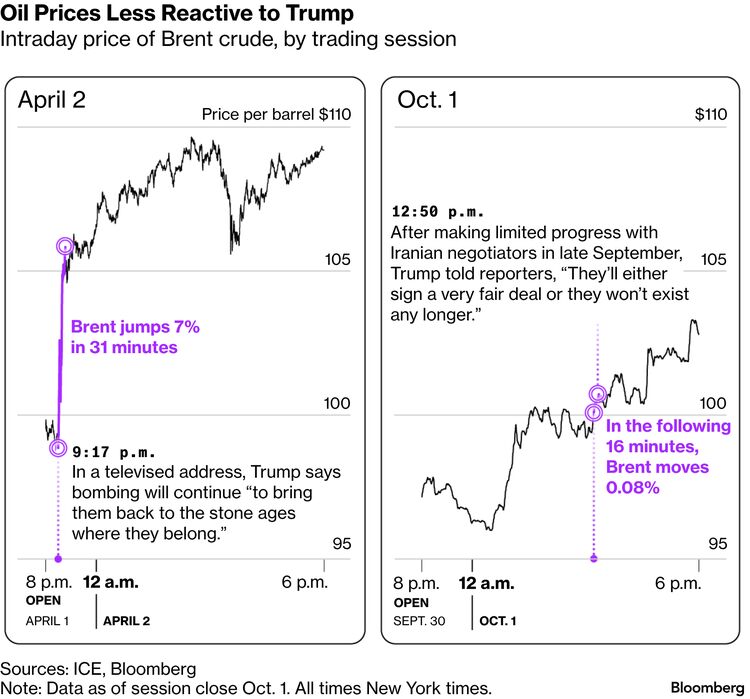
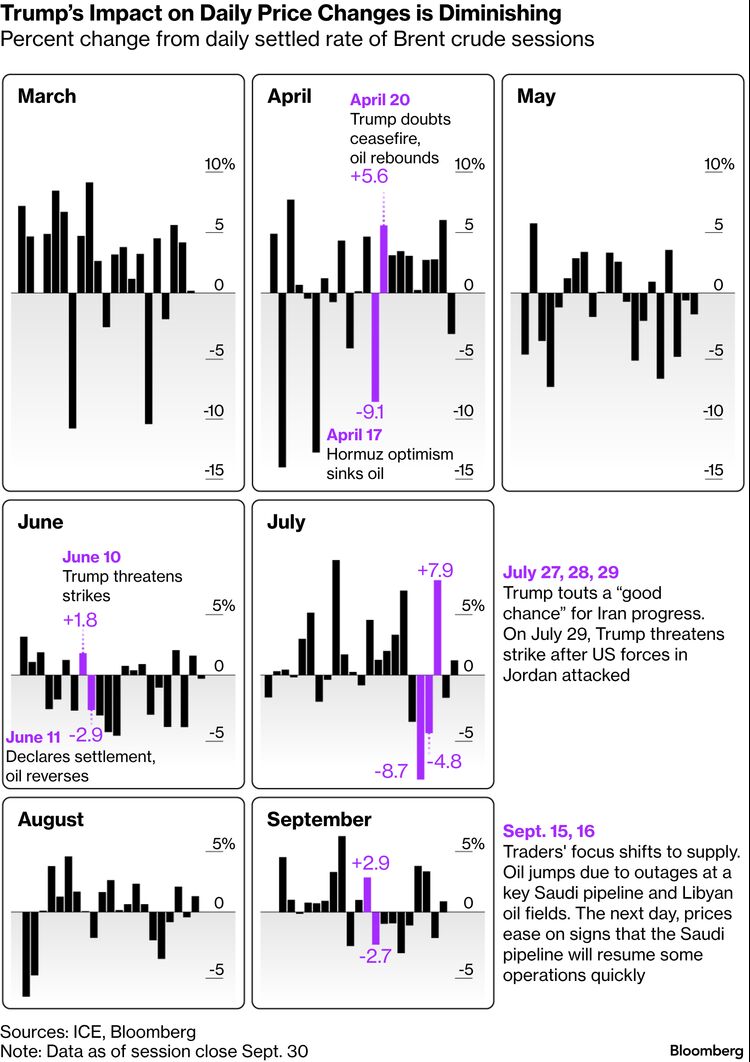
Since the US and Israel launched their initial attacks on Iran, Trump's commentary has been an almost constant accompaniment. But as the conflict has dragged on, the impact of his words on the global oil market has dimmed, according to a Bloomberg analysis of price moves.
Oil traders interviewed by Bloomberg News say they are less focused on on rhetoric and instead are more reactive to evidence of changes in physical supply or cargo flows. They’re also decreasing the size of their wagers given the unpredictability of US war strategy.
“It's been a headline-o-rama for months now,” said John Kilduff, a partner at Again Capital. “You're really playing geopolitical roulette at this point. Everybody I talk to is trading smaller.”
As traders pull back, the swings in oil prices are also shrinking. The gap between the high and low in oil prices during any given session is now much smaller compared with early in the war, according to a Bloomberg analysis of intraday price moves. Volatility has also calmed amid fewer strikes against energy infrastructure.
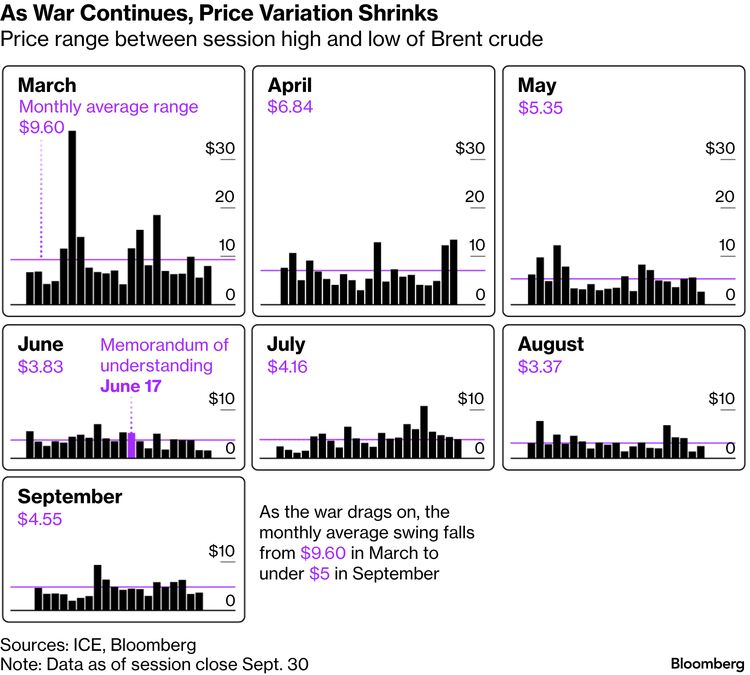
When the war began, oil traders were glued to every word from Trump as they tried to evaluate just how long the conflict would last. The specter of a closure for the critical Strait of Hormuz had long haunted the market as a worst-case scenario for oil supplies. Many of those fears became real as shipping through the waterway ground to a near halt, upending energy markets around the globe.
The war has triggered the worst oil supply shock in history. Reverberations are being felt through the global economy, and the outlook for continued energy inflation is also now driving moves in bond markets and equities.
The Iran conflict, combined with Ukraine’s attacks on Russian refiners, has sent retail fuel prices to record levels in many pockets of the world. Central bankers in Europe and beyond are voicing concerns about stubborn inflation due to soaring energy costs. And in the US, Trump’s Republican Party is facing political challenges ahead of November’s midterm elections.
But while the stakes for energy markets are striking, oil traders are now often on the sidelines in the aftermath of fresh comments from the US president, shifting focus instead to supply indicators such as cargo flows.
Over the course of the seven months, Trump has repeatedly indicated diplomatic talks with Iran were progressing or close to being finalized, only to quickly reverse course. He also floated ideas such as the US charging a fee on transits through the Strait of Hormuz, only to scrap plans within a day. The whipsawing means that traders don’t see the comments as a reliable indicator for what happens next for oil prices.
“Traders are paralyzed by all the back-and-forth out of the White House,” said Rob Thummel, senior portfolio manager at Tortoise Capital Advisors LLC.
Even analysts are running out of ways to model the path to the end of the war. “We simply don’t know how to model the endgame. At the onset, we thought we did,” JP Morgan analysts said in a note recently.
The risk for oil traders is that the uncertainty feeds into market liquidity. Open interest across Brent oil futures contracts has already plunged to the lowest since March 2025.
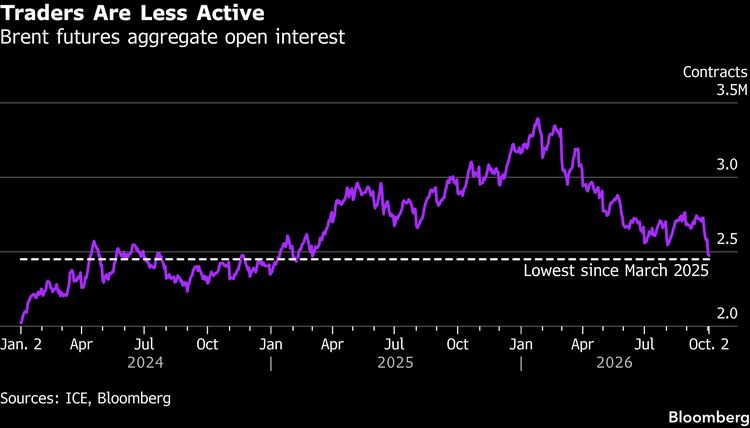
The shift also matters beyond the energy world. With the outlook for oil prices now increasingly part of the larger conversation around inflation, a murkier crude market will also cloud the outlook for broader moves in interest-rate policy and the global economy.
Read more: Oil Market Swings Wear Down Traders as Iran War Drags On
What’s more, as rhetoric-driven volatility subsides, it’s sometimes leaving the market at the mercy of machine trading that can cause unpredictable price swings. Algorithmic traders, known as commodity trading advisers, tend to be momentum driven, meaning they can amplify price swings in both directions. While these moves tend to reverse quickly or normalize over the course of the trading session, they can drive disconnects between physical and paper markets while sidelining traditional investors.
Most traders also admit they can’t fully ignore Trump’s comments. The president remains the final authority on decisions around military deployment and, ultimately, the course of the Iran war.
But for now, many speculators are hesitant to place significant bets on which way oil prices will move unless there is clear visibility from sources beyond Trump. Instead, they are looking at supply metrics.
“The president says a lot of things and he changes his view pretty frequently. After a few rounds of headlines, the market does become desensitized,” said Michael O’Rourke, chief market strategist at JonesTrading Institutional Services LLC. “There's definitely more focus on physical flows data because it's real-time and actionable.”