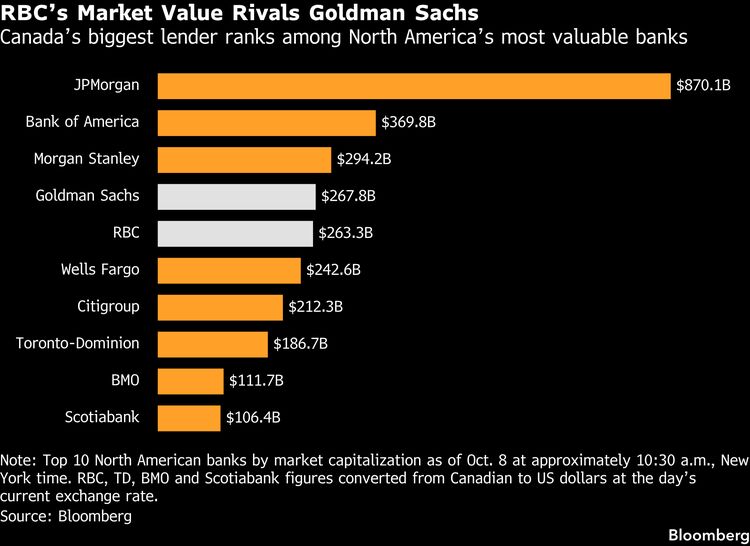
Royal Bank of Canada has climbed into the same market-value tier as Goldman Sachs Group Inc. and is worth more than Wells Fargo & Co. and Citigroup Inc., underscoring how a decade of expansion at home and abroad has pushed the Canadian lender into the upper ranks of North America’s most valuable banks.
Royal Bank’s market capitalization, converted into US dollars, briefly overtook Goldman’s earlier this week. At $263.3 billion, it’s larger than both Wells and Citigroup by tens of billions of dollars and is worth about 40% more than Toronto-Dominion Bank, its nearest Canadian rival.
RBC has surpassed Goldman in market value before, including earlier this decade. This time, however, the Toronto-based bank has arrived at roughly the same valuation after more than two years of widening its lead over its Canadian rivals — as recently as three years ago, it was only about 10% larger than Toronto-Dominion — while Goldman itself has benefited from a run of record equity-trading results.
Both firms have seen a pullback in their stock price in recent months, though that’s been more pronounced at Goldman, where last month Chief Executive Officer David Solomon cautioned that fixed-income trading has been softer than in past quarters and expenses are running higher across the firm. Goldman reports third-quarter earnings on Tuesday.
Dave McKay, who became Royal Bank’s CEO in 2014, has presided over the acquisition — and subsequent rehabilitation — of California-based City National Bank and snapped up the Canadian assets of HSBC Holdings Plc, adding significant scale to Royal Bank’s domestic retail- and commercial-banking operations. He also expanded the firm’s wealth-management footprint with the purchase of UK firm Brewin Dolphin Holdings Plc and steadily built out its capital-markets division.
The expansion has also raised Royal Bank’s profile on Wall Street, where it’s won roles on marquee transactions. The bank was the only Canadian firm among the 23 bookrunners on the SpaceX IPO, and it was a joint book-running manager on Alphabet Inc.’s $84.75 billion equity capital raise .
Royal Bank’s annual profit has nearly doubled since 2015, and the company last year became the first Canadian bank to earn more than C$20 billion ($14 billion) in a fiscal year. It posted the highest return on equity among Canada’s six biggest banks in the latest quarter, at 17.9%, which also tops the aggregate ROE of about 14% for a group of large US banks and financial firms tracked by the Federal Reserve.
“We generate the most amount of capital of any bank in Canada by a wide margin,” McKay said at a Bank of Nova Scotia conference last month, pointing to revenue growth, cost efficiencies and improvements at City National. He’s also highlighted Royal Bank’s investments in building its own artificial-intelligence tools, saying the firm is making progress toward its goal of as much as C$1 billion in annual efficiencies from the technology.
Asked for comment, a representative for Royal Bank pointed to McKay’s recent remarks and the firm’s strategic update from late 2025, when it raised its ROE target set just nine months earlier.
That room for continued improvement “validates the premium stock valuation,” Bank of America Corp. analyst Ebrahim Poonawala wrote at the time. In an August report, Poonawala said that RBC’s role as the only Canadian lender on the SpaceX IPO and an initial lending consortium to Anthropic PBC “highlight its ability to mingle with the Wall Street banks.”
Pulling Ahead
The path to today’s valuation hasn’t been linear, with Royal Bank shares facing periods of stress during the Covid-19 pandemic, a sharp turn toward higher interest rates in 2022 and uncertainty across the global banking sector in 2023 amid the US regional bank crisis and the collapse of Credit Suisse.
In 2018, Royal Bank posted its worst full-year total return of the past decade — a decline of 5.7% — and lost some ground to rival Toronto-Dominion, which was enjoying investor favor at the time for its larger exposure to the US retail market. In early 2019, McKay said Royal Bank had “competed poorly” in the Canadian mortgage space and vowed to make improvements .
Still, by late 2022, Royal Bank was able to commit C$13.5 billion in cash to acquire HSBC’s Canadian franchise as the UK-headquartered bank refocused its own capital toward Asia. The deal was the largest in Royal Bank’s history and bolstered the firm’s business-banking unit while adding more than 100 retail branches across the country.
Over the past year, Royal Bank has benefited from a surge in Canadian bank stocks, which have outperformed their US peers and the broader Canadian market by a large margin. The lenders have generally posted strong earnings and contained credit losses while keeping expenses in check, but have also seen a lift from an influx of foreign capital to Canada directed disproportionately to the financial sector.
Royal Bank’s scale is notably visible at home, where it accounts for 7.5% of the S&P/TSX Composite Index — roughly the same weight Apple Inc. has in the S&P 500.