Polish debt collector Kruk SA is working to accelerate expansion into the US and UK as it looks for a new engine of growth beyond continental Europe.
Kruk is considering both direct purchases of debt portfolios and opportunistic acquisitions of profitable competitors in the two markets, Chief Executive Officer Piotr Krupa said in an interview. The founder owns a 8.7% stake in the company, making him one of its largest shareholders.
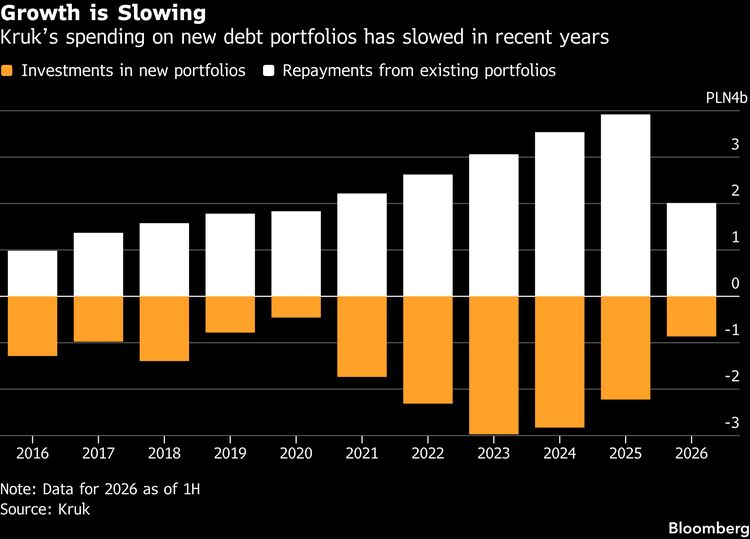
Over the past two decades, Kruk has expanded from Poland into Romania, Italy, Spain and, most recently, France. It is Europe’s largest listed debt collector by market value and estimated remaining recoveries. Its focus on unsecured consumer loans has helped keep leverage relatively low, but the firm has struggled to maintain the pace of portfolio purchases seen in previous years.
Kruk’s strategy through 2029 identified existing European markets as the core of organic growth and presented the UK and US as potential longer-term opportunities. Krupa admits the market is changing. European lenders are selling troubled consumer loans earlier, which makes portfolios higher quality, but also more expensive upfront.
Against that backdrop, Kruk is studying the UK and US simultaneously and could make its first portfolio investment within the next several quarters.
“We won’t wait until the end of our strategy horizon,” he said. “We are looking very closely at these markets and talking to a number of companies that are already there but don’t have sufficient capital to buy portfolios.”
The move would effectively close Kruk’s continental European expansion chapter, which has been marked with setbacks. Court delays in Spain forced writedowns and a temporary pullback in purchases, while the company has exited or scaled back in smaller markets, including the Czech Republic and Slovakia.
Krupa said that Kruk’s model works best in large markets where technology and data can be deployed across millions of consumer-debt cases.
“For now, we would consider the European phase of our expansion complete,” he said. “We don’t want to spread ourselves too thin across smaller countries.”
Polish firms are increasingly expanding abroad , including in Germany and France, reflecting how the country’s economy, the European Union’s sixth-largest, has grown into a $1 trillion regional powerhouse.
Investment Targets
In recent years, Kruk has typically invested about 2 billion ($512 million) to 3 billion zloty annually in new portfolios, while recoveries from existing debt have risen to almost 4 billion zloty a year.
Krupa said adding the UK could lift annual investment to 3 billion to 4 billion zloty, while a mature US operation could eventually take it to as much as 10 billion zloty.
Krupa said the company could initially test the UK or US by buying sour unsecured portfolios and using local service firms before building its own operations. He is also open to acquisitions of other debt collectors, including a larger US deal if the economics make sense.
Stock Selloff
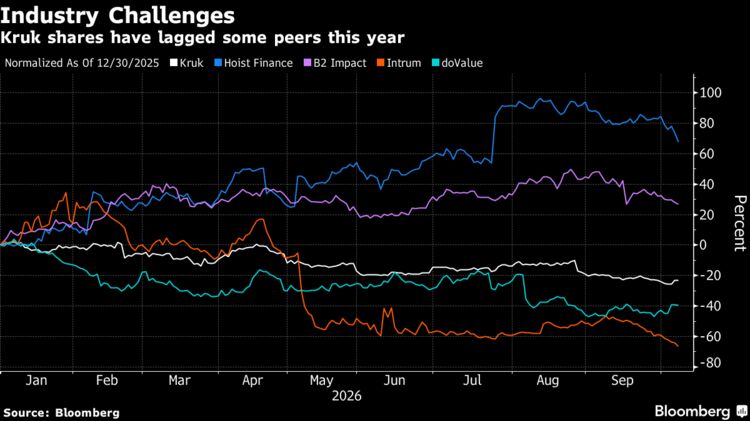
Concerns about future growth, compounded by capital shortfalls reported by some European peers , have pushed Kruk shares 25% lower this year, making it the worst-performing stock in Warsaw’s WIG20 benchmark.
“Maybe the last quarters, when we bought fewer portfolios than the market expected, also caused some concern among investors,” he said. “But we are not stopping.”
Patience has long been part of Krupa’s message to investors. An endurance-sports enthusiast who has completed 17 marathons and seven Ironman triathlons, he likens his approach to building Kruk to long-distance running.
Competitors, including Hoist Finance AB and PRA Group Inc. may move ahead at times, but the goal is to keep progressing, according to the CEO.
Kruk began as a legal publisher, later shifting into default debt purchases shortly before Poland joined the EU after a client asked for help with collecting overdue payments. More recently, Krupa and his wife have built an art foundation and gallery in Wroclaw, the southwestern Polish city where he built the business.
Krupa argues that slower growth doesn’t necessarily mean weaker returns for shareholders. The firm earns close to 1 billion zloty annually and currently distributes about 35% to 40% of profit.
“There are two scenarios,” he said. “Either we continue to grow quickly and maintain the current level of payouts, or we grow more slowly and become a company that, over the coming years, can distribute a significantly larger share of its profits.”