Private credit managers increasingly looking to offload battered funds are drawing interest from rivals eyeing cheap deals in one of the most turbulent periods for the $1.8 trillion market.
Firms including Ares Management Corp., Barings LLC, BC Partners and Churchill Asset Management have run the rule over troubled funds in recent months, according to people familiar with the matter. The talks are still preliminary and may not result in any transactions, the people added, asking not to be identified as the discussions are private.
“I can’t think of another time like this where you’ve seen so many public BDCs up for sale,” said Paul Johnson, an analyst at KBW. “The motivation for an outright sale comes from a long period of underperformance.”
Private credit managers have faced intense pressure this year, as investors pulled record amounts from nontraded funds and sold off shares of listed vehicles. Publicly traded funds including BlackRock Inc.’s beleaguered TCP Capital Corp., WhiteHorse Finance Inc. and Investcorp Credit Management BDC Inc. have said they’re weighing strategic options, which could include a sale. Apollo Global Management Inc.’s MidCap Financial Investment Corp. has also shopped its portfolio around, the people with knowledge said.
Representatives for Ares, Barings, BC Partners and Churchill declined to comment, as did a spokesperson for Apollo.
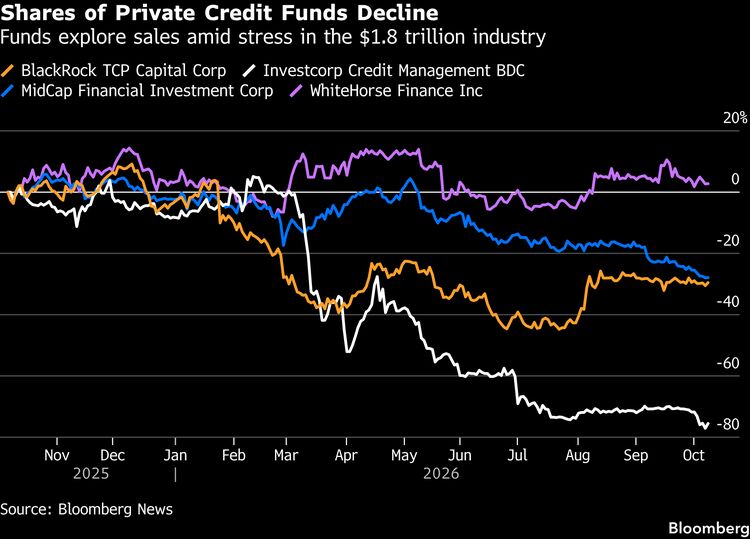
Private credit managers are typically loathe to sell publicly traded BDCs, since they offer both a more attractive fee structure than other vehicles and provide much-coveted perpetual capital. But as investors have turned away from the asset class in droves, that calculus has changed.
Once a public fund begins to trade poorly, its ability to grow can be limited because it is unable to issue equity below net asset value. With direct lending volume also shrinking, a manager can be left with an underperforming fund and few options.
Exit Route
A transaction can take several forms. A manager can buy a BDC through a merger or they can purchase the contract to run the fund. Other options include purchasing assets from the fund, which can allow the seller to combine what remains into an affiliated vehicle or simply return cash to investors.
Some firms are exploring these options because they don’t see the value in turning around their challenged funds, according to the people with knowledge. For the largest asset managers in the world, which oversee hundreds of billions of dollars across different asset classes, a relatively small underperforming fund can become an outsized distraction, especially as they look to push into retirement accounts .
TCPC, for example, is tiny in the scheme of BlackRock’s $15.3 trillion empire. The fund, which has marked down soured loans and been probed by US regulators over valuation practices, sold about half of its portfolio to secondaries specialist Pantheon in August, using the cash to help bring down leverage at the vehicle.
“BDCs might not just be worth the trouble, and trying to repair the credits and constantly go on public calls to discuss performance not worth the time,” said KBW’s Johnson, without referring to a specific fund.
Buying Scale
Consolidation is somewhat of a tradition in direct lending. Firms including Ares and Blackstone Inc. built some of the largest business development companies through acquisitions of rivals. BC Partners has also rolled up several funds, with Chief Executive Officer Ted Goldthorpe telling investors in March that a combination of two of its publicly traded funds “expanded our scale, and enhanced our portfolio diversification.”
“As a general matter, there’s nothing new about the idea that smaller business development companies can start to become merger targets,” said Christopher Healey, a partner at Davis Polk & Wardwell who specializes in private credit. He said he wouldn’t be surprised if more funds with less than $1 billion in investments started to think about selling.
For buyers, such deals offer a way to expand rapidly, boosting the assets that they can collect fees on, or potentially acquiring a new stream of permanent capital. For some, combining with a publicly traded vehicle is also an attractive way to provide liquidity for their existing private funds.
“The marketplace for these transactions is really robust and despite some of the retail pullback, we’re seeing that there is still an appetite to acquire BDCs and grow assets there,” said Healey.
| More on Private Credit Deals |
|---|
Bloomberg News is tracking corporate loans originated by private credit firms around the globe in the Private Credit Loan Monitor. Subscribe to the Private Credit Weekly for more news and analysis on the $1.8 trillion market. |
Deals
- Ares and Apollo are leading a $6.5 billion debt package for Phoenix Tower International, a Florida-based owner and operator of telecom tower infrastructure
- Waymo increased the size of its inaugural debt raise to $5 billion, tapping lenders to help fuel the robotaxi company’s growth as it expands globally
- Apollo is set to opt for aircraft financing rather than high yield bonds for a £3.5 billion debt package backing its acquisition of low-cost carrier EasyJet Plc
- LIV Golf Ltd. receives a financing commitment of as much as $300 million from BC Partners Credit, potentially obtaining the funding needed to launch a 2027 season
- Sellside adviser Lincoln International has tapped private credit firms in a so-called lender education process for a potential carve-out of IT company Akquinet’s healthcare business
Fundraising
- Janus Henderson Group raised $191 million at the second close of its MENA Private Credit Fund IV, putting it closer to its $300 million target
Job Moves
- Egan-Jones Ratings Co. tapped former US Securities and Exchange Commission staffer Kenneth Godwin, who oversaw examinations of firms like Egan-Jones, as its senior director for ratings amid concerns over its grading of private credit instruments
Did You Miss?
- Apollo Trades $35 Billion Private Credit in Push to Open Market
- Calpers to Step Up Its Private Credit Allocations to Energy
- KKR Private Credit Fund Creeps Beyond 5% Cap to Meet Redemptions
- Blue Owl Again Caps Two BDCs After 39%, 17% Withdrawal Requests
- Carlyle Warns Private Credit AI Push Runs Concentration Risk
- US Agrees to Loan for Chipmaker That Went Bankrupt Last Year