By David M. Drucker | Updated on Oct 08, 2026 at 11:00 AM
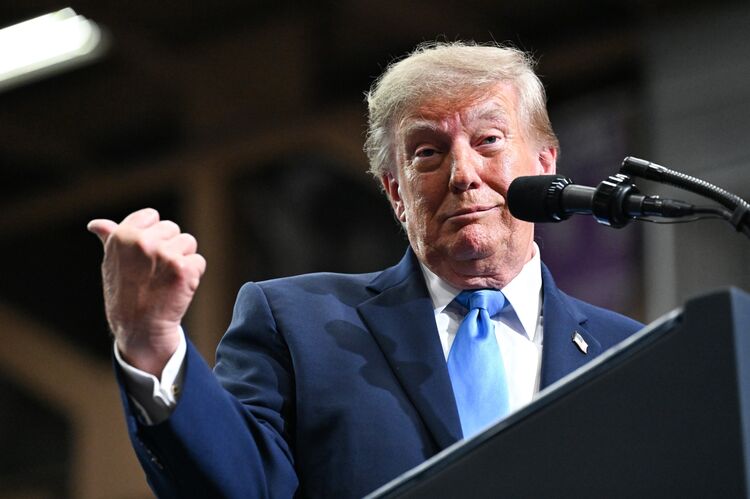
Complaining about subpar public relations is the last refuge of the political loser. It’s a bipartisan affliction that surfaces in every American election, including this year’s midterm campaign. President Donald Trump is patient zero this time.
His Republican Party might yet surprise everyone on Election Day. But every indicator suggests voters are poised to deliver control of the House of Representatives to the Democrats — and maybe the US Senate, too, despite structural disadvantages that buttress the GOP’s 53-47 majority in that chamber. Yet another forecast of the left’s electoral strength: Trump’s own lament that Republicans haven’t adequately informed voters who are struggling economically just how prosperous their lives really are.
“We’re doing an extremely poor job of promotion and an extremely good job of running the country,” the beleaguered president insisted recently . Then there was this excuse: “The only thing we don’t have is good public relations.” Trump appears so intent on off-loading responsibility for the GOP’s political predicament on faulty messaging that he was even willing to blame himself. “I’m very proud [of] the job we’ve done,” Trump said . “But I’ve done a very bad job of explaining.”
The president’s overriding desire to identify a culprit other than his agenda, and his leadership, for his 38.4% job approval rating is understandable. The same goes for Trump’s attempt to rationalize the Democratic Party’s 8.3% lead on the generic ballot gauging which party voters would prefer to control Congress. The alternative would be reckoning with voters’ conclusion that he is a failed president on issues — like affordability — that matter most to them. That Americans rate Trump 11 points lower on inflation than his overall job approval is the equivalent of a vote of no-confidence.
Then again, it’s difficult for the president to maintain voters’ confidence when he regularly dismisses their anxiety about making ends meet as “ a hoax. ” Even the best PR campaign — and Trump’s effort is hardly that — would have a hard time healing that self-inflicted wound.
The president accepting voters’ stinging indictment would call into question everything he believes — about his omnipotence as an elected leader; closely held beliefs (or is it instincts?) on matters like international trade and the efficacy of tariffs; his management of the Iran war; and his bureaucratic prowess. Good luck with that. In that regard, the 45th and 47th president is hardly unique.
Griping about public perception as a means to explain voter discontent is common among presidents in tough midterm and reelection battles. I’ve learned as much after a quarter century of reporting on campaigns.
A favorite target is the news media. President George W. Bush and his supporters often pointed fingers at journalists as backlash over the Iraq War developed in 2006, eventually sweeping Republicans from power in Congress. The implication: Voters would have thought better of the conflict, and possibly preserved the GOP’s House and Senate majorities, absent biased coverage that painted an unfair portrait of US military action in the Middle East.
It was the Democrats’ turn to scapegoat messaging in 2014 after Republicans flipped the Senate with a massive nine-seat gain. Instead of validating voters’ economic experiences and fears about ISIS, President Barack Obama explained their harsh rebuke in the second midterm election he presided over by blaming the marketing. "It's not enough just to build a better mousetrap," Obama said . "We've got to sell it.” (But kudos for owning the bad salesmanship, I suppose.)
Complaints about public relations are occasionally warranted. If a political party is being drowned out by the competition on television or social media platforms, it’s possible that a lack of resources, not positions on key issues, is the cause of poor poll numbers. If a candidate’s agenda is broadly appealing but not focused on voters’ urgent priorities, it’s possible that messaging is, in fact, the problem — and fixable.
But less than four weeks until Election Day, advertising analyses and fundraising reports have shown that Republicans aren’t suffering from financial or airtime disadvantages. Indeed, anxiety about money and getting outspent on the air, and online, is strictly a Democratic concern. Meanwhile, many Republican candidates are focused on the issues voters care about most, notably the high cost of living. Some are even urging Trump to wind down the unpopular Iran war regardless of conditions on the ground. Their challenge, then? Well, the president.
Trump has the country’s loudest political megaphone and is the undisputed leader of the GOP. He’s who voters are hearing and who they are seeing, when most other Republican candidates are campaigning. That’s quite the dilemma. And unless the president immediately acknowledges voters’ frustrations and alters his agenda based on that, 2026 is likely to end on a high note for Democrats — if it’s not already too late to change the dynamics of this election.
There’s an old saw in politics that goes something like this: “It’s not the message; it’s the messenger.” In this case, it’s both.
More From Bloomberg Opinion:
Trump’s Popularity Has Reached a Critical Point : David M. Drucker
Iowa Is a Microcosm of All the GOP’s Problems : Nia-Malika Henderson
Democrats Should Be Converting More Trump Skeptics : Ronald Brownstein
Want more Bloomberg Opinion? OPIN <GO>. Or subscribe to our daily newsletter .