
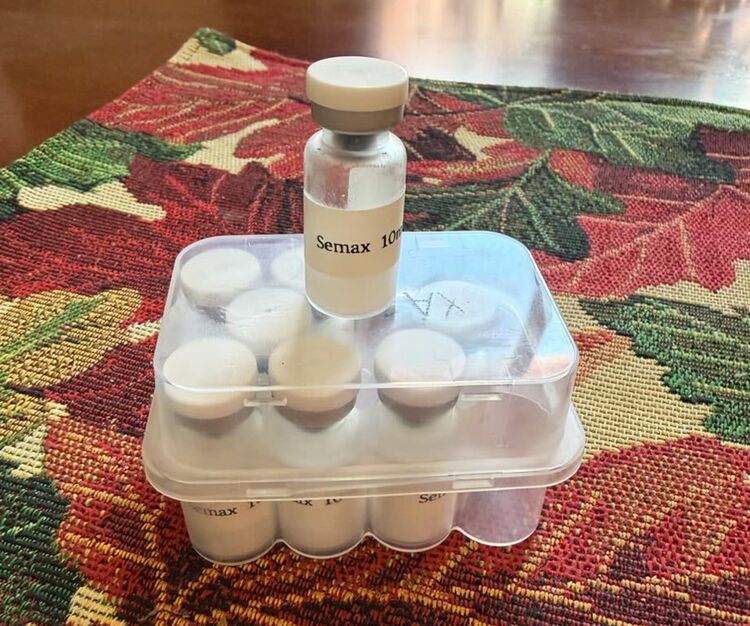
Taylor Bauer is a 44-year-old self-proclaimed biohacker in Los Angeles. He decided to taper off Adderall around 2023, after nearly two decades, when he experienced mental and physical side effects. Instead of another form of psychiatric medication, Bauer turned toward an unlikely — and largely unproven — candidate to help with his brain fog and focus: a Russian peptide called Semax.
The first time Bauer took the nasal spray, he says he felt a shift in his focus. “Gosh, how do you really describe it?” he said. “It’s like, all of a sudden, the clouds have cleared. You’re sharper, any brain fog goes away very quickly.”
Bauer is among the millions of Americans taking peptides, short strings of amino acids that can act as biological signals for cells. Peptides like insulin can occur naturally in the body, or they can be synthetically introduced to induce a biological process, as happens with semaglutide , the active ingredient in Ozempic.
But insulin and semaglutide are approved by the US Food and Drug Administration. Unapproved peptides like Semax, which are marketed as research chemicals, have been circulating in what's become a billion-dollar gray market .
Read More: Can Unregulated Peptides Really Make You Smarter and More Resilient?
These substances have skyrocketed from a niche topic on biohacking forums to the mainstream in a matter of months. Most of the conversation has focused on how they might help you lose weight, boost muscle growth or rejuvenate your skin. Now the movement has shifted to an even more controversial frontier: the human brain.
People are taking peptides for mental clarity and cognitive benefits, as alternatives to psychiatric medications, and to gain a competitive edge or stave off the inevitable effects of aging.
Because importing or selling unapproved peptides for human use is not legal in the US, many people turn to online forums for guidance and overseas vendors with questionable credentials to obtain them. The peptides forum on Reddit has more than 174,000 followers, while another popular site connecting gray-market peptide users to vendors boasts about 87,000 members and 257,000 posts. Through the advice of strangers, prospective users cobble together routines, with crowdsourced dosages and administration plans.
Do-it-yourself medicine has been on the rise as people increasingly turn to social media or artificial intelligence for medical help. A 2025 survey from strategic communications firm Edelman found that 28% of adults have disregarded their doctor in favor of advice from social media , a 10-percentage-point increase from the prior year. One in four Americans have used an AI tool or chatbot for health information or advice, according to a Gallup survey of more than 5,500 US adults. Of recent users, about 14%, said they’ve skipped a doctor’s visit after getting AI-generated guidance.
Read More: The Billion-Dollar Peptides Gold Rush
There are several reasons people turn to DIY treatments, said Anna Wexler, an assistant professor of medical ethics and policy at the University of Pennsylvania’s Perelman School of Medicine. Some find the approved treatments don’t adequately address their symptoms, so they take care into their own hands. Then there are the optimizers, who want to push the limits of their own bodies and minds.
“They want to be more productive. They want to be smarter. They want to be more efficient,” Wexler said.
When it comes to brain function, the line can get blurry. Many people naturally experience periods of memory decline, poor focus or stress, she said. That doesn’t necessarily mean they have a disorder to be treated.
Peptide nation
Cognitive-enhancement drugs, also known as nootropics, have existed for years, both to treat illness and enhance natural neural processes like memory or focus. Some are as common as the caffeine in a cup of coffee. Others, like the wakefulness drug modafinil or ADHD stimulant Adderall, can be legally obtained in the US and many other countries only with a doctor’s help. But as peptides grow in popularity, new products have cropped up, with their makers claiming that they offer the same benefits for the brain and body.
Since peptides are often used without doctor supervision, it’s difficult to document the number of people using them. Nutrition Business Journal estimated that the market for brain health supplements will reach $1.6 billion by the end of 2026 and grow to nearly $1.9 billion by 2028.
In some small-scale studies, primarily done in Russia, researchers have suggested that Semax might increase signaling in the brain for stroke patients, leading some to say that the substance could be used as a nootropic. Long-term safety data in humans is extremely limited. The FDA has warned that compounded Semax can trigger an immune reaction.
It’s gained enough traction in the US to reach the desks of top public-health officials. An advisory committee convened by the FDA recommended Semax for approval, and eventual public use, during a set of hearings in July. But the panel drew scrutiny for including several people with ties to peptide-related businesses and clinics.
The vote was divided , with eight members voting yes, five voting no and one abstention. Some scientists have voiced concerns about the vote, pointing to the lack of clinical studies on the drug outside Russia. Others say that legitimizing the products, which are often bought through the black market, could help protect the many Americans that already use them.
Read More: ‘Wild West’ of Untested Peptides Has Americans Paying in Crypto to Get Their Fix
“The advisory committee made some recommendations, but the peptides still aren’t FDA-approved,” said Fred Mills, a pharmacist and the chief policy officer at Americans for Safe and Effective Medicines, a group that advocates for increased regulation of peptide use. He warned that there isn’t enough clinical or scientific evidence to support the claim that humans can safely use peptides.
Because of the dearth of data, many curious potential users must rely on word of mouth, or their own experimentation, to see what works for them. Bauer is on a self-imposed cycle where he uses the injectable form of Semax for about a month and then stops taking it for a month, to gauge the effects of the drug. He also experiments with a litany of other treatments: red-light therapy, cryotherapy, hyperbaric oxygen chambers, saunas, Pilates and more than 50 different types of supplements.
Luis, a 47-year-old based in São Paulo with ADHD and autism diagnoses, started experimenting with nootropics after his stimulant medication was giving him high blood pressure. He began to try Semax to help him focus. He now takes it nearly every day, saying he hasn’t had any side effects from the drug but has seen a meaningful drop in his compulsive behavior.
Experimenting with unproven nootropics without professional help can also yield unexpected results and shouldn’t be tried without extensive research, doctors say. Luis had tried taking methylene blue, a nootropic that’s advertised to promote memory and energy. But the substance made him more tense and anxious, which he attributed to a negative interaction with another medication he was taking. Luis stopped using methylene blue. He declined to allow the use of his full name because of peptides’ legal ambiguity in Brazil.
John Whyte, chief executive officer of the American Medical Association, warns against self-experimentation.
“People have always been looking for the quick fix, the magic pill,” he said. “On peptides, people aren’t talking enough about [how] these are compounded substances, there’s issues of safety, there’s issues of dosing.”
Read More: Texas Pharmacy Recalls Popular Peptide Due to Bacterial Toxins
Mental capital
From the inside, Extension Health, a concierge longevity clinic in New York City, looks like a cross between a therapist’s office and a futuristic tech hub. The waiting room is replete with lush greenery and comfortable sofas, and the doctor’s offices have beds along with seating.

Jonathann Kuo, the clinic’s founder and a physician who specializes in longevity services, describes his clientele as affluent and “very go, go, go.”
“A lot of CEOs and executives, people running companies, and they’re always trying to squeeze every last ounce of cognitive performance," he said. "A lot of my clients are, baseline, really pretty healthy, just looking for that extra edge, extra boost, extra 20% unlock.”
The facility offers services ranging from vitamin-filled IV drips to full-body scans. For about $5,000 a year, patients can get concierge peptide services, supervised by a medical practitioner. (A few invitees get full access to Kuo’s offerings, exclusive new treatments and an entire team dedicated to their longevity care for $250,000 a year.) For those who don’t want to spend that much, individual cognitive peptide therapies run $300 to $375 for a month’s worth, with a required consultation session before. About a fifth of Kuo’s patients used a cognitive or neuro-focused peptide or service in the past year, the clinic estimated.
“We’re in a global environment, and what we have, which is highly valued, is mental capital,” said Barbara Sahakian, a professor at the University of Cambridge who has studied modafinil and other cognitive enhancers. “So anything you can do to raise the mental capital, whether that be through education, through healthy lifestyles or through drugs, I think will become more and more attractive.”
People in high-performing jobs look to substances to stave off their brain’s natural decline, Sahakian said. In her research , she’s noticed people turning to cognitive enhancers like modafinil to preserve or boost their brain function for common work tasks, like giving presentations or conducting negotiations.
Elvis Garza first heard about Semax online. When an older friend started using the peptide last December, it piqued his interest. The 26-year-old had never been formally diagnosed with ADHD, but he sometimes had difficulty focusing on tasks. After taking an injection one morning before his sales job, the Indiana resident noticed that he had entered a “flow state” as he emailed and called prospective clients. Now, he takes Semax when he has to complete work that requires deep, sustained focus.
Garza said he researched the peptide before taking it, and makes sure that it’s tested for purity and sterility. He doesn’t mind that Semax is not yet approved by the FDA, pointing to other common products, like dietary supplements, that aren’t FDA-regulated. “I'm doing it myself, so it's nobody else's problem, really,” he said.
The desire to stay mentally fit comes as more Americans are experiencing cognitive decline. A study of more than 4 million Americans found that rates of self-reported memory, concentration or decision-making troubles increased from 5.3% to 7.4% between 2013 and 2023, with young adults seeing the biggest rise. Cases of dementia in the US are expected to double by 2060 from their level in 2020. What’s more, brain fog is emerging as a leading symptom of long-term Covid-19, with 86% of nonhospitalized Americans with infections reporting the symptom.
Amanda Pachios is a 52-year-old jazz singer from western Massachusetts. She first started looking into brain health when her aunt entered memory care. Pachios already knew dementia ran in the family — her father and grandfather both passed away from Alzheimer’s disease. But her aunt inspired her to take stock of her own symptoms.
“Over a couple of years, my thought processes slowed way down,” Pachios said. It started with small things, like having trouble finishing song lyrics, but soon trickled down to stalled sentences during conversations.
Pachios found herself entering the world of nootropics. She takes magnesium glycinate, omega-3 fatty acids and other supplements for her brain health, keeps to a Mediterranean diet and does light exercise to keep her mind active. She also participated in a sleep study and got diagnosed with sleep apnea, and she credits the treatment with clearing up some of her symptoms. The lifestyle changes were enough to help her cognitive functioning, so she never tried peptides, she said.
Simple lifestyle changes like diet, light exercise and sleep can reduce the risk of cognitive decline, Sahakian said. Doctors caution against taking substances advertised on social media as miracle cures, and advise people to talk to their providers before trying any new therapies. For their part, Pachios and Bauer keep their primary-care physicians in the loop.
But some, like Bauer, don’t mind being the first to test a new product, arguing that the potential benefits outweigh the risks.
“I use myself as a guinea pig,” he said. “I think that one of the beauties of living is the God-given right we have to self-experiment.”