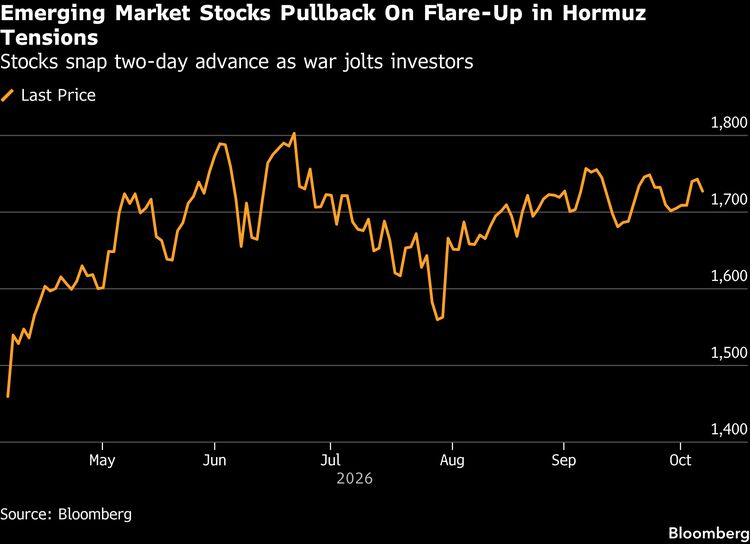
Emerging-market stocks and currencies closed lower on Wednesday, halting their weekly advance, after a flare-up of attacks in the Strait of Hormuz pushed oil prices and the dollar higher.
The MSCI Inc. index of developing-world currencies edged lower, with Central and Eastern European countries leading the decline. The Colombian peso and the Indonesian rupiah were among the few outliers.
Latin American currencies also declined. Investors are now watching inflation data in the region, beginning with Colombia late on Wednesday, followed by Chile, Mexico and Brazil, which could offer additional clues on local monetary policy direction.
“As long as oil prices and geopolitical headlines signal uncertainty, EM FX may be a bit more volatile relative to what we saw over the summer,” said Brendan McKenna, an emerging-markets strategist at Societe Generale in New York.
The latest flare-up in geopolitical tensions comes from Iran, which ratcheted up the pace of attacks on tankers in the Strait of Hormuz, sending Brent crude prices above $100 per barrel. The attacks come just as oil shipments through one of the world’s most important energy waterways return to near prewar levels.
The MSCI gauge for EM stocks fell for only the second day in five, declining 1%, with South Korea’s Kospi Index slipping 2%, its worst day so far this month. Despite Wednesday’s pullback, Franklin Templeton is upbeat on equities amid continued spending on artificial intelligence, particularly in Asia.
“Many EM companies play an important role in building the technology that supports AI,” Bassel Khatoun, head of research for Templeton Global Investments, said in a note. “Overall, EM stocks remain well placed for the future.”
Khatoun said more EM firms were focusing on capital discipline and improving shareholder returns, while “local economies also have their own growth profiles,” which help lure investors to the asset class.
Elsewhere, India’s rupee fell 0.3% against the dollar, even after the central bank raised interest rates for the first time in almost four years. The lack of more aggressive steps to tighten liquidity and support the currency left traders disappointed .
Poland’s zloty dropped 0.7% as the central bank left its benchmark rate unchanged at 3.75%.
In Peru, the central bank is expected to hike rates later today, according to a majority of analysts surveyed by Bloomberg. A hike would be the first since January 2023 and would interrupt a two-year easing cycle that has trimmed the key rate by 3.5 percentage points.