A bidding war for TDK Corp.’s hard-disk drive parts business could determine the prospects of Japanese corporate icon Toshiba Corp. as well as who controls an increasingly lucrative AI data center storage market.
Seagate Technology Holdings Plc and delisted Toshiba are vying for TDK’s magnetic-heads business in a deal that could be worth several billion dollars. The winning bidder would be able to expand in-house capabilities in the $23 billion hard-drive market that’s been transformed by voracious AI data-center demand.
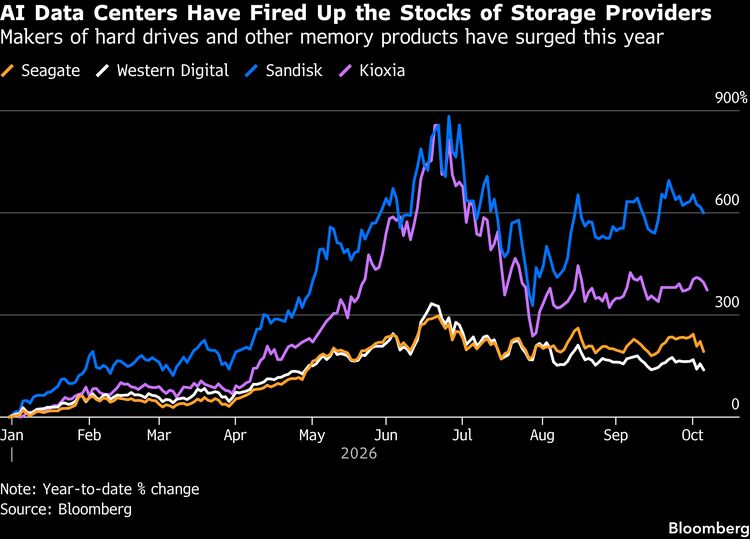
Fast-moving AI data-center operators now are demanding hard-drive suppliers pack ever more storage into limited spaces. Prices are climbing and net income at Seagate and Western Digital Corp. — which together control more than 90% of the global HDD market, according to research firm TrendForce — has grown by multiples in recent quarters.
A deal for TDK’s HDD components business reflects a fierce race for the power to control technological development and limited manufacturing resources. It also raises the question: Is there room for three HDD producers?
If Seagate were to win the deal, that would be a blow to Toshiba’s ability to produce HDDs just as AI data center demand for all memory and storage products is surging. It would also mean more market share for both Seagate and Western Digital, according to Hideki Yasuda, an analyst at Toyo Research Advice Co.
“The likelihood of the HDD market becoming duopoly between the two US companies is very high if Seagate wins,” he said.
| Read more |
|---|
|
Seagate, Toshiba Said to Vie for TDK’s Hard-Drive Head Unit Seagate Falls on Report of Interest in TDK Unit: Street Wrap WD CEO Is Focused on Making Bigger Hard Drives, Not More of Them Seagate at the Center of AI Storage and Data: Tech Disruptors |
TDK is the only independent maker of HDD magnetic-recording heads — the part of a hard drive that actually records and retrieves data. Toshiba’s offer is lower than Seagate’s, according to people familiar with the matter, although it’s possible that it will raise its offer, given it has more to lose, they said.
Toshiba, whose products span nuclear reactors and defense equipment, was taken private in 2023 and is seeking an initial public offering as early as in fiscal 2028. A key part of its comeback and future growth hinges on its HDDs, which all use TDK’s magnetic heads.
If Toshiba loses the deal but is able to wrangle an agreement to procure HDD heads from Seagate, that would still eliminate the Japanese company’s competitive edge as the US company would have visibility into everything Toshiba is trying to do, Yasuda said. “For Toshiba, this is a deal it has to win at almost any cost.”
Toshiba has long relied on outside suppliers for key HDD parts to keep pace with advances in data storage.
While that approach helped lower Toshiba’s capital spending, it’s now putting it at a disadvantage against its bigger rivals, which are ramping up output far quicker. Toshiba also depends entirely on Resonac Holdings Corp. for platters, the circular disk inside hard-disk drives. Both US companies make such essential components in-house.
Discussions continue between Toshiba, Seagate and TDK around ways for TDK to continue to supply its customers should a deal go through. Any acquisition would also likely trigger scrutiny from antitrust regulators, as well as from a Japanese government that sees Toshiba as strategically important.
What Bloomberg Intelligence Says
A deal for Toshiba — which denied any three-party discussions over head supplies — could remove a key supply and technology dependency, while a win for Seagate could make Toshiba’s already ambitious 30% share target even harder to reach. Toshiba remains years behind STX and WDC on leading-edge drive density, critical in AI data centers where higher-capacity drives reduce rack space, power and infrastructure per exabyte.
Click here for the report.
-Derek Mogull and Woo Jin Ho, industry analysts
The HDD industry — which is competing with pricier solid-state drives inside advanced data centers — is moving toward heat-assisted magnetic recording, a technology that enables the storage of far bigger volumes of data. Seagate has already begun mass-producing such drives, while Western Digital is set to follow suit next year.
Toshiba, which has a midterm target to raise its share in the HDD market to 30% from roughly 10% now, is waiting for TDK to mass-produce such heads. TDK expects to be able to do so only in 2028 .