BE Semiconductor Industries NV shares once rode high on optimism over its next-generation chip technology. Now, the global memory shortage has thrown the pace of adoption into doubt, and the market is losing patience.
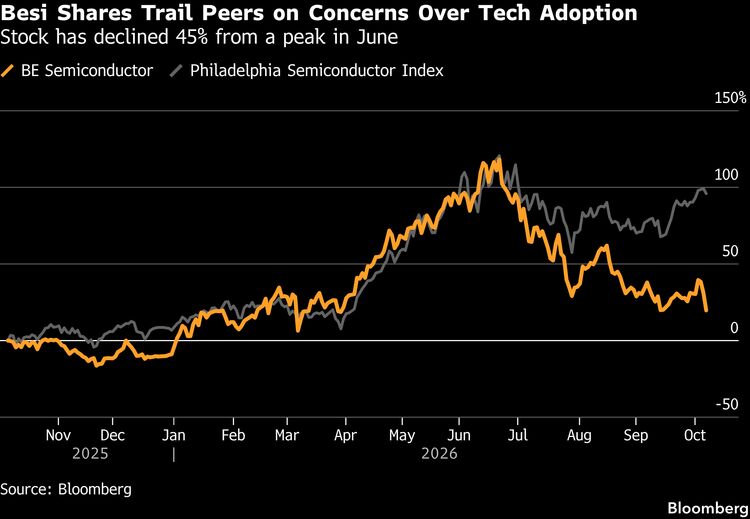
The stock is down 14% this week, with losses accelerating after UBS Group AG downgraded it to sell from buy on lower earnings expectations, a day after Bank of America cut it to neutral . That deepened a selloff that made Besi the Stoxx 600’s worst performer between June and September.
The world’s leading maker of hybrid-bonding equipment, Besi’s flagship technology directly connects semiconductor components to enhance computing performance in a smaller space. Investors had bet on rapid adoption by chipmakers, but the memory crunch and cost concerns threaten to push that transition further out.
“There are all these other factors involved that have a number of inputs driving them, and none of that is really in Besi’s hands, unfortunately for them,” said Barclays analyst Simon Coles, who holds an equal-weight rating on the stock.
As it gets harder to make individual chips smaller, the industry is seeking other ways to improve performance. One approach is to connect several chips together or stack them on top of each other. Doing so requires specialized tools, such as Besi’s hybrid bonding machines.
For investors, the concern is whether Besi’s technology remains relevant if the memory architecture is actually getting simpler, rather than more complicated.
Nvidia Corp.‘s AI accelerator Rubin Ultra, set to be released next year, will use fewer memory layers than the current generation according to independent research firm Semianalysis, a stopgap measure to allow more AI chips to be shipped despite the memory supply constraint.
Besi had projected that each memory component that goes into Nvidia’s AI accelerators will become increasingly intricate, to the extent that chipmakers turn to the Dutch firm’s technique to squeeze stacks of memory chips into a package thinner than a credit card.
A spokesperson for Besi did not respond to a request for comment.
Advanced Micro Devices Inc. is an early adopter of Besi’s technology, using hybrid bonding in its Ryzen 7 processors in 2022. But it’s taking longer for the tech to gain traction among memory chipmakers. That’s because for hybrid bonding to work, it’s not just about using Besi’s tools, said Myron Xie at SemiAnalysis.
It also involves costly preparation steps to make sure the two chip surfaces are almost perfectly smooth. For high bandwidth memory, the cost of using hybrid bonding is “probably not worth the incremental benefit,” Xie said.
Read More: ASML’s Chip Technology Move Threatens Besi Shares, BofA Says
There are trade-offs: by avoiding hybrid bonding and packing fewer silicon layers, the amount of workload that one memory unit can handle becomes more limited. While that’s not ideal for AI computing, there are workarounds, according to Xie. Workloads can be spread across multiple units, while newer AI models are being designed to use less memory.
Bullish analysts see it through another lens. In an ideal world where supply is plenty, AI models should run on memory modules that have more capacity, not less. So if memory supply eventually catches up with demand, which could happen in 2028, according to Bernstein analyst David Dai — Besi’s hybrid bonders should be called into use.
“The thesis is still intact,” Dai said. Hybrid bonding is needed in the long term, he added. Dai cited South Korea’s semiconductor giant SK Hynix Inc., which is yet to adopt the tech in a big scale but highlighted its benefits at a closely followed conference in August.
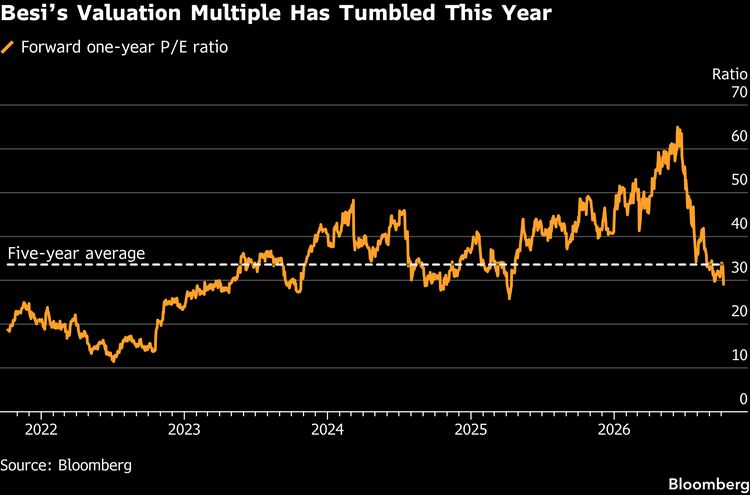
Having fallen 45% since late June, Besi shares currently trade at about 29 times next year’s earnings, less than half of its peak valuation roughly four months earlier. Still, that’s unlikely to be the biggest focus for Besi investors, Barclays’ Coles said.
“For the last three, four years, the Besi story has predominantly been about hybrid bonding,” said Barclays’ Coles. “If hybrid bonding adoption momentum is positive, the shares will do well. And if there’s uncertainty on hybrid bonding outlook, then the shares are going to struggle, like they have done this summer.”