
When the well-known hedge fund Sachin Gupta worked for closed last year, he did what star traders with a track record of moneymaking ideas have been doing for decades: He started his own firm. Gupta, now 37, secured $250 million in backing from Blackstone Inc., one of the biggest and most prestigious investors in the industry, and if the other promising portfolio managers who’d gone before him were any indication, he would soon be overseeing a billion dollars or more from pensions, foundations and sovereign wealth funds.
A year in, while Gupta’s Covara Capital has seen some gains, it’s managing just $265 million, barely more than what Blackstone handed him in the first place.
In the world of hedge funds, coming from a big-name firm or getting a well-known backer used to almost guarantee a billion-dollar start, but Gupta’s less-than-stellar launch is endemic of a major shift in the industry: As the biggest hedge funds get even bigger, early-stage vehicles like Gupta’s are finding there’s scant financing left for newcomers. “It’s harder to get a new fund off the ground,” says Adam Blitz, a longtime hedge fund investor whose Evanston Capital Management has farmed out about $4 billion to such firms. (Gupta declined to comment on his money-raising efforts.)
The greatest challenge facing a would-be hedge fund titan today is that the largest firms keep expanding to previously unfathomable sizes, crowding out their smaller competitors. Each of the top 10 funds oversees at least $75 billion, and a few are nearing or have even surpassed $100 billion. Izzy Englander ’s Millennium Management, for instance, just raised $22 billion , showing that investors would rather seek out an established player who reliably generates double-digit returns than try their luck with a newbie. Blitz estimates the industry is seeing half the number of launches it did just five years ago.
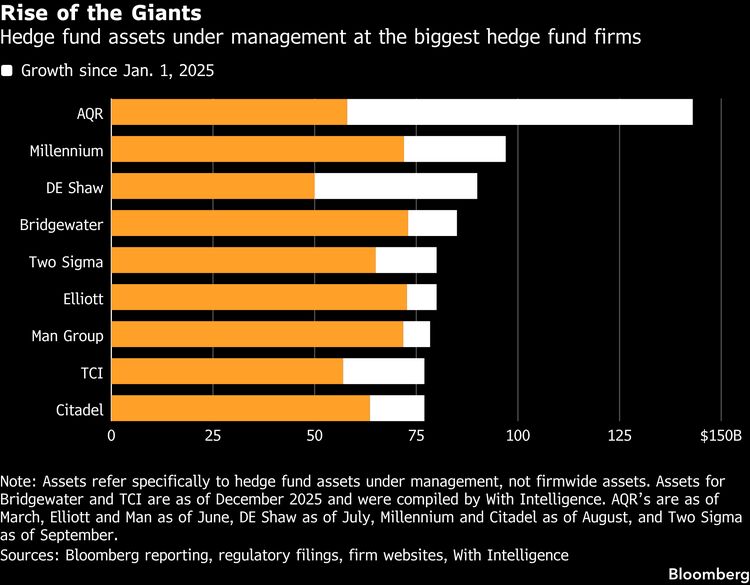
Investors are worried about the shift. A concentration of talent in a handful of large firms creates a lack of diversity in how money is managed, which could make markets riskier and more volatile. Many of the biggest firms tend to invest similarly, and in times of distress they often sell at the same time.
Starting a hedge fund used to be a lot easier. In 2005 a record 12 firms opened with more than $1 billion, according to Bloomberg calculations. This year through the end of September, there’s been only one such megalaunch . Starting big matters. A new firm that begins with $1 billion or more has an 84% chance of staying in business for at least five years, according to a report compiled by Goldman Sachs Group Inc. Managers who begin with $25 million have less than a 50% chance of making it and more often close in about three years.
A growing number of talented investors have decided not to try. One recent example is Kelly Granat. Among the most senior women in the $5.6 trillion hedge fund industry, she worked for two decades at the well-established Lone Pine Capital, where she was named co-chief investment officer when her boss, founder Stephen Mandel, decided to step back to let the next generation run the firm. Several Lone Pine alumni eventually left and opened their own shops. Granat had no interest in doing that, according to people who know her. Wanting to focus on public and private technology companies, she took a role as co-chief investment officer at another firm, Boston-based Atreides Management. Although there are plenty of reasons a manager might choose the career path they do (Granat declined to comment on her move), her decision not to launch her own fund surprised others in the industry, as she would have been one of the few who could have raised billions of dollars, said one of these people who asked not to be identified discussing a private fund.
Others are striking out on their own and then changing tack. Geoffrey Lauprete, formerly chief investment officer of WorldQuant, left the quant behemoth in 2024 and planned to start his own shop. He had been in talks with Blackstone and Paloma Partners, which were potentially interested in backing his new fund, Libero Capital. But late last year he ditched the effort and joined Steve Cohen ’s Point72 Asset Management instead, becoming head of its quant business.
While the difficult money-raising environment won’t necessarily stop a good portfolio manager from having a high-paying career, it seems to have quashed, or at least slowed, the next generation’s dream of creating a big firm of their own. Take Connie Lee. She left Tiger Global Management, a large technology-focused stock fund, in 2023 because she always wanted to build her own business. “I come from a long line of entrepreneurs,” Lee said in a 2025 interview with Hedge Fund Alpha , an industry publication. Her father, an executive at South Korean conglomerate LG Corp., had brought the family to the US for his job when Lee was a child. “My dad ended up leaving LG and becoming a small-business owner,” she said, adding that her grandparents, who fled the Korean War, “took our family out of poverty by building their own businesses. So, for me, it’s been a really big inspiration in terms of what I’m doing today.”
Lee, who declined to comment on her money raising, finally launched her own fund, Felis Advantage, in March, roughly three years after leaving Tiger. She amassed $150 million, anchored by a large endowment, according to a regulatory filing and a person familiar with the fund who asked not to be named discussing nonpublic information. That’s a relatively small start for someone who came from one of the most respected stock funds in the industry.
As nascent funds struggle to get off the ground, Englander’s Millennium has offered perhaps the most viable alternative to portfolio managers who decide not to go it entirely alone. In a fairly new model, Millennium has seeded dozens of smaller external hedge funds, often writing multibillion-dollar checks, with the practice picking up pace in recent years. In some cases, the new funds manage money solely for Millennium; in other instances, they can seek other clients too. That has let the firm pull in established managers under its umbrella, including some high-profile former employees, while continuing its own growth.
The biggest name to make that kind of move this year was Jain Global, a $5 billion hedge fund with seven distinct business lines that Bobby Jain built after leaving Englander’s employ in 2023. Jain
returned all of his external clients’ cash
earlier this year to manage money exclusively for his old boss. Even with $5 billion, it was going to take too long to get big enough to compete.
Read next:
How to Get a Job on Wall Street