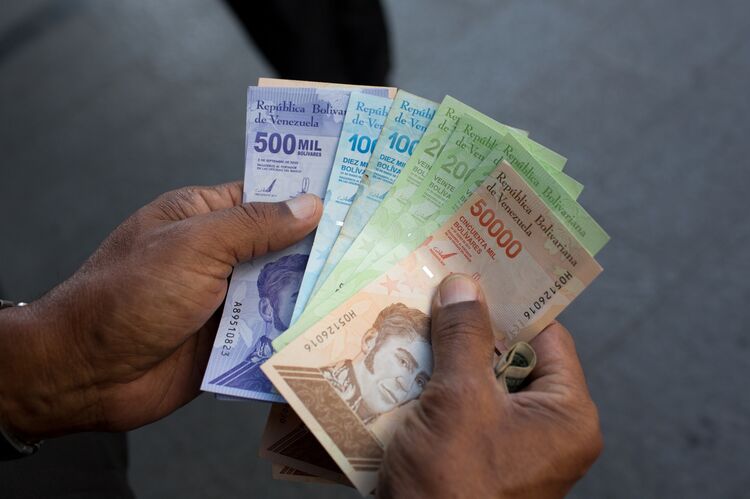
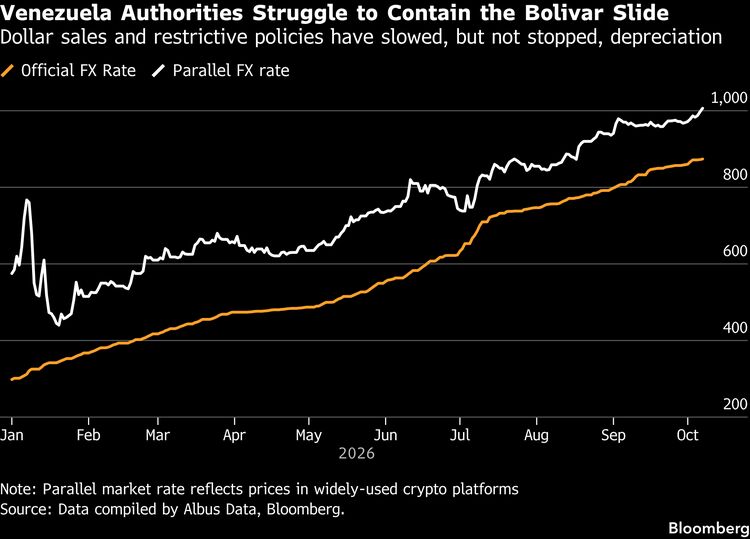
Venezuela’s bolivar weakened past 1,000 per dollar in the parallel market for the first time, testing authorities’ efforts to contain its slide amid declining government sales of hard currency.
The battered bolivar hit the symbolic milestone this week in crypto markets, where the price of Tether’s USDT stablecoin is widely used as a proxy for the unofficial exchange rate. The gap between that rate and the official exchange rate widened to 15%.
The government had managed to keep depreciation relatively contained by supplying billions of dollars to the currency market, but those sales have declined steadily over the past three months. They fell to $1.4 billion in September, the lowest since April, according to data from Caracas-based consultancy Sintesis Financiera.
To contain the impact in currency markets, the central bank introduced new measures last month to squeeze bolivar liquidity in the local financial system, but their effect is yet to be seen.
Read more: Venezuela Squeezes Banks as Higher Spending Tests Bolivar
“There are still adjustments to be made to these foreign-currency flows,” Venezuela’s President Delcy Rodríguez said Thursday at a business event in Caracas, while highlighting a narrowing of the exchange-rate gap to a level she described as “more appropriate” for productive sectors.
“But foreign currency for the country must definitely be guaranteed,” she added.
Pressure on the currency could intensify as government spending picks up toward the end of the year, injecting more bolivars into the economy.
“Public spending will have to rise in October,” analysts at Caracas-based Sintesis Financiera, a financial consultancy, wrote in a report this week. “We forecast a 20% acceleration in public spending, typical of the fourth quarter.”
Controlling the exchange rate has been a key element in Venezuela’s policy to tame inflation. Consumer prices accelerated 225.3% through September, though monthly inflation has held near 8%, according to central bank data.
The government has sold more than $12 billion in the currency market this year using funds from oil revenue, which are closely overseen by the US ever since the capture of strongman Nicolás Maduro in early January. Economists have warned that relying on continued dollar sales to defend the bolivar will become increasingly difficult if the supply of hard currency declines while domestic spending rises.