Artificial-intelligence regulation, along with government spending on healthcare and defense are emerging as equity investors’ chief points of focus as the final month of the US midterm campaign kicks into high gear.
Polls show the Democratic Party as a heavy favorite to win control of the House of Representatives, with an edge in key Senate races as well. Taking at least one chamber of Congress would give the party control of committees that can propose legislation and open investigations.
Concerns about AI cross party lines, with voters worried about potential risks along with job losses and higher electricity prices. Some Wall Street strategists are positioning for a push from Democrats for tighter regulation, which could fuel selling pressure .
“The midterms will be critical not for the immediate risk of federal policy restricting data centers but to lay the groundwork for potential legislation toward that end in 2029,” Ariana Salvatore, head of US public policy research at Morgan Stanley, said in a note.
History suggests that whatever happens, the midterm elections are unlikely to knock the stock market off its course. The S&P 500 Index has risen in the 12 months after every midterm election since 1946, according to Wells Fargo. President Donald Trump’s veto powers can keep Democrats in check, a recipe for government gridlock that might create stability for investors. The Cboe Volatility Index signals little election-related turmoil, making it cheap to bet on price swings picking up.
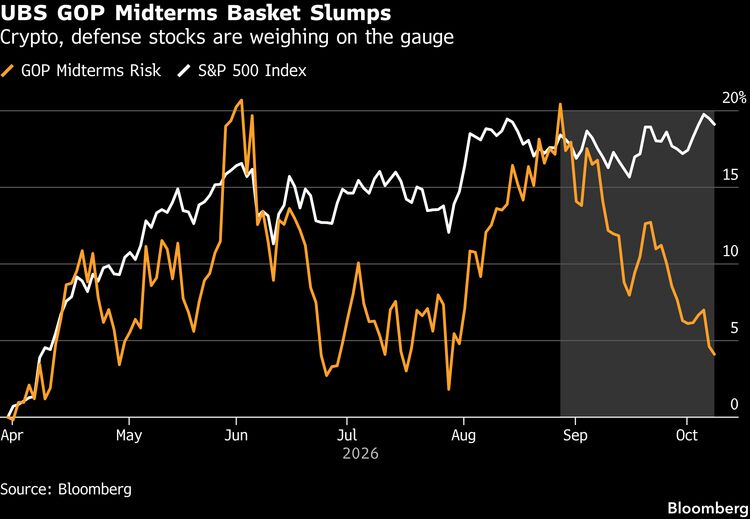
Yet under the hood, unease about the upcoming elections may already be influencing the market. A UBS election basket, made up of stocks that should underperform if Republicans lose ground in Congress, is badly lagging the broader market since late August. The biggest drags on the gauge since then include crypto exchange Coinbase Global Inc., bank Morgan Stanley and military contrator L3Harris Technologies Inc.
Banks and industrials, which are sectors that “typically do better under Republican policies,” have recently weakened, Manulife John Hancock Investments strategist Matt Miskin said. That may signal the market is “pricing in a bit more of a blue wave.”
Compared with the 2024 presidential election, “the equity impact for the upcoming midterms across election outcomes scenarios will likely be more nuanced and favor stock picking,” JPMorgan Chase & Co. strategists led by Dubravko Lakos-Bujas wrote in a note.
Here are the sectors worth watching with less than a month to go before the vote.
Technology and AI Infrastructure
Over the next two years, Trump is likely to veto any legislation that’s too unfavorable to the technology industry. That may limit risk to fundamentals for chipmaker Nvidia Corp., the AI rally’s poster child, and megacap peers like Alphabet Inc., Meta Platforms Inc. and Microsoft Corp.
Data center real estate investment trusts and neocloud companies are negatively exposed to potential legislative proposals to levy a tax on computing power, according to Morgan Stanley analysts. Off-the-grid power providers like Bloom Energy Corp., Cummins Inc. and GE Vernova Inc. may get a boost from more restrictive policies, the analysts said.
| Read more: |
|---|
|
AI Trade a Key Concern as Stock Investors Map Election Risks Brent Rises on Report US Seeks Iran Strike Options Pre-Midterms Midterm Elections Are Potential Test for US Defense Investors |
Healthcare
Hospitals may benefit if Democrats manage to walk back Medicaid cuts included in last year’s tax and spending bill, said Tobin Marcus, head of US policy and politics at Wolfe Research.
Democrats looking for concessions in a possible debt ceiling negotiation next year may seek wins in healthcare, he said.
Hospital names like Acadia Healthcare Co., HCA Healthcare Inc. and Tenet Healthcare Corp. have near-term upside linked to the election, according to Jefferies analysts. Insurers Centene Corp. and Oscar Health Inc. may see “buying pressure” on the hope that Democrats will negotiate to restore enhanced Affordable Care Act subsidies that expired at the end of last year, though the firm sees reestablishing them as a long shot.
Defense
Shares of defense contractors have underperformed this year amid worries a potential Democratic takeover of Congress could lead to tighter oversight and funding delays. That sets up a “very wide” range of outcomes for spending in the fiscal year that started Oct 1., according to Melius Research. The Department of Defense’s budget would effectively fall 15% if legislative gridlock means it’s funded by a stopgap measure for the full year, analyst Scott Mikus wrote in a note.
Read More: Risk of Midterm ‘Blue Wave’ Leaves Defense Stocks Out of Favor
If Republicans hold their ground in both chambers, spending could rise and become a tailwind, according to JPMorgan. The firm’s analysts point to L3Harris Technologies Inc., Lockheed Martin Corp. and Northrop Grumman Corp. as possible beneficiaries.
Financials and Crypto
Republicans tend to favor lighter oversight of the financial sector, leading JPMorgan analysts to predict that a surprise sweep by the party could favor banks such as Bank of America Corp., Citigroup Inc. and Wells Fargo & Co.
Still, independent agencies and the executive branch wield a great deal of power over regulatory policy. With the heads of the Federal Reserve, the Federal Deposit Insurance Corporation and the Office of the Comptroller of the Currency likely to remain in place for the next several years, the election is unlikely to alter things like bank stress testing, Barclays analyst Jason Goldberg said in an interview.
In cryptocurrencies, the odds for any legislation may decline if Democrats take control. Democrats, along with a few Republicans, blocked the advancement of the Clarity Act in September, sending stocks such as Coinbase Global Inc. and Circle Internet Group Inc. tumbling.
Housing
Trump and housing official Bill Pulte have offered initiatives aimed at addressing housing affordability, but few have helped. Data in September showed the median home sales price rose 1.6% from a year ago to $429,100. That, along with spiking mortgage rates , poses an issue for homebuilders and related sectors. The S&P 500 Homebuilders Index has tumbled 25% since its mid-February peak.
Once the midterms are over, Congress may increase its focus on housing, according to Isasc Boltansky, PennyMac’s head of public policy. Easing supply constraints will be a “durable bipartisan priority, giving us a clear launchpad for the next Congress,” Boltansky said.
Recently, Pulte renewed attacks on credit-score related companies, pressuring shares of firms like Fair Isaac Corp. and TransUnion. Mortgage finance giants Fannie Mae and Freddie Mac soared after Trump’s 2024 win on optimism the administration would lift government control. They’ve since retreated as any potential action appears to be on hold.
Potential Probe Targets
Wall Street is bracing for Democrats to hold hearings and launch a wide range of investigations, with Evercore ISI telling clients that probes focused on AI could create market risk. The firm also expects probes into sectors related to affordability challenges that loom large for voters, including energy, healthcare, food and agriculture.
Strategists are preparing for potential scrutiny of companies that have won equity investments from the US government, creating risk to their brands and share prices. That’s a broad group that includes chipmaker Intel Corp., tech stalwart International Business Machines Corp. and rare earth producer MP Materials Corp., among others.
Read More: Trump Backlash Adds New Risks to the Stocks the Government Owns