
The Federal Reserve said income inequality fell over the last three years, but the change did little to narrow persistent wealth disparities.
Lower-income families saw modest pay gains overall in the three years through 2025, according to the Fed’s Survey of Consumer Finances released Friday. Incomes declined for those at the top end of the distribution, who derive a large share of their income from more volatile components such as capital gains and businesses.
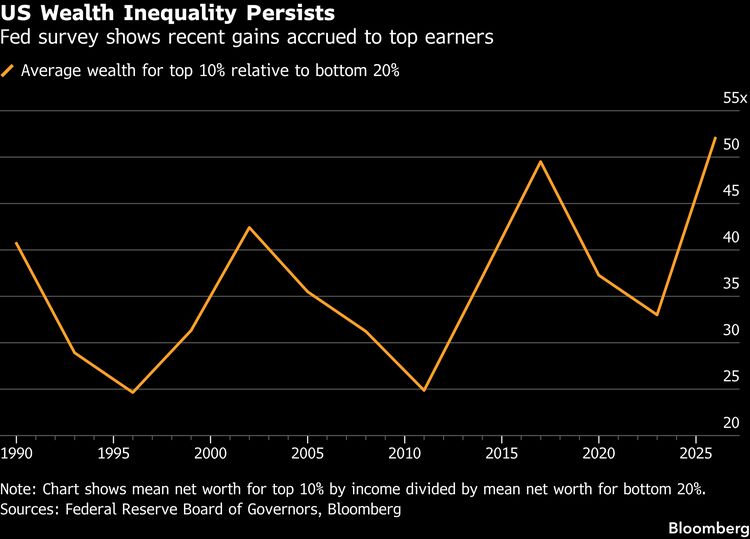
The wealth gap remained wide, the report shows. Americans’ median net worth rose 2% to $215,900, while average net worth rose 7% to $1,241,500. The disproportionate average gains underline the wide wealth gap, with the top 10% of earners holding over 50 times more wealth on average than the bottom 20%.
The triennial survey is widely regarded by economists as the most comprehensive data on the economic well-being of American households, including changes in wealth, income, debt and financial security.
The data help shed light on the divergence between the stock market, which in recent years has pushed to new highs, and measures of consumer sentiment, some of which are hovering near record lows. The wealthiest Americans own vastly more stocks than lower-income families.
Read More: US Consumer Sentiment Falls to Five-Month Low in October (1)
The report showed a decline in the share of families who owned stocks between 2022 and 2025, to 56% from 58%. That coincided with a nearly 80% rise in the S&P 500 index, and the Fed said those in the bottom half of the income distribution “accounted for nearly all of the overall decline in participation” in the stock market over that period.
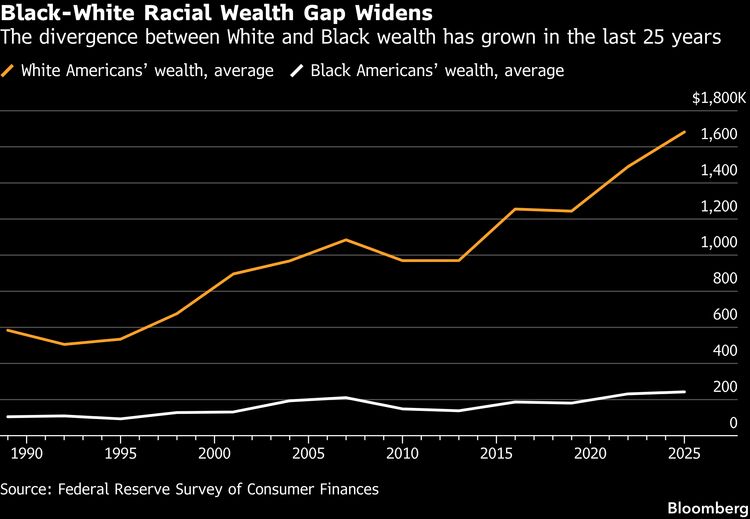
The findings showed unequal gains by race and ethnicity. Incomes declined, on average, for Black and Asian families. The racial wealth gap also widened slightly for Black Americans, who had one-seventh the wealth of White Americans in 2025 — a ratio that remains largely unchanged from where it stood in 2010. The median Black family saw wealth plummet 25%.
The new data show how the economy has evolved from earlier in the decade. Americans have spent down their pandemic savings and are now increasingly turning to debt and other methods to maintain spending, which has remained robust even as inflation outstrips wage gains.
Though the share of families with any type of debt remained stable at 77%, the report highlighted “an important indicator of potential financial distress,” the proportion of families with particularly large debt burdens. Some 8.6% of families had payment-to-income ratios greater than 40%, the largest share since 2010, according to the figures.