As Brazilian markets opened for business on Monday, Pradeep Kumar watched a move unfold on his screen that was unlike anything he’d encountered in his two decades trading the country’s assets.
Interest-rate swaps — which reflect where traders expect borrowing costs are headed — immediately plunged 90 basis points, the maximum allowed by the exchange. The limit was widened and then loosened again later in the session, as the results of Sunday’s presidential election led investors to price in higher odds of a change in government — and, with it, the prospect of fiscal steps that might allow for double-digit interest rates to fall.

“I’ve never seen this kind of move,” said Kumar, a portfolio manager on the emerging-markets debt team at $1.5 trillion asset manager PGIM in Newark, New Jersey. “Nobody wanted to miss this trade.”
It was just the start of the week’s superlatives for Brazilian assets after right-wing candidate Flávio Bolsonaro’s stronger-than-expected showing against incumbent Luiz Inácio Lula da Silva in a first-round vote.
Read more: Brazil Market Euphoria Hinges on Fixes Bolsonaro Hasn’t Laid Out
Trading in the largest exchange-traded fund tracking Brazilian stocks, which goes by the ticker EWZ, surged to a record on Monday. That ETF and the Ibovespa index are headed for their best week since 2020, up 14% and 8.8%, respectively. The real has climbed more than 4% and is on track for its strongest week since 2022.
The frenzy, traders say, reflects both the appetite for trades driven by country-specific catalysts at a time when global risks are buffeting markets everywhere — and just how unprepared investors were for the scale of Bolsonaro’s performance.
Brazil was already offering investors some of the highest interest rates in emerging markets, with a benchmark rate at 13.75%. And Sunday’s surprise came just as global investors were holding more cash than usual, leaving plenty of money on the sidelines to flow into Latin America’s largest economy, said Raghav Adlakha, a strategist at Bank of America Corp.
“It was a bit of a perfect storm” on Monday, Adlakha said.
Many traders had steered clear of outright bets ahead of a vote that was widely seen as a coin toss . While the Brazilian real had been a favorite among carry traders this year, the local rates market reflected greater caution over the risks.
The sharp swings also highlight the potential peril that money managers face in the weeks ahead: Bolsonaro still has to turn his momentum into a runoff victory, with the next vote slated for Oct. 25, and he has yet to offer details for the fiscal overhaul investors are betting on.
“The market is eager to create a narrative that Brazil will no longer be ‘the country of the future,’” said Luis Estrada, a strategist at RBC Capital Markets. “I’m being sober about it.”
Estrada sees the main risks as an about-face in markets if Lula wins — a scenario he considers unlikely — or the potential for disappointment with Bolsonaro’s plans.
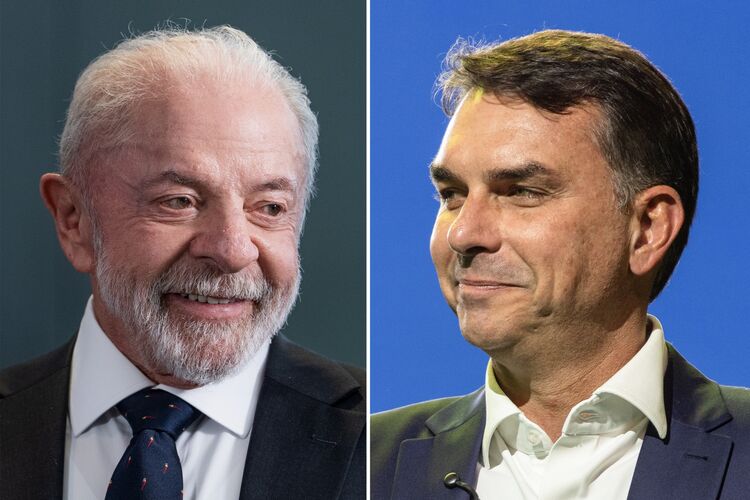
During Lula’s third term, debt as a share of gross domestic product has risen by roughly 10 percentage points, to 82.6% in August from 73.1% when he took office in January 2023, according to central bank data. A fiscal surplus of 2% to 3% of GDP is needed to stabilize the ratio, compared with a deficit of 0.6% in the 12 months through August, according to data from Bloomberg Economics and the central bank.
Read more: Hedge Funds That Won Big on Brazil Vote Bet on More Gains
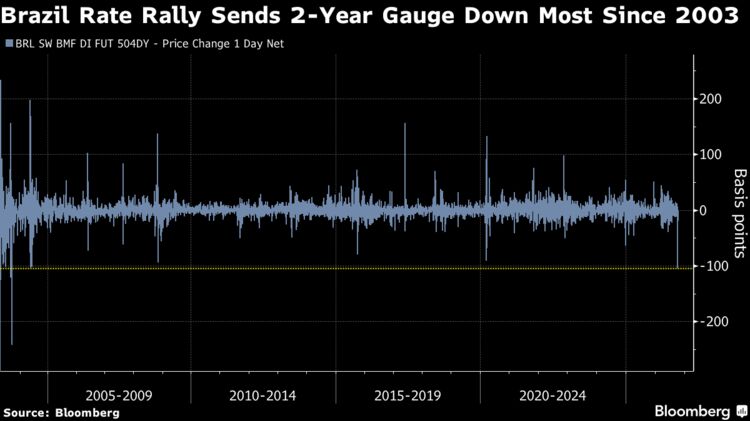
In the swaps market on Monday, an instrument representing the implied rate for a roughly two-year maturity posted its biggest decline since 2003.
That was just a year after Milena Landgraf started trading Brazilian rates. Now a partner at money manager Jubarte Capital, Landgraf is sticking with positions that profit from lower rates. She expects Bolsonaro’s economic proposals and, should he prevail, the makeup of his economic team to provide the next catalysts for local markets.
Read more: Bolsonaro’s Potential Finance Chief Wants Fast Fiscal Policy Fix
While a chunk of the upside potential has already been priced in, BofA’s Adlakha says, he sees room for the rally to extend in the short term.
“There’s still some risk premia in long-end bonds, but most of the premium in front-end rates has been squeezed,” said Adlakha. Historically, DIs, as the interest-rate swaps are known, “trade better on momentum than value,” he said.