
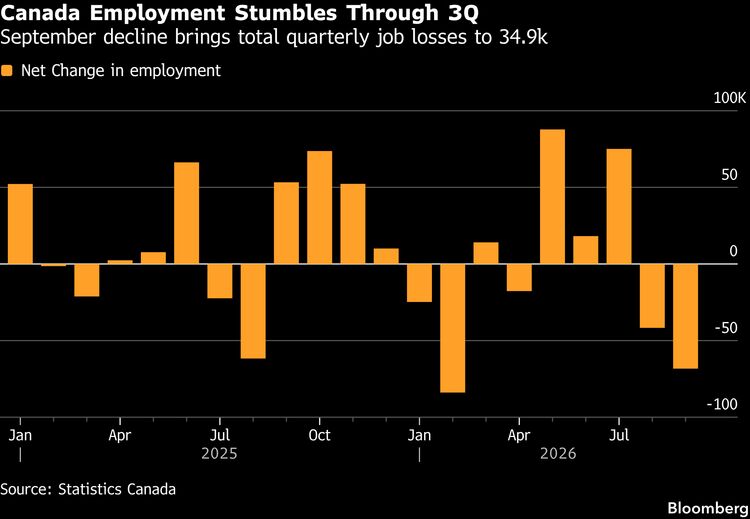
Employment in Canada fell by 68,300 last month, more than erasing previous job gains this year as the trade war with the US drags on.
The unemployment rate ticked up to 6.5% in September from 6.4% in August, Statistics Canada reported on Friday.
The job loss reflected a decrease in public sector employment, which fell by 70,000. Education led the decline, with 35,300 fewer people working the sector. Employment also fell in healthcare and social assistance by 23,100.
Manufacturing saw a decrease in employment of 12,700.
While the job losses last month were driven by the public sector, the cumulative decline in employment since the start of the year paints a sluggish picture of the labor market. Employment fell in Canada by 41,200 since December 2025, the largest year-to-date loss since the 2009 financial crisis, excluding 2020 during the Covid-19 pandemic.
The September data also gives the first glimpse of the impact of so-called Section 338 tariffs on the Canadian economy. New 50% US tariffs on $20 billion of Canadian goods took effect on Aug. 22 after the breakdown in trade negotiations between the two countries, while retaliatory tariffs on US goods kicked in on Sept. 8. Job losses in August and September total 110,000.
The trade war escalation is expected to weigh on the economy, but the Bank of Canada has put more emphasis on inflation risks, as the Iran war continues to drive up energy prices.
Bank of Montreal chief economist Doug Porter said the sharp decline in education, which was concentrated in Quebec, may reflect a decrease in international students.
Still, “the underlying picture in other regions and industries does not inspire confidence,” he said in a note to investors, adding that “the pullback in manufacturing may be an early warning of the weight from the amped-up trade tussle.”
Bonds rallied, with the two-year Canadian government note yield falling 4 basis points on the day to 3.203%. The Canadian dollar tumbled as low as C$1.4299 per US dollar, the lowest since April 2025, before paring those losses to trade at C$1.4276, down 0.3%, shortly after 9 a.m. New York time.
Economists surveyed by Bloomberg had expected the economy added a modest 10,000 jobs and the unemployment rate ticked up to 6.5%.
Charles St-Arnaud, chief economist at Servus Credit Union, said the latest data suggests economic resilience in recent months is not translating to job market improvements, adding to the Bank of Canada’s monetary policy dilemma.
“On one hand, the outlook for the domestic economy remains uncertain, with a weak labor market and a likely slowdown in growth in coming months because of the intensification of the trade war. On the other hand, high fuel prices risk fueling broader inflationary pressures,” St-Arnaud said in an email.
St-Arnaud said he believes the central bank will opt for “patience” and keep its policy rate unchanged for the remainder of the year, unless there are signs of inflationary pressures broadening.
Traders in overnight swaps had priced in a rate hike by December prior to the labor force survey release, but those expectations eased slightly after the print.
Governor Tiff Macklem warned last month that being too slow to hike could force the central bank to raise higher and faster later.
Read More: Canadians Expect Higher Inflation as Bank of Canada Weighs Hikes
The bank will get a final reading on inflation on Oct. 19 ahead of its rate decision at the end of the month.
Friday’s report also shows the participation rate declined by 0.2 percentage points to 64.8%, marking the lowest level since December 1997 — excluding 2020 during the pandemic.
StatCan says the decline in the participation rate can be attributed largely to population aging , and says this trend is expected to continue, despite older Canadians participating in the labor market at higher rates compared to previous cohorts.
Meanwhile, employment increased in September in other services by 17,000, which includes repair and maintenance as well as personal or household services.
The average hourly wage for full-time permanent employees rose by 2.3% from a year ago, matching economists’ expectations, and up from 2% the previous month.