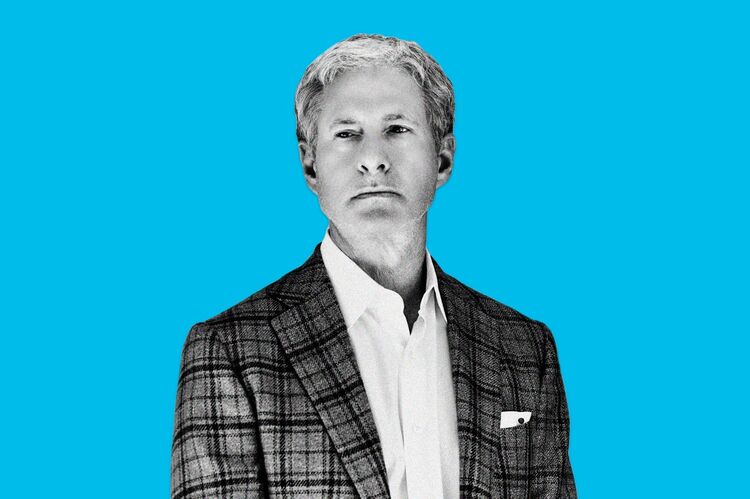
Crypto billionaire Chris Larsen , one of San Francisco’s top political donors, is stepping onto the national stage.
Larsen emerged as a major player in federal politics this election cycle, spending tens of millions of dollars on some of the midterm’s biggest issues: artificial intelligence, clean energy, cryptocurrency and taxing the ultra-wealthy. He’s given at least $22.5 million directly to federal candidates and super political action committees — and plans to go even bigger.
“If you’re going to be effective when it comes to politics and policy, you’ve got to be showing up cycle after cycle after cycle,” he said in an interview.
Larsen, 65, the co-founder and chair of blockchain payments company Ripple, is worth $13.3 billion, according to the Bloomberg Billionaires Index .
Larsen gained national attention in 2024 when he donated $11.6 million to a super PAC supporting Democratic presidential candidate Kamala Harris. But he’s best known for his political work in San Francisco, where he’s drawn protests for funding police surveillance technology, fought labor unions and written record checks to support centrist Democratic candidates.
Money from his company has flowed to Republicans as well: Ripple gave $4.9 million to President Donald Trump’s inauguration committee last year.
Larsen says several forces have pushed him deeper into “national and global” issues this year: climate change; the existential risks posed by AI; the growing influence of progressives within the Democratic Party; and what he calls the “wimpy” clean energy sector.
His political giving is quick, pugnacious and often runs against the zeitgeist. While some major donors plan their spending months or years in advance, Larsen’s biggest checks this year have often been triggered by frustration with individual political decisions — particularly those made by his peers in crypto and tech.
‘Poor Decision’
Last month, he was incensed when crypto industry super PAC Fairshake said it planned to spend $30 million to defeat Democratic Senate candidate Sherrod Brown of Ohio, a longtime industry target. Within days, Larsen personally injected $4 million into Brown’s campaign — a striking rebuke of Fairshake, which was heavily backed by his own company, Ripple.
“It was a really poor decision,” Larsen said, breaking with Fairshake publicly for the first time after his company poured $25 million into the super PAC this year. “I’ve had a lot of conversations with him. He is not anti-crypto.”
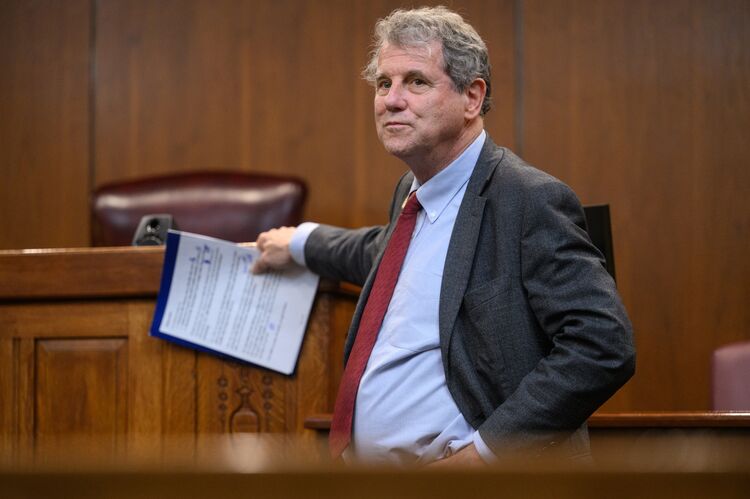
“He’s not a coastal lefty, and I think Fairshake is treating him like a lefty, like Bernie Sanders or Elizabeth Warren,” Larsen said. “I think they’re making a big mistake there.”
Brown’s campaign didn’t respond to a request for comment.
Ripple has given a total of $93 million to Fairshake, including $48 million this cycle, making it one of the group’s top funders alongside Coinbase Global Inc. and Andreessen Horowitz. Ripple Chief Executive Officer Brad Garlinghouse and Larsen are now evaluating whether to keep funding Fairshake, with Garlinghouse making the final decision, a Ripple spokesperson said.
“At the end of the day, Ripple and the whole industry should be reassessing our engagements in Washington,” Garlinghouse said in a statement. While he said no decision has been made, “To say we aren’t supporting Fairshake right now is not accurate.”
A spokesperson for Fairshake declined to comment.
Larsen has taken a similarly contrarian approach to AI. In April, he gave more than $4.5 million to a new super PAC, You Can Push Back, to counter pro-AI group Leading the Future. The spending came after Leading the Future, backed by venture capitalist Marc Andreessen and OpenAI President Greg Brockman, announced plans to spend as much as $10 million opposing AI safety-focused candidate Alex Bores in New York’s 12th Congressional District.
You Can Push Back spent nearly $3.4 million on Bores’ unsuccessful campaign, a one-off effort that Larsen said was intended to show the AI industry there would be consequences for targeting candidates seeking guardrails on the technology.
Larsen now plans to support more candidates seeking to rein in AI. In September, he gave $500,000 to the congressional campaign of Manny Rutinel, a Colorado state lawmaker who helped pass an AI safety bill.
Still Larsen distinguishes between what he calls “AI safety” and “AI sanity.”
“AI safety means you’re Bernie Sanders and want to shut it down,” Larsen said, again invoking one of his favorite political foils. “I don’t want to do that. I think, go out 10 years, this could be the greatest thing that ever happened to the world. The problem is we’ve got to survive 10 years, so we need strong guardrails.”
Several AI safety groups have approached Larsen about funding new projects, according to a person familiar with the outreach, though he declined to say whether he plans to donate. He’s also sought to bring together California labor and business leaders to discuss ways to mitigate AI-related job losses.
New Detractors
His biggest electoral success this cycle came through the Invest in Tomorrow Coalition PAC, which he founded with clean energy executive Tom Matzzie and former Sierra Club head Michael Brune. Backed by $10 million from Larsen, including a $3.5 million infusion this week, the pro-solar super PAC helped lead to the primary defeats of six Republicans who had opposed renewable energy.

That work has earned Larsen new detractors. US Representative Andy Ogles, a Tennessee Republican backed by Trump, referred to the crypto mogul as “some libtard in California that’s a billionaire.” Ogles ultimately lost his primary race in August.
The group is undeterred by the conservative backlash. Larsen compared the Invest in Tomorrow Coalition’s efforts with the oil and gas industry’s decades-long campaign to build political influence in Washington.
“If we can show what had otherwise been a pretty wimpy solar industry that this is successful, then they’ll grow the stomach to invest more, which they should,” Larsen said.
The Invest in Tomorrow Coalition announced plans last week to spend $15 million opposing seven incumbent Republicans who previously voted to end renewable energy incentives during former President Joe Biden’s administration.
Larsen said the PAC is now preparing to go after Democrats as well, particularly those associated with the Democratic Socialists of America.
“We’re going to take out some of these DSA people that are standing in the way,” Larsen said. “There’s no time to waste.”
For all his expanding national ambitions, Larsen remains deeply engaged in California. He has given at least $12 million to oppose the state’s proposed billionaire wealth tax, which has pitted progressives against moderates, and has already endorsed Governor Gavin Newsom for the Democratic presidential nomination in 2028.
“I hate the word moderate, it sounds so wimpy,” Larsen said. “The word ‘problem solvers’ — that’s where we need to go.”