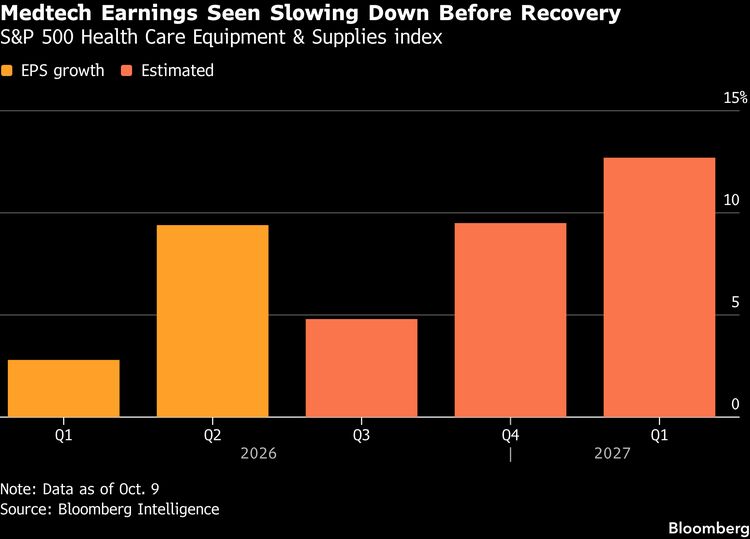
Medical technology companies face one more subdued earnings quarter before heading into 2027 with their strongest growth outlook in more than two years, following a punishing stretch of policy uncertainty, cyberattacks and device recalls.
Third-quarter earnings are estimated to have risen 4.8% across the sector, weaker quarter-on-quarter and trailing the gains expected for the broader US benchmark, according to Bloomberg Intelligence data. By the first quarter, that growth is seen accelerating to 13%, the group’s strongest performance since late 2024.
Though expectations are low for the third quarter, Citi analysts including Joanne Wuensch also look for “pockets of growth” next year, while Barclays’ Christopher Pasquale expects revenue growth to stabilize.
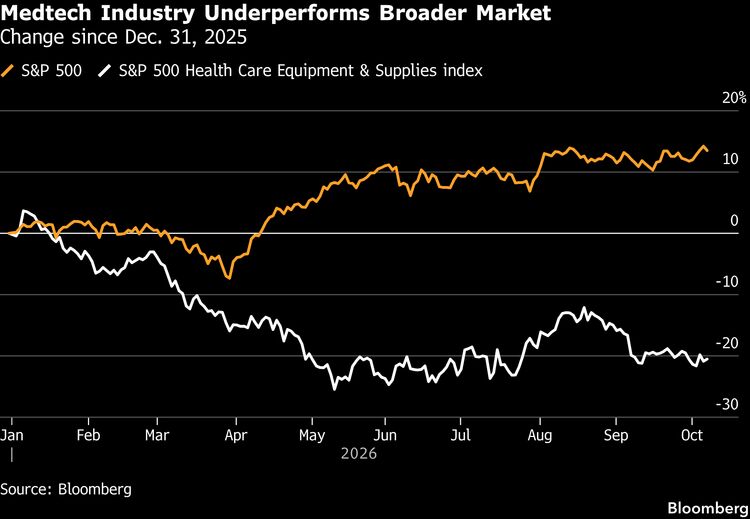
The S&P 500 Health Care Equipment and Supplies Index — which includes pacemaker manufacturer Medtronic Plc, hip replacement maker Stryker Corp. and surgical robots firm Intuitive Surgical Inc. — is down more than 20% year to date. The broader index has jumped 13% over the same period.
Medtech has been relatively insulated from tariffs and energy shocks, but uncertainty over changes to the Affordable Care Act and Medicaid programs under the One Big Beautiful Bill Act has weighed on sentiment. “The view of the sector as a safe haven has diminished,” BI analyst Matt Henriksson said.
“There certainly is a question of whether the new projects or new expensive equipment that we plan to purchase, maybe we should pause or push some things for next year,” Evercore ISI analyst Vijay Kumar said, referring to hospital spending plans.
Few product launches, biopharmaceuticals attracting capital at the expense of medtech and a general rotation toward artificial intelligence-exposed stocks have also weighed on the industry, according to JPMorgan analyst Robert Marcus.
Idiosyncratic challenges, including cyber attacks at Boston Scientific Corp. and Stryker, and product recalls at Baxter International Inc., further damaged investor confidence.
“The sector narrative will be tough to reverse in 2026,” RBC Capital Markets analyst Kendall Au wrote in a note. “But we are positive on the 2027 setup.”
A decisive victory from the Democrats in the midterm elections could potentially boost medical devices stocks, even though it won’t impact healthcare policy over the next two years, according to Marcus. “This isn’t yet in valuations and could be a nice benefit.”
Zimmer Biomet Holdings Inc. is in the middle of a new product cycle and Edwards Lifesciences Corp. has several trial readouts coming up, Citi’s Wuensch said.
Boston Scientific, though “still in the penalty box,” could see a way out thanks to new launches and data catalysts in 2027, according to Marcus.
“Long-term innovation and solid procedure volume support largely sound fundamentals,” BI’s Henriksson said, pointing to resilience beneath the near-term pressures.
Pulsed field ablation, a treatment for heart rhythm disorders that uses high-intensity electrical pulses, continuous glucose monitors for diabetes, and ongoing progress in surgical robotics are some of those key developments, according to Evercore’s Kumar.
Overall, the third-quarter earnings season could be seen as a “major clearing event,” said Marcus, as medtech firms reset expectations for 2027 and get investors back onside.