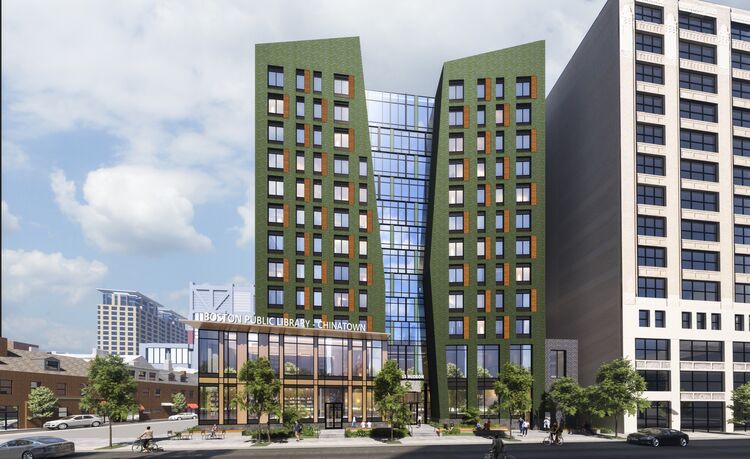
Boston’s Chinatown is getting its first permanent library in over six decades, and for 110 households, it will be just an elevator ride away. The new branch, slated to be completed in 2027, will be housed in a two-story, 17,000-square-foot space. On top: a 10-story residential complex with 44 affordable units for sale and another 66 for rent.
The project is under construction at 55 Hudson Street, one of the few city-owned undeveloped spaces left in the neighborhood. The new branch is the first of three planned library-housing combos across Boston, as Mayor Michelle Wu looks to plug a severe affordable housing shortage.
Building a standalone library is “often our preference,” said David Leonard, president of the Boston Public Library. “But the reality is there was no other way other than through a mixed-use development.”
Piggybacking books and bedrooms is an approach that several other cities are exploring: Similar projects are in the works across the US. The strategy is aimed at leveraging publicly owned land to increase housing supply, while also giving these embattled civic institutions — which have recently endured Covid closures , book banning campaigns and funding cuts — some much-needed upgrades.
Other co-location efforts have proposed combining housing with firehouses , community centers and even museums . But library branches are particularly well-suited for the role because they often boast easy access to transit, shopping and other amenities, says Yonah Freemark, a housing researcher at the Urban Institute. Since 2020, there have been nearly two dozen combined library-housing developments in the US, adding more than 1,800 market-rate, senior and affordable housing units, according to his 2025 report .
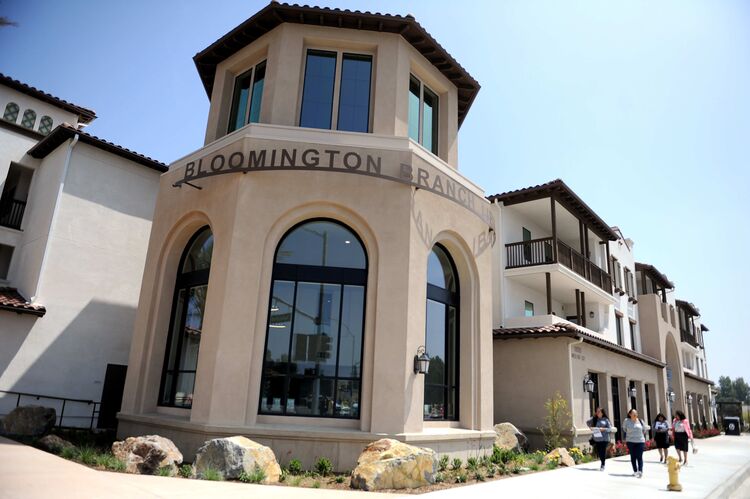
Aging and underinvested library systems, meanwhile, can tap into additional capital funding — or in BPL’s case, land — to renovate and modernize their branches. In nearly 40% of US public libraries, totaling more than 6,000 facilities, at least one part of the building is in poor condition, according to a 2025 survey by the Government Accountability Office. And some 11,800 libraries had a backlog of maintenance and repairs at the time of the survey, with more than half reporting a backlog of over $100,000.
But these projects aren’t easy to pull off, requiring lots of coordination among diverse stakeholders. Proposals can also get dragged into local debates over zoning, development and affordable housing. And with a national shortage of 7.2 million housing units available for rent to low-income Americans, filling the gap would require the US to significantly scale up such efforts.
“It’s not that these are impossible projects to do,” said Ted Ferringer, a Cleveland architect who’s worked on library projects in his hometown. “But if they were easy, they would happen all the time.”
Growing a New Branch
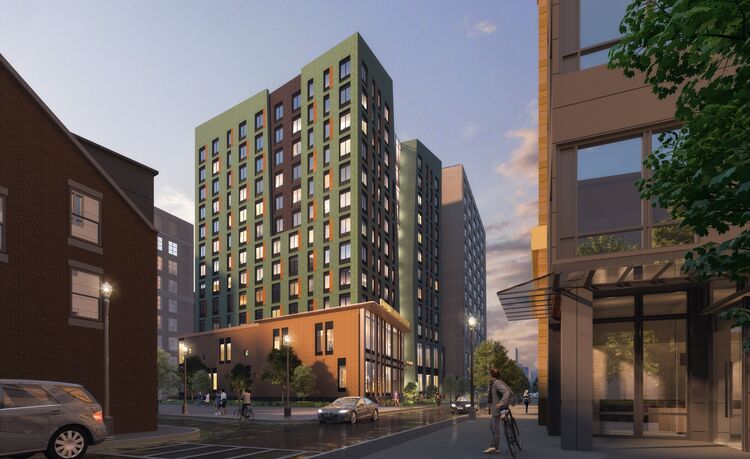
In Boston’s Chinatown, the steel frame of the 10-story library/apartment complex is taking shape, a year after it broke ground. Next comes the building’s exterior: a green and brown brick facade split lengthwise, exposing a glassy midsection. At street level, the two-story library branch wraps around one corner of the tower.
The design, from the architecture firm Stantec, draws inspiration from the Tianmen Mountain in China and the Chu River that cuts through it — a nod to the community’s fight to preserve its cultural heritage amid surging housing costs . “Like the Chu River, the people of this neighborhood have fought for their livelihood with unyielding persistence,” wrote the Asian Community Development Corporation, the nonprofit developer overseeing the project, in its design submission to the city.
Part of that fight has also been to give residents back their library. Chinatown lost its library in 1956 to the construction of the Central Artery, an elevated highway that split the neighborhood and forced the demolition of more than 1,000 buildings across the city. (The roadway was later buried as part of Boston’s “Big Dig” megaproject.) The city offered alternatives, including a bookmobile in the 1960s and ’70s. In 2018, a small temporary branch opened in the basement of the China Trade Center.
Finding room for a permanent replacement was a challenge. In February 2020, the city approved a plan to construct a library on the ground floor of a hotel and affordable housing development. Then came Covid-19, and by 2021 the project was “dead in the water,” said Angie Liou, executive director of the ACDC.
Boston, at the time, had begun exploring ways to boost housing by leveraging space above city-owned properties like municipal offices, fire stations, libraries and underused lots. “We have had a couple of these large parking lots that the city owns, and when you do get the rare chance to do something with it, we should maximize the uses on it,” Liou said.
In 2022, plans for a Chinatown library emerged again — this time in a parking lot at 55 Hudson, where the city had been looking to build affordable housing. “People were excited,” Liou said. “After all these years, we’re actually going to see this promise to bring a library back come to fruition.”
Balancing Act
Integrating two buildings with very different functions — private residences and public space — into one cohesive structure comes with a host of complications. Costs and construction timelines need to be aligned; sometimes, the public and private sides follow different labor rules, meaning projects can involve multiple builders, designers or engineers. “There’s a ton of coordinating,” said Bridget Kent Márquez, executive director of Northwest Neighborhoods in Cleveland.
The nonprofit community developer is currently working with the Cleveland Public Library to build a senior housing complex that includes a replacement for the 55-year-old Walz branch in the Detroit-Shoreway neighborhood. The project had a rough start. In 2022, the old library and a nearby apartment complex were torn down to make way for the new project. But financing the residential portion amid pandemic-related disruptions halted work for over two years. Detroit-Shoreway residents — including architect Ferringer — have not had access to their library since.
“Those delays caused natural construction cost escalation to the library, and it just turned into this negative feedback loop,” said Ferringer, who was also on the project’s design team while he worked at his former firm, Bialosky.
The project finally broke ground in 2025, with a 10,300-square-foot library topped by the Karam Senior Living Apartments, a five-story, 51-unit building. One of the design challenges was to figure out how to create shared spaces without inadvertently giving the public access to the residential side of the building. The team considered a shared rooftop deck, but ultimately designed a street-level public space that functions as an “outdoor living room,” according to Ferringer. Residents of the senior apartments, meanwhile, get their own community room and wellness center.
Slated to be completed in 2027, the new Walz campus will operate as a partnership with CPL and Northwest Neighborhoods; agreements about construction, costs and responsibilities are laid out in a physical document. “We tried to anticipate almost every single thing that could possibly happen and encapsulate it in a document,” Marquez said. “This is a very long-term relationship.”
Zoning Battles
Sometimes, library projects can get entangled with community debates over development and zoning.
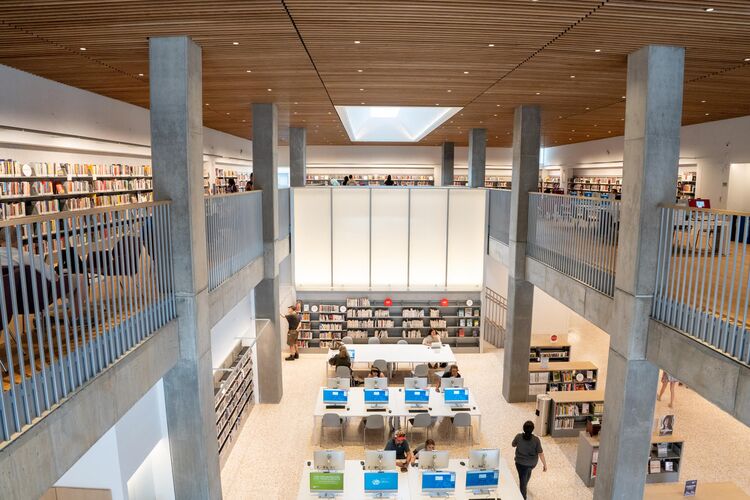
At the northern tip of Manhattan, the redeveloped Inwood Library is a showcase of the model’s possibilities. The facility, which has won awards from the American Institute of Architects and the Urban Land Institute, includes a $10 million, 20,000-square-foot library with an early childhood education center and a STEM robotics center; above it is the Eliza apartment complex, standing 12 stories tall with 174 units for low-income New Yorkers.
But the project met resistance when it was first proposed in 2017 — not because residents didn’t want a new library, but because it hinged on the approval of a controversial city plan to rezone parts of Inwood, a lower-income neighborhood with a large immigrant population . Allowing taller buildings would encourage more affordable housing, proponents of the zoning change said; critics argued that the development would spur gentrification. One local lawmaker denounced the library as a “ Trojan Horse for Uptown.”
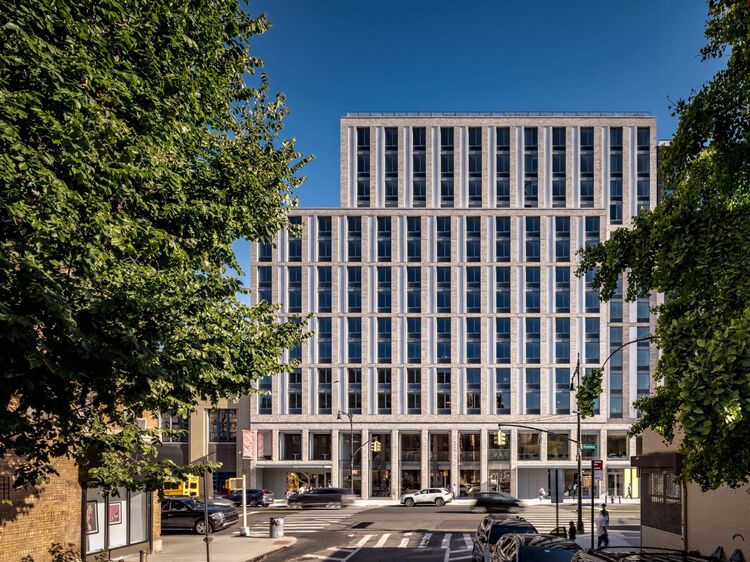
After a two-year court battle , the rezoning plan moved forward and the Inwood Library broke ground in 2021. The facility opened in 2024, with space for early childhood reading programs, English language for adults and tech classes on coding. The new library has become a “fixture of the community,” said Anthony Marx, president and CEO of the New York Public Library. “We got a bigger library than we probably would’ve gotten with a straight replacement. That’s ideal, right? Everybody wins.”
New York City has been an avid experimenter with the joint library-housing model, with four facilities completed since 2016. Three more are on the way in Manhattan, the Bronx and Brooklyn. In June, a city councilmember proposed including $60 million in the city’s budget to pair another three libraries with affordable housing.
Filling the Gap
At least a dozen other joint library-housing developments are in the pipeline or under consideration across the US. But the broader US housing shortage is measured in millions .
Libraries alone aren’t enough to fill that gap, but Brooks Rainwater, president and CEO of the Urban Libraries Council, thinks combining housing with other city properties more broadly is a good long-term strategy. “When you look at the full scope of publicly owned land within cities, yeah, it can make a dent,” said Rainwater, who once led the National League of Cities’ solutions center.
Boston, for example, has 530 vacant parcels that could be used to build housing, according to a 2022 land audit . A 2018 survey found that residents supported efforts to put housing on public assets, as long as community benefits were clearly laid out.
The construction of BPL’s Chinatown branch is one of the first projects to emerge from these exploratory efforts. Two more library-housing projects are underway, bringing an additional 152 affordable units once they’re completed. The city is also looking to combine affordable housing with a community center for a site, said Sheila Dillon, Boston’s chief of housing. “What we have to do, always, is be looking for new sites throughout the city to build additional income-restricted housing,” Dillon said.
Getting community buy-in for this kind of hybrid development means delivering not only housing but also a “top-notch” library, said Rainwater. That starts at the entrance: “One of the things we think is incredibly important and we see in most of these projects is that you want to make sure the front door to the library is still just as prominent as it would be if the library was a standalone building,” he said.