Elon Musk’s extraordinary swipes at Indian billionaires this week mark a sharp turn in a relationship that once promised to make the world’s most populous nation a major new frontier for his business empire.
The world’s richest person lobbed accusations that powerful corporate interests in India maintain a “monopolistic chokehold” over the local market, blocking his Starlink space-based internet service. He called this “a crime against the people of India” in a post on his social media platform X this week.
On Thursday, Musk followed up by asking if Indian billionaire Mukesh Ambani, whose Reliance Jio Infocomm Ltd. is one of two telecom giants that together account more than 80% of the country’s market, is “the real boss of India?”
The outbursts come after SpaceX has spent years trying to bring its satellite unit to the country — and amid a broader string of disappointments for Musk in the subcontinent.
Tesla Inc., Musk’s electric car company, has sold around 1,000 vehicles since opening its first Indian showroom 15 months ago. And X, now part of SpaceX, is embroiled in a court fight over the government’s powers to order online content removed.
The cool reception for Musk’s business operations has confounded expectations they would make rapid headway into India’s vast but complex markets.
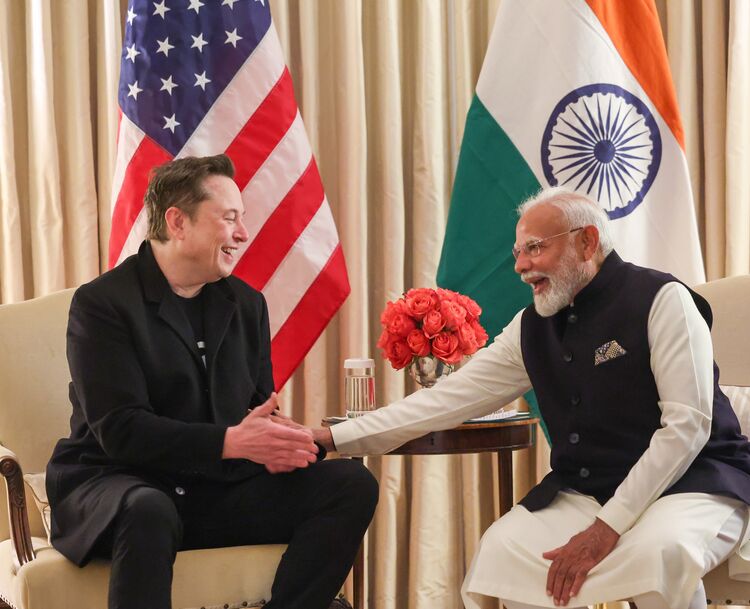
It looked very different less than two years ago when Prime Minister Narendra Modi met Musk in Washington in February 2025 — a time when the tycoon was a frequent White House guest of newly inaugurated President Donald Trump. Within months of that meeting, India’s telecom department granted Starlink a crucial license to provide satellite-communications services, clearing one of the biggest obstacles to its entry.
The relationship has since been complicated, according to people familiar with the government’s thinking, by two main factors: Musk’s own volatile political standing in Washington, and a loss of enthusiasm for him in New Delhi after years in which promised investments and visits failed to materialize.
Starlink Stalls
Musk’s business woes in India illustrate the difficulty for companies involved in sensitive industries operating across borders in an era of heightened geopolitical tensions. The national security implications of next-generation technology in areas ranging from satellites to semiconductors have increasingly become a barrier to global trade.
What makes the case for SpaceX, Tesla and X more difficult in some markets is concern about Musk’s relative proximity to power in Washington, as well as his penchant for speaking out about sensitive topics — both at home and abroad.
The Indian government publicly disputed the suggestion Starlink is being singled out for unequal treatment.
Responding to his “oligarchs” attack, the Ministry of Communications said Thursday its satellite-communications framework was fair and non-discriminatory, and that Starlink, Reliance Industries’ Jio Satellite Communications and Bharti Airtel Ltd.-backed Eutelsat OneWeb have all received broadly the same level of scrutiny.
Ambani, Reliance Industries, Bharti Airtel and India’s Ministry of Communications didn’t respond to emailed queries on Musk’s recent X posts. SpaceX and Tesla didn’t respond to requests for comments.
Government officials are holding back on final security clearances for Starlink due to concerns over technological sovereignty and relying on a US-controlled network for critical communications, especially in the wake of the war in Iran, people familiar said, asking for anonymity to discuss private deliberations. And the security issue intersects with a more delicate calculation: how dealing with Musk could affect New Delhi’s relationship with Washington.
Musk’s shifting relationship with Trump has led to greater caution, the people said. The one-time major backer of Trump’s re-election campaign feuded with the president last year, but more recently the two men have shown signs of mending fences. Amid that confusion, New Delhi sees little reason to tackle Musk in a way that could be poorly received by the White House, they said.
India also has bigger problems with the US that transcend the gripes of any one American tycoon. Top officials in both countries said this week that negotiations over a bilateral trade deal have reached an impasse. That has exacerbated tensions over other issues, such as India’s purchases of Russian oil and Trump’s effort to insert himself into a regional conflict with Pakistan.
Separately, Washington on Thursday announced suspending an immigration initiative that’s allowed foreign workers, including many from India, a path to permanent residency. Shares of Tata Consultancy Services Ltd. — among companies cited in the announcement — gained in Mumbai after upbeat results. Lobby group Nasscom earlier said that Indian IT giants have substantially cut their dependence on H-1B visas.
That thinking is filtering down to corporate India. Some of the country’s most powerful billionaires rushed to announce partnerships with Starlink when Musk appeared to be drawing closer to both India and the incoming US administration. There is now little pressure on them to execute those agreements while Starlink remains in regulatory limbo, according to the people.
Promises, Promises
India’s hesitation comes at an awkward moment for Musk, whose need for the country is arguably growing. India is one of the few big markets where his businesses — Starlink, Tesla and X — still have substantial room to expand.
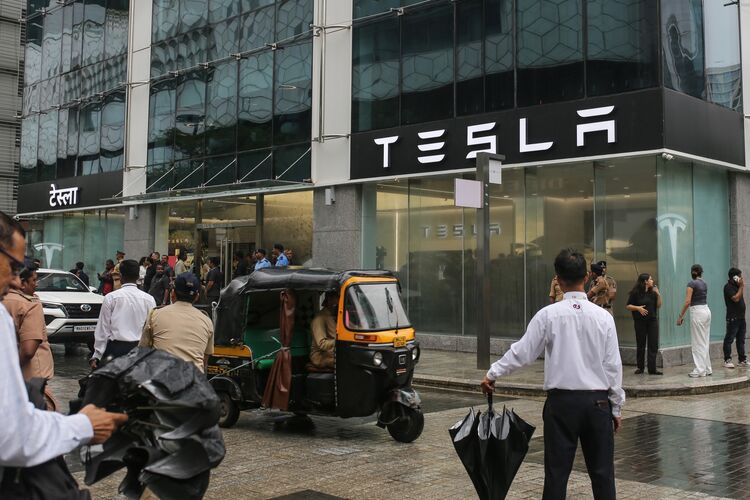
India spent years courting Tesla, hoping Musk would build cars locally and bring investment, jobs and advanced manufacturing technology with him. Tesla instead entered with imported vehicles, opening its first showroom in Mumbai in July 2025 without committing to the local factory New Delhi had sought.
Fifteen months later, it has struggled with sales hovering around 1,000 cars — a paltry number for a company that delivered more than 625,000 vehicles in China last year and another 589,000 in the US. Meanwhile, competitors including BYD Co. and VinFast Auto Ltd. have steadily expanded their presence in India’s EV market, leaving Tesla as the outlier who’s struggling to gain traction.
X has provided another source of friction. Musk’s social-media company has fought government orders to remove content, adopting a more confrontational stance than some other American technology companies operating in India.
Then there are the no-shows.
Musk was due to visit India in April 2024 for a meeting with Modi and an expected announcement around Tesla’s investment plans. But he canceled at the last minute, citing “very heavy Tesla obligations” and promising to come later that year. Days later, he surfaced in Beijing instead, rubbing salt in the wound.
After speaking with Modi in April 2025, Musk revived the pledge, saying he was looking forward to visiting India “later this year.” That visit didn’t happen either.
The repeated snubs have come to symbolize a courtship heavy on anticipation but relatively light on tangible commitments.
“The momentum often begins with a meeting between Modi and Musk” said Ajay Srivastava, founder of the Global Trade Research Initiative, “only to lose momentum when discussions turn to the operational details and actual investment.”
The risk for Musk is that the balance of leverage is changing. India once pursued his good graces as a prize that could bring an electric-car factory, cutting-edge satellite technology and billions of dollars of investment. Today, Tesla and Starlink both need new avenues for growth, but India is beginning to see home-grown alternatives to those cars and satellites.
Reliance and Airtel dominate its telecom market, and Ambani is looking to build a homegrown Starlink-rival with ambitions to put hundreds of satellites in space over the next few years. Similarly, Tesla has entered an auto market saddled with high import levies, crowded with domestic and global manufacturers competing for a piece of the pie.