By Erika D. Smith | Updated on Oct 09, 2026 at 11:30 AM
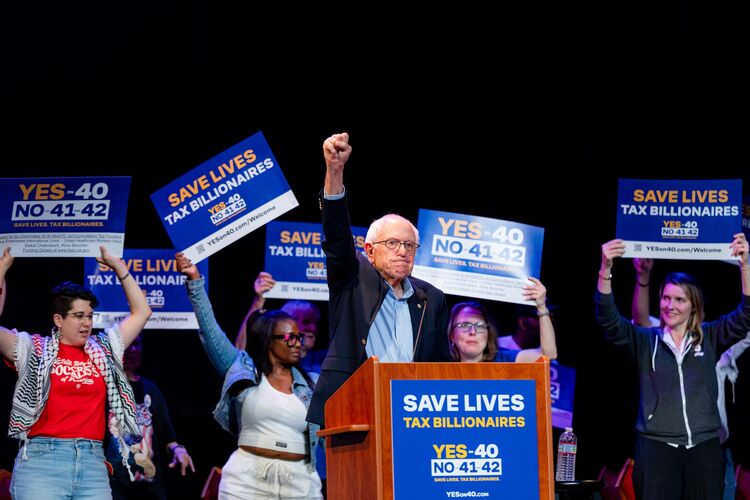
For months, the billionaires of Silicon Valley (and a few other gilded corners of California) have been scrambling to stop a statewide measure that would levy a one-time 5% wealth tax on their assets. Until now, they haven’t had much luck. But as ballots begin arriving in voters’ mailboxes this week, they arguably have some reason for optimism.
A few recent polls have found that voters across California, where registered Democrats outnumber Republicans roughly 2-to-1, are far from sold on taxing the rich in such a novel way. As of last month, fewer than half said they would support the measure, known as Proposition 40 — and, according to UC Berkeley’s pollsters , even that tepid support is slipping.
Come November, Google co-founder Sergey Brin could end up with a solid return on his investment of more than $100 million to stop Proposition 40. But he and the rest of California’s billionaires shouldn’t confuse short-term political success with longer-term political trends.
The backers of Proposition 40 have a point when they argue that policy discussions about imposing new taxes on the ultrawealthy — including a controversial tax on overall assets, not just on income or capital gains — are unlikely to end in November in California. If anything, such discussions are likely to be supercharged.
As Dave Regan, president of the state’s powerful SEIU-UHW labor union and the architect of the ballot measure, told Bloomberg News : “I think we’ve made this issue inevitable.” He says that even though his side is being wildly outspent on advertising, which seems to be turning public opinion against Proposition 40.
Instead, Regan points to populism. Indeed, polls show rising support for it among majorities of Americans, driven by widespread feelings of economic insecurity over housing, groceries, childcare. A recent poll from the Wall Street Journal concluded that “a coalition reaching beyond the nation’s familiar party labels exists for a range of policies at a time when Americans view Republicans and Democrats negatively.”
Roughly two-thirds of voters believe the US is on the wrong track. And rightly or wrongly, billionaires are getting a lot of the blame for that. This is particularly true of the Trump-administration-aligned billionaires of Silicon Valley, where tone-deaf statements about data centers and artificial intelligence — and equally tone-deaf strategies for pursuing them — have become routine.
This is why Senator Bernie Sanders of Vermont — the most high-profile backer of Proposition 40 — shouldn’t be ignored when he is whipping up crowds, as he did recently at rallies in San Francisco and Los Angeles .
“What you are showing people from coast to coast and all over is that, yes, we can take on the greed of the oligarchs,” Sanders said in LA. “Yes, we can create an economy and a government that works for all of us, not just the 1%.”
Nor should Representative Ro Khanna, a Democrat whose district includes Silicon Valley. “There are five trillion-dollar companies in my district,” he recently told the New Yorker , explaining his support for Proposition 40. “When I got elected to Congress, there wasn’t a single trillion-dollar company. They’re seen as oligarchs, as the people with wealth and power, controlling our lives. … There’s also a lot more arrogance.”
Sanders has repeatedly declared Proposition 40 the “most important” ballot measure in the US. That’s probably a stretch. But its very existence has set several things in motion. Most importantly, it has forced Democrats to pick a side in the populism debate.
So far, the California and Los Angeles County chapters of the Democratic Party have endorsed the ballot measure, while the San Francisco Democratic Party has opposed it. Labor unions are split, too. Governor Gavin Newsom, meanwhile, has suggested that he would support a national wealth tax in lieu of supporting Proposition 40, which he argues would devastate California’s economy by driving billionaires to move their homes and businesses out of state.
Newsom’s is a common argument among the ballot measure’s opponents — and they aren’t wrong. After all, Brin, with a net worth of about $270 billion, according to Bloomberg’s Billionaires Index, has already left California for a mansion across the state line in Nevada.
But Newsom’s decision could come back to haunt him — and other Democrats — if he makes a widely expected run for president in 2028. Khanna, who’s also considering running, is sure to try turning taxing billionaires — and specifically, taxing their assets — into a litmus test for his party’s nomination.
Khanna and Sanders have already introduced the Make Billionaires Pay Their Fair Share Act , which would levy a 5% annual wealth tax on about 900 Americans with a net worth of $1 billion or more. That all but assures that what’s happening with Proposition 40 is only the beginning.
As Sanders told a crowd in San Francisco over the weekend, “The whole country, and frankly people from around the world, are paying attention to what is happening here.”
In other words, “As California goes, so goes the nation.” It’s an adage that Democrats in the nation’s most populous state use proudly, but suddenly it has become as much of a promise as a source of fear.
More From Bloomberg Opinion:
Want more Bloomberg Opinion? OPIN <GO>. Or subscribe to our daily newsletter .