If the definition of madness is doing the same thing again and again and expecting a different result, what are we to make of the latest broadsides in the trade war brewing between the European Union and China?
The ostensible purpose of the latest proposals from France and Germany is to give Brussels tools for supporting domestic industries, as strong as those employed by Washington since the first Trump administration. In their letter this week to European Commission President Ursula von der Leyen, they called for rule changes allowing Brussels to go as far as cutting off imports from targeted countries unless a majority of member states object. In its fullest form, that’s a more radical proposal than anything President Donald Trump has contemplated.
US trade policy has certainly been muscular, but measure it by its real-world effects and it has been an ignominious failure. As my colleague Scott Lincicome has written, the US actions have failed to achieve almost every significant goal . Far from damaging China’s trading prowess, they’ve enhanced it. While the restrictions have reduced imports of Chinese finished goods, removing a Made-in-China label has only a superficial effect: The amount of Chinese content in goods coming into the US has barely moved.
Tariffs have raised costs on American households and deterred them from buying the clean technologies in which China specializes. Worse still: Rather than taking the opportunity of government protection to catch up in developing future industries, America’s auto manufacturers have doubled down on building obsolete gas guzzlers for a walled-off domestic market.
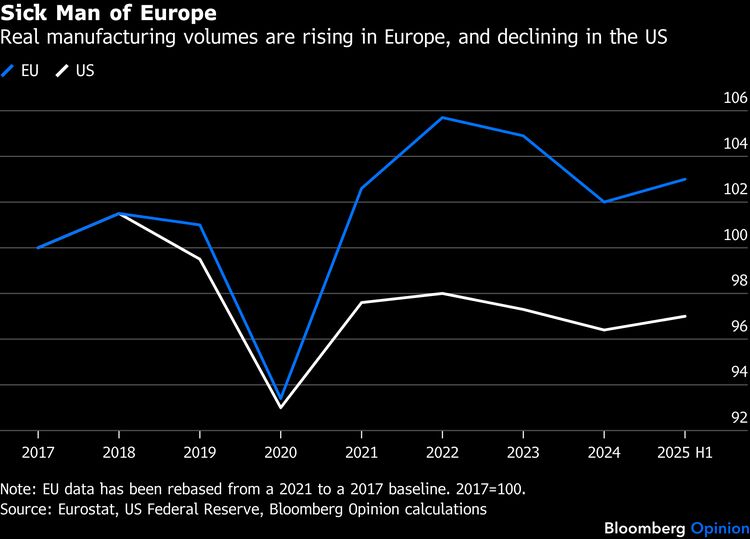
It’s a particularly dispiriting record when you compare it to Europe itself. The EU’s failure to establish anything resembling the US technology industry is a serious drag on its economy, but in manufacturing it has actually outperformed. A decade of trade restrictions have left the US with a smaller factory sector than it had in 2017. Europe hasn’t exactly boomed, but it is at least growing.
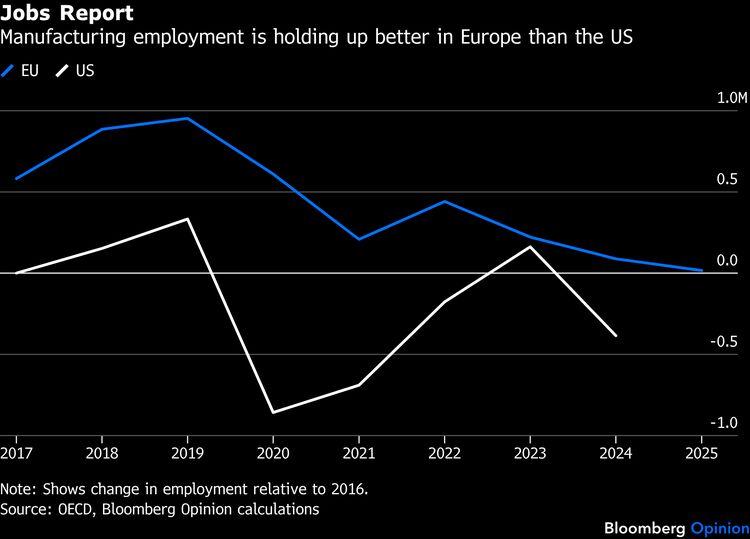
The same pattern shows up in jobs. US factory employment collapsed during the Covid-19 pandemic and never really recovered. In the EU, the decline has been far more gentle. The total manufacturing workforce, of nearly 32 million people, is more than twice the 15 million in the US.
“Core Europe,” in particular Germany, has certainly suffered a disproportionate hit — but that’s because jobs have been migrating to booming corners elsewhere in the bloc, such as Spain and Poland.
The danger in misreading this recent history is that by mistaking the problems of a handful of automakers for the state of manufacturing as a whole, Europe may be overestimating how much it’s threatened by China, and how much firepower it would be able to bring to bear if things deteriorate to an all-out battle.
The US is unusual among major economies in the weakness of its export sector relative to the entire economy. Exports of goods and services make up just 11% of gross domestic product. That’s a smaller share than Tajikistan or Cameroon, neither of which would turn up on anyone’s list of major trading powers. As a result, it’s able to shrug off the effects of a disastrous trade policy better than most other countries.
The EU lies at the opposite end of the spectrum: At 23% of GDP , exports from the bloc are more important to the economy than in even China, which comes in at 21%.
Therein lies the danger in the Franco-German proposal. The kill switch it proposes on imports won’t strengthen European industry — it would instead represent a devastating act of self-harm.
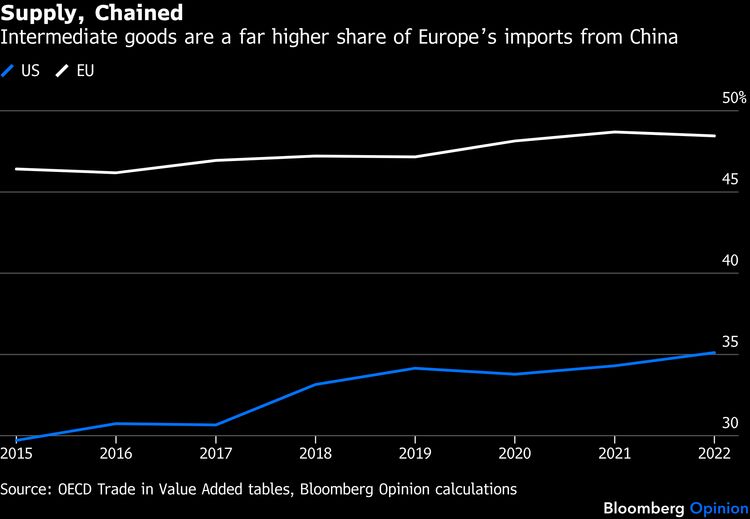
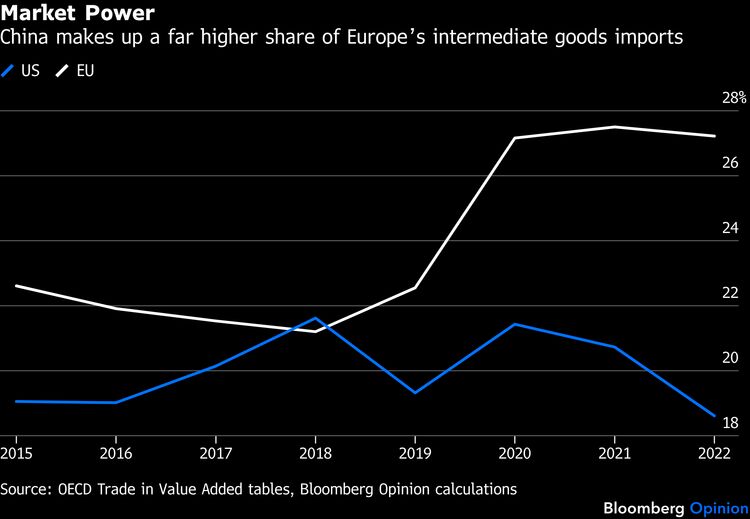
That’s because the bit of China-EU trade that’s been growing in recent years hasn’t been consumer goods with “Made in China” stamped on them, but smaller equipment and parts bought by European businesses and used to manufacture their own products, many of which are in turn exported. Nearly half of Europe’s imports from China are such intermediate goods, compared to less than a third in the US at the time Trump started the first round of trade wars in 2018.
Cut off imports, and you’re going to do far more harm to local industries than their Chinese counterparts. More than 27% of Europe’s imports of intermediate goods comes from China, a much higher level than the US ever reached. Production lines can’t run unless they have free access to essential parts and inputs, which the current Franco-German proposal would put in jeopardy.
Think of the havoc last year when China shut off global exports of rare-earth magnets amid a trade dispute with Washington. Then imagine the same chaos across a far wider range of products, and this time provoked not by Beijing but by Brussels.
The trading relationship between Europe and China is a lot deeper and more integrated than you can measure by just counting the number of XPeng Inc. cars on the road in Denmark. If European leaders really care about jobs and competitiveness rather than pride and headlines, they’ll think twice before following America’s disastrous path.
More From Bloomberg Opinion:
- China Can Give Europe a Break on EVs: Juliana Liu
- Audi’s $89,000 Q9 Shows Chinese Competition Is Hitting the US: Liam Denning
- China’s Growth Target Has Become a Trap for Xi : Daniel Moss
Want more from Bloomberg Opinion? OPIN <GO> . Or subscribe to our daily newsletter .