Malaysian Prime Minister Anwar Ibrahim hiked the minimum wage, expanded tax relief for the middle class and pledged to ease cost-of-living pressures in his 2027 budget, potentially the last before he calls a general election.
Anwar is also boosting support for schools, hospitals, farmers and the elderly as he seeks to spread the benefits of an economy that is expanding at a faster pace, but has yet to leave many Malaysians feeling better off.
The government raised its growth forecast for 2026 to 4.8%-5.3% from 4%-5%, as resilient domestic demand and surging exports offset a challenging external environment, according to economic and fiscal outlook reports released on Friday.
“The question is not simply how large an economy we want to build, but whether that growth creates opportunities for families to build up savings, for workers to earn more dignified wages, and for small businesses to continue growing,” Anwar, who is also finance minister, said in his speech.
To lift household incomes, the minimum monthly wage will rise to 2,000 ringgit ($490) from 1,700 ringgit starting in June, Anwar said. Tax relief for the middle class will also be expanded, including a one-percentage-point cut in personal income tax rates for resident individuals. At the same time, the threshold for its 30% top tax rate will be lowered to those with a chargeable income exceeding 1 million ringgit, from 2 million ringgit currently.
The budget also directs more support toward groups that could prove important in the next election. Borneo’s Sabah and Sarawak states, whose parties could again play kingmaker if the vote produces a hung parliament as it did in 2022, will receive increased funding. Anwar also pledged more investment in businesses owned by ethnic Malays and indigenous groups — collectively known as Bumiputera — as he seeks to shore up support among the country’s majority.
The 79-year-old premier, whose Pakatan Harapan coalition has suffered setbacks in a succession of state elections, is trying to both court voters and deliver fast growth, while limiting deficits. He is said to be considering calling nationwide polls in the second half of next year, ahead of the February 2028 deadline.
“This budget clearly focuses on improving the people’s well-being,” Second Finance Minister Amir Hamzah Azizan told reporters on Friday. The government is increasing the individual income tax relief to 12,000 ringgit, from 9,000 ringgit, a move that is set to benefit more than 5 million people, he said.
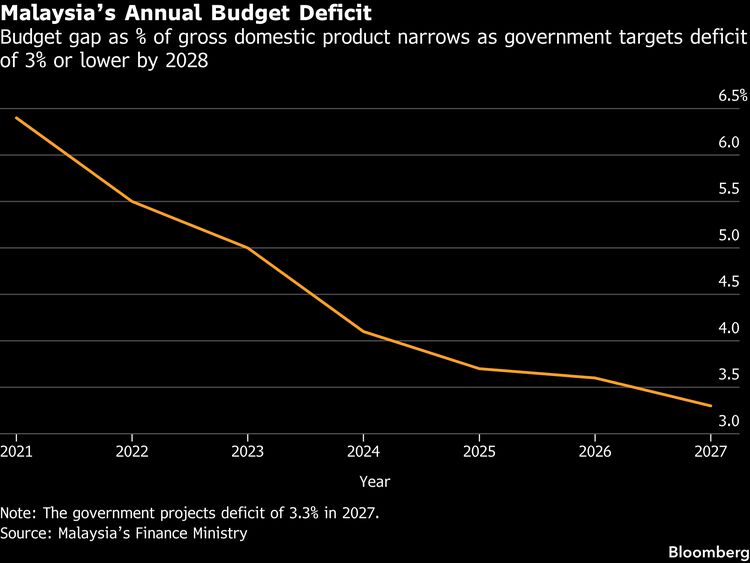
Tech exports and investment have spurred tax revenue that should bring the budget deficit to 3.6% of gross domestic product this year. That is just a slight overshoot of the original 3.5% target, despite a surge in spending linked to fuel subsidies and social assistance.
Anwar plans to narrow the deficit to 3.3% of GDP next year and remains committed to a medium-term fiscal target of 3% or lower by 2028.
“Additional support measures and pre-election spending pressures could limit the pace of fiscal consolidation in 2027, although we expect the government to maintain its medium-term commitment to a fiscal deficit of 3% of GDP,” said Arjun Khaitan, senior ratings associate at Moody’s Ratings.
After his speech, the ringgit held gains of 0.2% versus the dollar at 4.09, while bonds edge up with the 10-year benchmark down 3 basis points to 3.93%. Stocks were up 0.5%, the biggest daily gain since Sept. 22.
However, benchmark palm oil futures in Kuala Lumpur slid 1.6%, after rising 2% earlier Friday. The higher minimum wage will raise costs for Malaysia’s plantation companies, squeezing margins in the labor-intensive industry, where Malaysia is the world’s second-largest producer.
Sustained Subsidies
The government forecasts 2027 GDP growth of 4.2%-5.2%, supported by sustained domestic demand investment activity, according to the economic reports.
It plans to spend 459.8 billion ringgit in 2027, 3.6% higher than in 2026. Of this, 72.7 billion ringgit will go to subsidies and social assistance. There will be 16 billion ringgit in cash aid, up from 15 billion ringgit this year.
Malaysia’s subsidies to maintain some of the world’s lowest fuel prices have been key to keeping a lid on inflation despite the global oil shock. Fuel subsidies will remain elevated at 40 billion ringgit next year, Anwar said.
The nation’s status as a net energy exporter due to its reserves of oil and natural gas has also cushioned its economy even as neighbors like Thailand and the Philippines struggle with the surging cost of imports.
Contributions from national oil and gas company Petroliam Nasional Bhd., or Petronas, a key revenue stream for the government, are expected to rise to 32 billion ringgit next year from 27 billion ringgit in 2026.
Read more: Petronas Boosts Payments to Malaysia as Oil Prices Surge
Overall government revenue is meanwhile expected to increase 4.7% to 380.8 billion ringgit in 2027, from 363.6 billion ringgit this year, as steady economic activity and stronger compliance boosts tax collection.
Some 37.7 billion ringgit will be earmarked for the economic sector that includes transport, environment and trade. Gross exports are forecast to increase by 3% in 2027, coming off a robust 31% estimated this year, with continued demand seen for artificial intelligence-related products and semiconductors.
The budget is directing more investment toward the nation’s crucial semiconductor industry, with sovereign wealth fund Khazanah Nasional jointly investing 100 million ringgit to help startups in Penang.
“Malaysia must move decisively towards higher-value manufacturing, accelerate the energy transition and strengthen its capabilities in artificial intelligence, robotics and other emerging technologies,” Anwar wrote in the Economic Outlook report.
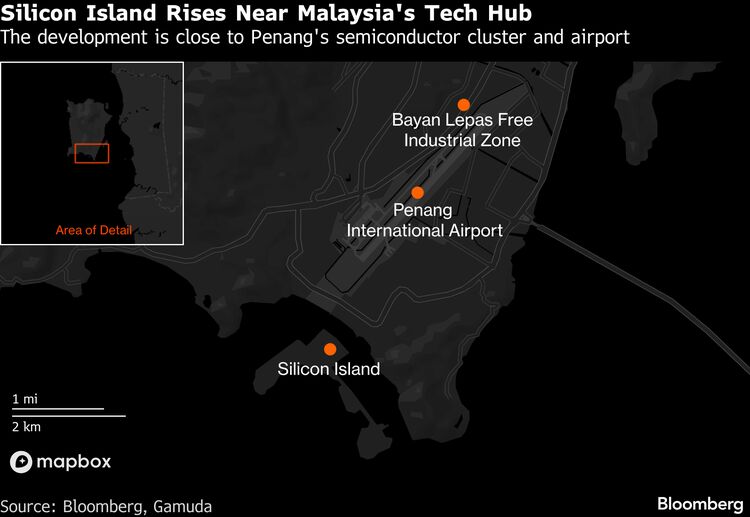
Read More: Malaysia Builds a New ‘Silicon Island’ to House Its AI Ambitions
The past two years have seen Malaysia and its neighbors buffeted by headwinds from Trump’s tariffs to disruptions caused by the Iran war, and Anwar warned that while the country will enter 2027 from a position of strength, risks remain. Global policymakers have also started airing caution around the sustainability of the AI boom, which has been the key driver of Asia’s economic fortunes this year, including Malaysia’s.
“Geopolitical fragmentation, climate risks and rapid technological change will continue to reshape the global economic landscape,” Anwar said in the report. “Malaysia must therefore remain agile, strengthen its resilience and pursue reform with clarity and purpose.”
2027 Budget Highlights:
- The government allocated 2.62 billion ringgit aid for paddy farmers and 100 million ringgit hybrid aid for palm oil replanting
- Starting Jan. 1, the service tax rate for elderly-care services will be reduced from 8% to 6%. A full exemption will apply to care fees of up to 96,000 ringgit a year
- Funding of 1.2 billion ringgit is earmarked to upgrade hospitals and public clinics
- State-linked companies will invest 2 billion ringgit to aid Bumiputera firms
- Federal grants were increased to 18.7 billion ringgit for Sabah and 16.2 billion ringgit for Sarawak