Lumentum Holdings Inc.’s optical components are “completely sold out” through early 2029 on demand from tech companies clamoring for faster AI data centers, according to its chief executive officer.
Lumentum is unable to meet about 70% of demand for some products through next year, and won’t be able to address 30% of demand for some other products through 2028, Michael Hurlston said in an interview in Tokyo Friday. Customers are already starting to lock in orders for 2030, he added.
Shares of Lumentum rose around 6% during pre-market trading on Friday.
The company, which received an investment of $2 billion from Nvidia Corp. earlier this year along with rival Coherent Corp., supplies advanced indium phosphide devices that help enable high-speed cloud computing and data transmission. Analysts on average expect Lumentum’s sales to more than double this year.
“We are really trying to catch up, add capacity as fast as we can, but we are very, very far behind what customers want,” Hurlston told Bloomberg News. “We are completely sold out, so there’s no end in sight.”
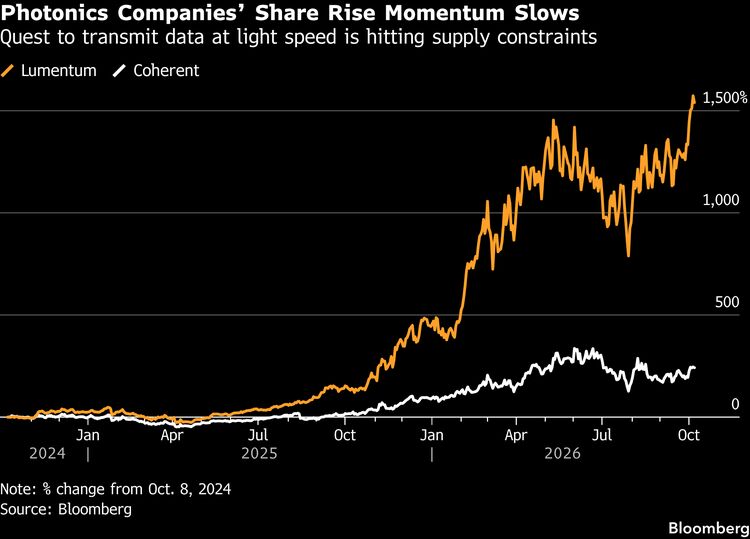
That’s as some investors are becoming more cautious around a global rush to build data centers due to rising costs, debt levels and competition. Such concerns have slowed the rise in Lumentum’s shares, which still hit their highest this month.
Hurlston shrugged off fears of a pullback. The buildout remains intact, and the sector is on the cusp of a bigger opportunity when data centers adopt optical technologies at shorter distances to AI accelerators, he said.
Silicon photonics, which uses light to transmit data, is expected to replace copper-based interconnects in data center clusters as advanced AI hardware demands faster transmission. Optical connections, which generate less heat and consume less power, are also moving progressively closer to the chips. In addition to connecting data-center racks to one another, they are increasingly eyed as ways to link tiny components on the same circuit board.
Lumentum offers a type of laser that’s used to encode data onto light near the chip. Since that means high-speed electrical signals only have to travel a few millimeters, that cuts power loss and heat emission even further.
“This market can be our biggest by far,” Hurlston said, adding that demand for lasers in next-generation AI systems is expected to gain traction around 2029. “It’s another order of magnitude in terms of size.”

The sector is also bracing for further supply constraints as the US reportedly considers a ban on new Chinese optical transceiver models. Lumentum and Coherent would not be able to fill the vacuum left by Chinese makers such as Innolight, according to Counterpoint Research. Roughly two-thirds of the world’s high-speed AI optical transceivers come from Chinese makers. China also remains a big source of indium-phosphide substrates used to make lasers and other optical components.
The US needs to balance national security concerns with the risk of disrupting the supply chain, Hurlston said.
To meet demand, the San Jose, California-based company has ramped up capacity 12-fold at its Sagamihara facility — one of the world’s most advanced indium-phosphide device production sites — in the Tokyo metropolitan area over the past two years. It plans to invest at least $350 million in the site and a neighboring facility, of which it’s deployed $75 million so far. It’s also expanded capacity at its plant in Caswell, England.
The company seeks to buy a facility in Japan and may seek subsidies to expand, Hurlston said. Lumentum engineers are forced to shrink their desk space to allocate more space for production, he said. The company may seek subsidies to help it expand in Japan, he said.
It takes three to five years to build new production capacity, and Lumentum will also need to consider an acquisition over the next year to expand product lineup, he added.
One factor that allays Lumentum’s concerns about fast-paced ramp ups is the willingness of hyperscalers to take on some of the risk that suppliers take on when they build new production facilities.
“These hyperscalers are willing to put money behind it,” Hurlston said.