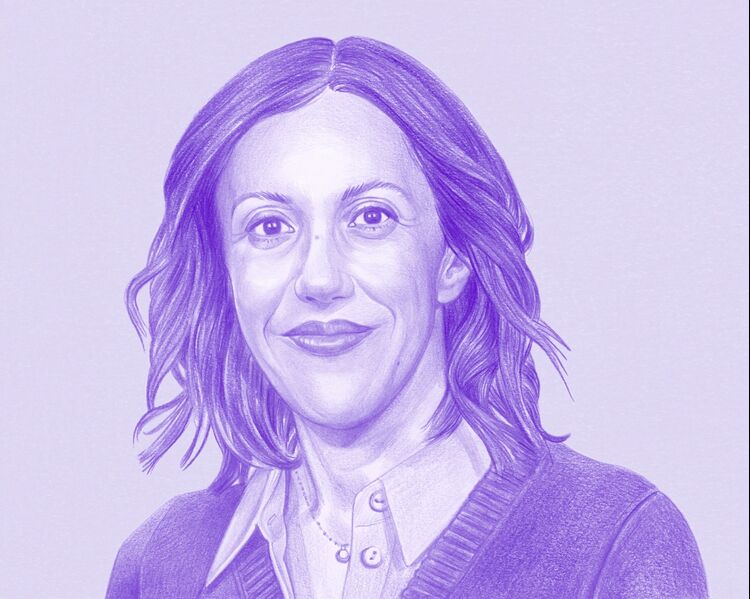
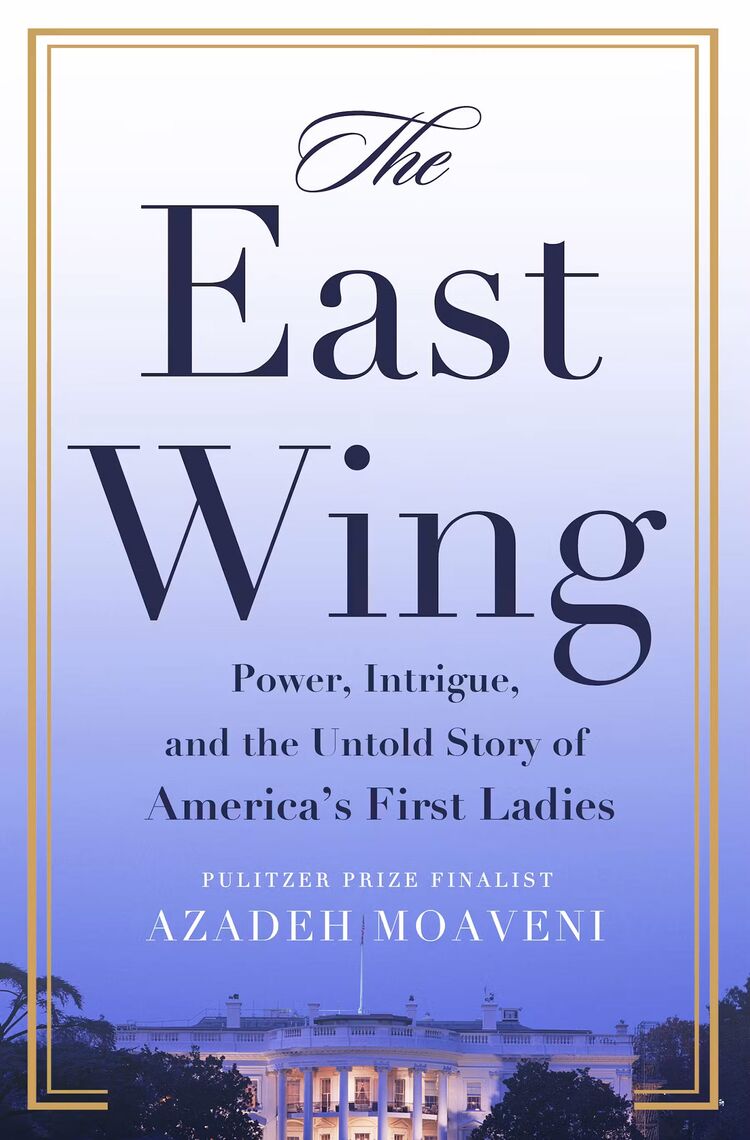
As Azadeh Moaveni was writing The East Wing , her history of America’s first ladies and their staff, the demolition of the place where those women had worked for decades ignited a conversation about history and heritage. In what she calls a “parallel women’s history,” Moaveni traces how they shaped politics at home and abroad as their roles evolved alongside American society.
Today a professor of journalism at New York University, Moaveni is also a longtime chronicler of the Middle East who continues to travel to Iran. She took on The East Wing at a moment when Iran seemed unusually quiet — then war broke out. Here, she reflects on a seismic year and how sentiment within Iran may be shifting back toward greater anger at the regime.
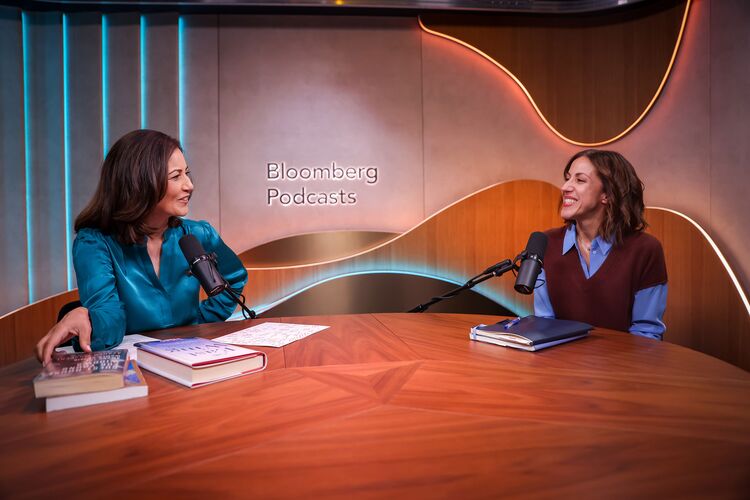
This conversation has been edited for length and clarity. You can listen to an extended version on The Mishal Husain Show podcast.
What got you interested in the stories of the first ladies?
I was in Lebanon writing about a plan to defuse the conflict in Lebanon by bringing together [the] wives of all the big political leaders — recognizing them as influential. Then I took this job in New York and needed to work on something that was US-based. I thought, What are the wives of the big powerful men doing here ? I saw they’re not written about in a political way. They’re covered as celebrities.
[I look] at them in the way we would look at the Queen Mother in monarchical systems. They have a lot of power through their familial linkage to the throne.
They’re in the president’s ear. I also like the way you foreground the staffers, who are more hidden behind the scenes.
They are completely unobserved in history. Chiefs of staff [to] the president are superstars, the object of attention as the engine that runs the presidency.
And now we have a female chief of staff to the president, Susie Wiles , in a uniquely powerful position.
It’s extraordinary that she is the first — and in this presidency that is breaking all these democratic norms. She is the most effective chief of staff that Trump has ever had, but doesn’t see herself there to advance any kind of women’s agenda.
The East Wing comes out when the actual East Wing is a pile of rubble. Did you see that as something bigger than the plan for the White House ballroom? A slight on the role of First Lady?
Many of the women who worked for first ladies in the past certainly felt that way. The East Wing is synonymous with their office. There was almost a violence to the way the public learned of it, that seemed insensitive to the profound importance of this place in the history of the White House for women. 1
1 Demolition began in October 2025, the biggest change made to the White House exterior in more than eight decades. There was no advance notice to the public. “To denigrate it, tear it down, to pretend like it doesn’t matter — it’s a reflection of how you think of that role,” former First Lady Michelle Obama said . The ballroom plan has been subject to legal challenge, but Chief Justice John Roberts has allowed construction to continue for now .
Do we know if it was run past Melania Trump ? What’s your sense of whether she is happy with this?
Reportedly she was unhappy with it. She hasn’t come out in defense of it.
Do you have a sense of her being a different First Lady in this second chance at the role?
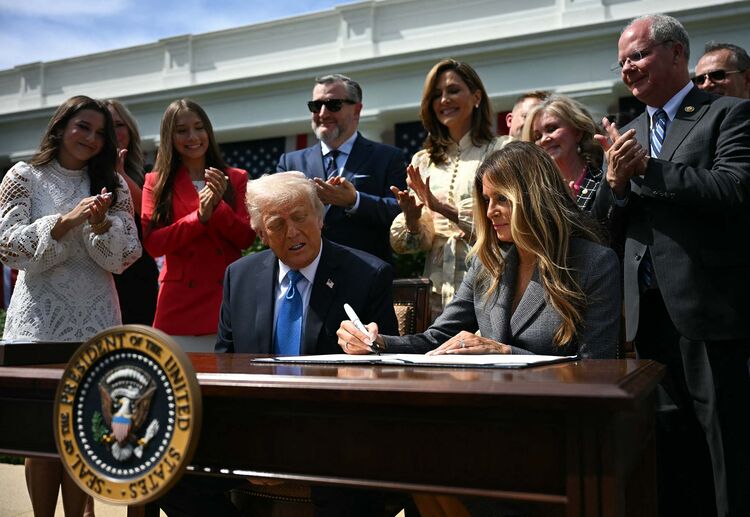
Her second term is completely different, and she acknowledges it herself. She is not in residence much, but is much more deliberate. She has more serious staff. She helped push through the Take It Down Act , a bipartisan bill that criminalizes deepfake and revenge porn. It’s been a very long time since a First Lady’s been able to push through a really critical piece of legislation in Congress. 2
2 Melania Trump’s championing of this legislation has its roots in her first-term “Be Best” initiative, which included online safety and anti-bullying. During that term, she was also pictured visiting a child migrant detention center wearing a jacket emblazoned with the words “I Really Don’t Care, Do U?” — she later said it was a message to the media. This year, a Melania documentary for which Amazon paid $40 million was released in theatres, depicting her in the run-up to the second inauguration.
I think she is partly misunderstood. She shuns the attention of what she would call the “mainstream media,” because she thinks it slights her and doesn’t take her seriously.
You cast The East Wing as a parallel women’s history. It is really Eleanor Roosevelt in the 1930s who strikes out in a new way — the First Lady that no one can ignore.
She really creates the role as this influential partner to the president, interpreter of America’s maladies, mirror to the nation. She’s a peace activist, diplomat, champion for women. She institutes women-only press conferences, because she wants women reporters to be able to get on the front page and be taken seriously in newsrooms. She has a profound legacy.
When Hillary Clinton is coming into the White House as First Lady, Eleanor Roosevelt is her big role model. She thinks she can act in that image, but America is not ready.
Eleanor Roosevelt was of her time: the Second World War and the Great Depression. In the 1990s, Clinton went about her incredibly politically ambitious healthcare agenda not [anticipating] the way Americans expected the First Lady to hide and soften her political ambitions — even [acting] on behalf of the president's agenda. 3
3 Hillary Clinton was an accomplished lawyer and activist when her husband ran for the White House, but her “I suppose I could have stayed home, baked cookies and had teas” remark during the campaign went down badly, as did Bill Clinton’s suggestion that the couple represented “ two for the price of one .” Once in the White House, Hillary Clinton chaired a task force on healthcare reform, which had to be abandoned in the face of political opposition.
She went too fast?
She was perhaps too explicit. After that experience, first ladies learned that they needed to be apolitically political . There had to be a narrative about what they were doing that made it seem about soft power [and] values. There had to be a story.
Michelle Obama wanted to transform an aspect of healthcare — childhood obesity — but went about it as though she was planting a White House garden, carrying the nation along with a different, more healthy way to live.
It’s a safer issue, isn’t it? Eating healthily compared to actual healthcare — the system in America.
Until the Reagan era, Republican [and] Democratic first ladies could take on projects that related to women’s equality and rights in a way that was not dangerous to their husband’s electoral prospects. Betty Ford supported the Equal Rights Amendment. Pat Nixon was critical to getting more women appointed into the federal government.
In the 1990s, America was changing. We had the rise of evangelical Christianity. Traditional gender roles became an element in politics, in a way [they] hadn’t before. That really constrained what the First Lady could attempt to do. There was a shrinking.
Jackie Kennedy was known for her style, charm and love of the arts. You portray something that is little recognized: her diplomatic achievements.
She is such a superstar of her time — remembered as a queen of America, of Camelot. Her incredible diplomatic ambition, sensitivity and shrewdness is almost lost.
She worked closely with social secretary [Letitia] “Tish” Baldridge , who wanted to be a diplomat but couldn’t go into the diplomatic corps at the time because it was the 1960s. In this incredibly subtle way, they turned political entertaining into an element of the Kennedy administration’s foreign policy during the Cold War.
Particularly in relation to India and Pakistan. 4
4 In this period, the US could rely on Pakistan as a staunch ally, while India under Prime Minister Jawaharlal Nehru pursued a policy of “non-alignment” with either the US or the Soviet Union. There were also concerns about China moving toward a nuclear-weapons capability: The tense India-China relationship could push New Delhi to do the same, likely followed by Pakistan. A South Asian nuclear arms race did later ensue, becoming public with a series of tests in the 1990s.
She turned around America’s relationship, certainly with India. Prime Minister [Jawaharlal] Nehru was very distant towards the Kennedy administration. He felt that Kennedy was young, debonair — didn’t take him terribly seriously, but was really drawn to Jackie Kennedy and her sister. Jackie gets dispatched by the US government as essentially the envoy to India and Pakistan. She has this mesmerizing tour, covered around the world, and Nehru keeps a picture of her in his office forever after.
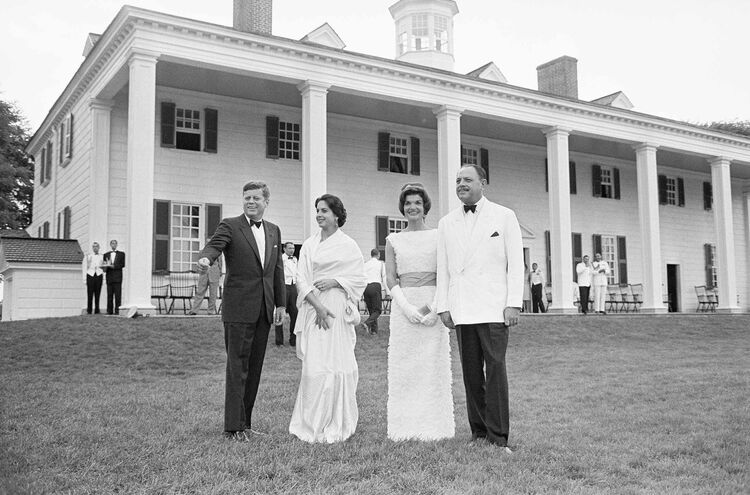
Before Jackie Kennedy goes to India and Pakistan, there’s a very high-profile visit to Washington by Pakistani President Ayub Khan, and a big dinner at Mount Vernon. His daughter, Begum Naseem Aurangzeb, acted as his First Lady. I looked up pictures of the dinner and there was Naseem in her sari. My grandmother taught her to wear a sari.
It’s the most iconic, elaborate, creative state dinner ever. They sailed down the Potomac River to Mount Vernon at dusk — orchestras on the banks. There’s been nothing like it since. 5
5 It was quite a feat of organization, from choosing a menu that could be prepared at the White House and then transported, to trying to deal with mosquitoes at Mount Vernon. The photographs certainly brought back memories — my grandmother Tahirah knew Naseem’s parents and had taken the younger woman under her wing as she began to represent Pakistan overseas.
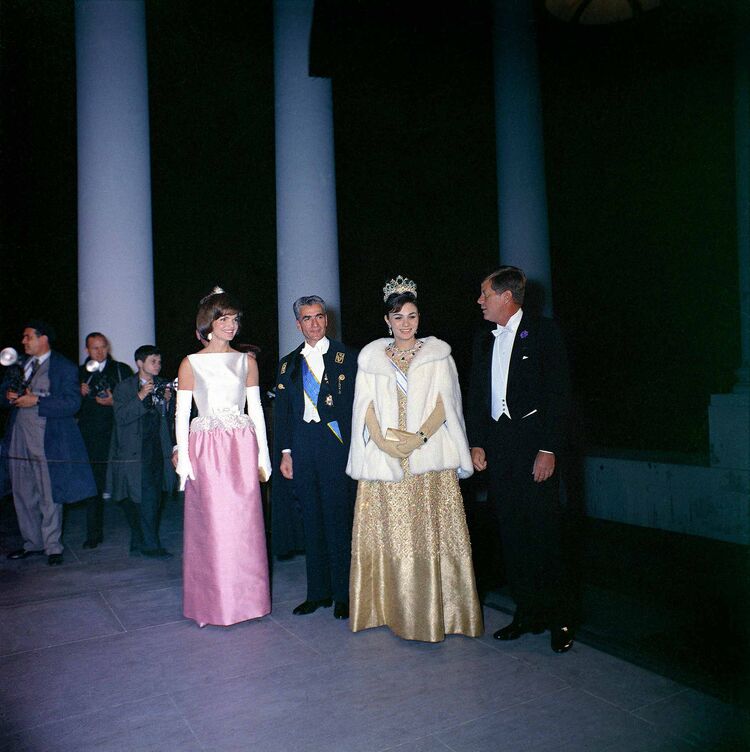
I’d love to talk a bit about your lens on this as an Iranian-American. There is a moment in this book when your worlds intersect: Empress Farah Pahlavi of Iran comes to the White House.
It was a style showdown. President Kennedy teased Jackie, You should get your jewels out . You need to make sure the Empress doesn’t outshine you. It was fun to see how both of them [were] watched on the world stage to see who — for the glory of their nation — was the most sparkling woman on the stage.
Bring us up to the present day, and this extraordinary year between Iran and the United States. You must feel it, as well as analyze it? What didn’t you expect?
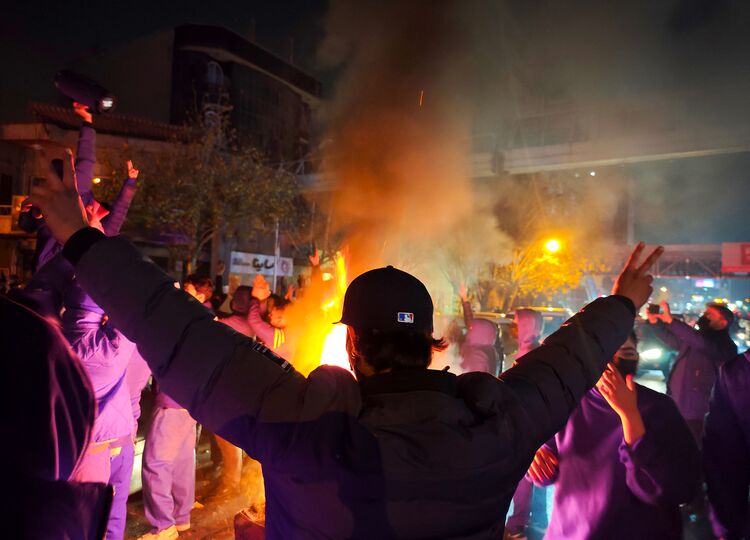
I didn’t expect Iranians to turn out in January against the regime in the way they did.
Of course, they’ve been impoverished and angry for many years now, and have managed to carve out space for themselves to have more civil and social liberties through civil disobedience campaigns. The Woman, Life, Freedom movement really ended dress codes in Iran.
I didn’t expect them to respond to the call of the crown prince in exile, Reza Pahlavi. Those of us who covered the Iraq war saw that the role of the diaspora can be over-imagined by politicians. It can be very risky to put hopes on a diaspora leader to be part of an agenda — military or otherwise — for change in their home country. 6
6 Moaveni is referring, I think, to Ahmed Chalabi, who left Iraq as a child in 1956 and, from exile in the US, encouraged the war that ended the regime of Saddam Hussein.
Then the war began. What are your conclusions about what that movement in January could have grown into, in different circumstances?
It’s a very good question, because we almost forget about the few weeks in between. Iran went quite rapidly from a terrible massacre [to the war]. The numbers are disputed, but [there are] accounts of 5,000-7,000 killed by the regime in 48 hours. 7
7 Iran’s biggest demonstrations since the Revolution were followed by a security-forces crackdown in early January, characterized by Amnesty International as “mass unlawful killings on an unprecedented scale.” The precise number of dead has been impossible to verify, not least because of a regime-imposed internet blackout over the key period.
Had there been any kind of military intervention — the assassination of the supreme leader, or any move towards war much earlier — I think the Islamic Republic might have really teetered. People were on the brink and it looked like things could collapse.
But [in] the weeks in between, people came to understand the scale of atrocities. That frightened them. This is a country that went through the profound trauma of these massacres — that have no precedent in living memory — and was figuring out how to even countenance, or think about its relationship with the system in the aftermath. And then, this war.
President Trump did say at the time of those protests, Help is on the way .
It was not on the way. People were not aided or assisted. Whether they ultimately would’ve wanted that, I don’t know.
But then the war didn’t turn out to be just a war of decapitation, striking military sites and the regime. Civilian infrastructure — a school in Minab — was hit. Many of those who at the outset thought, Perhaps this will save us , saw this was not just a war against the regime but a war against the whole country.
When you were there recently, did you feel the regime was stronger?
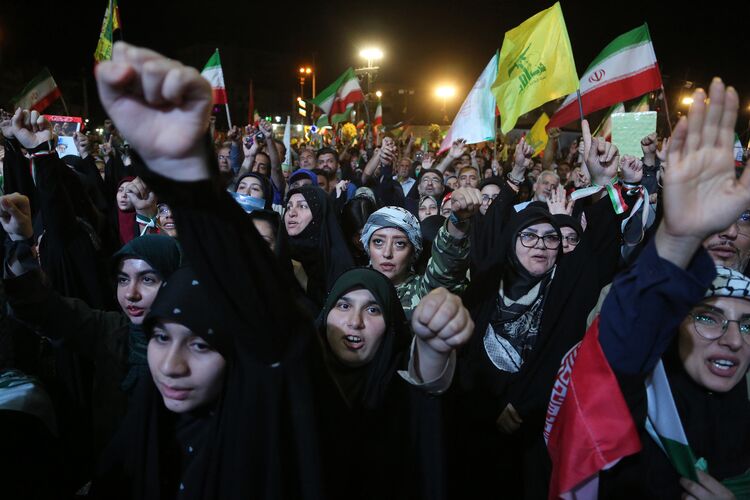
When Tehran was being bombarded, there was a real kind of seizing up of nationalism: a sense [that the] system, for everything else that it had done, was defending the country.
That has really started to evaporate. They were relieved that this memorandum of understanding was signed by the US, and now watch what the regime is doing — firing on ships in the Persian Gulf, seeking out provocation again. The mood has shifted once again towards anger and frustration: You defended us well, now go back to the negotiating table, make some concessions, we want this war to end . This regime seems like it can deliver some war, but it can’t deliver peace.
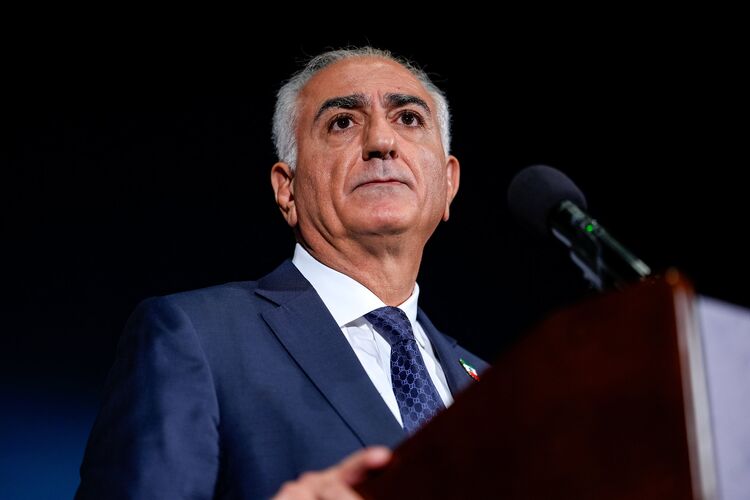
Do you think Reza Pahlavi could still be a future leader, or has that moment passed?
The moment passed. There was much hope in him and he performed really badly. He was never able to walk the line of being a nationalistic protector of the country, never able to say, I don’t want my country to be attacked . I am worried for the state of my country. I mourn when my compatriots are killed in US attacks. He allied himself in such a crude way with the Israelis, in a way that worried people. He never [had] the charisma, leadership and empathy that people were looking to him for. He was seen as someone who was just abetting the destruction from the outside.
There’s a lot of debate about the future of the US presence in the Middle East. What do you think it looks like?
The relationship between the US and the region will be fundamentally altered.
All the big regional players see they have to wait out this [US] presidency. The Persian Gulf monarchies who believe[d] they could rely on the US security umbrella now see they cannot.
The big US bases in Qatar, Bahrain and Saudi Arabia — do you think they will want those to come to an end, rather than the US deciding it doesn’t want that kind of presence? Or maybe it’s mutual?
Maybe it is mutual. The bases have been very hard to defend. For these countries, what is the utility of these bases if they are making [them] vulnerable? They buy [US] arms by the billions — they pay protection money, and aren’t being protected anymore.
What have these months of the war been like for you as an Iranian-American? Vali Nasr told me in March that the community was eating itself.
It has been a very painful time. 8
Many diasporas become so out of touch with the suffering of people in the homeland that their politics almost detach. Maybe Cuban-Americans are similar.
8 Moaveni writes in her 2005 memoir, Lipstick Jihad , of being born in California “into the lap of an Iranian diaspora community awash in nostalgia for an Iran many thousands of miles away.” Later, while working in Tehran, she came to see Iranian society as “culturally confused, politically deadlocked and emotionally anguished. While the vast majority of Iranians despised the clerics and dreamed of a secular government, no easy path to that destination presented itself.”
Most Iranians inside Iran are angry at the US for attacking their country, but do not see the US as a reason for why Iran is in the dreadful hole it’s in. They hold the Islamic Republic accountable.
The diaspora are just like American leftists: They’re anti-imperial, angry at the US. [But] the United States is not ultimately responsible for the welfare of Iranians. The Iranian leaders are.