When financing gets more expensive, companies usually slow down their bond sales. Tech companies have instead been ramping up this year, and talk this week of potential big financings from SpaceX and Broadcom Inc. only amplified investor fears about the wave of coming debt.
Big tech companies known as hyperscalers are willing to pay higher yields, because they’re borrowing to fund artificial intelligence investments like data centers and AI chips, and their potential profits are enormous. OpenAI expects its annualized revenue to reach $70 billion or more by the end of the year.
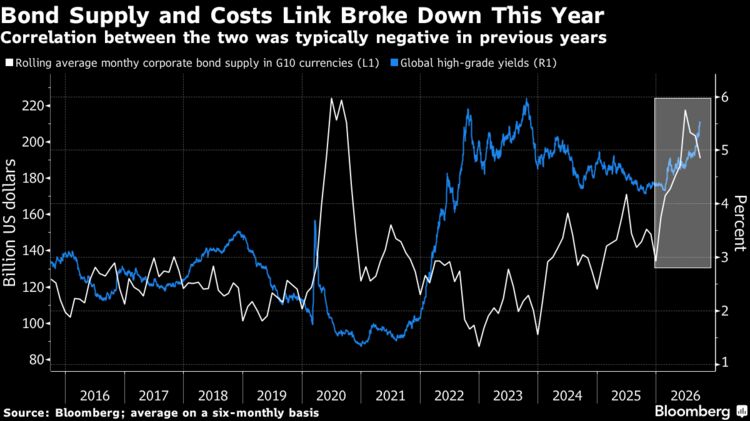
But their willingness to borrow even when credit is growing more expensive threatens to disrupt a longstanding safety valve in debt markets, where rising borrowing costs typically cut into issuance and give investors relief from new supply. For a decade through 2025, high-grade debt sales were negatively correlated with borrowing costs, as companies tended to avoid selling bonds into a weakening market, according to data compiled by Bloomberg.
This year that relationship has flipped, with yields and the supply of new bonds climbing together. Companies have sold $1.69 trillion of US corporate bonds this year, up about 30% from the same time last year, while average yields this year have risen about 1.2 percentage point to 5.97% as of Thursday’s close.
“Capital expenditure from hyperscalers is expected at around $1 trillion next year, which means AI bond issuance isn’t going to slow down despite the higher-rate environment,” said Scott Schulte, global co-head of investment grade debt syndicate at Barclays. “There’s a lot of investor concern about the market’s ability to absorb all the supply, especially when several European elections coming up may push global yields higher.”
Those concerns are showing up in credit derivatives and risk premiums on many tech companies, which broadly rose on Wednesday and Thursday after reports of additional big tech financings coming.
Bloomberg and other press outlets reported that Elon Musk’s SpaceX is in talks with banks and investors to raise $40 billion to buy chips from Nvidia Corp. It would be among the biggest-ever debt financings for the AI buildout. The deal is expected to close next year.
Broadcom Inc., meanwhile, is sketching out plans for another blockbuster deal to help OpenAI buy custom AI chips that the two companies are developing together, Bloomberg and other press outlets reported this week. That’s soon after Broadcom started to gather $60 billion of AI chip financing to benefit Anthropic PBC and other companies.
Even if this fundraising doesn’t happen this year, the deals underscore how relentless the wave of debt hitting the market is. Rising yields might not have much impact on their demand for capital: an increase of 0.25 to 0.75 percentage points in credit spreads would mostly only affect the makeup of issuance for hyperscalers, with more borrowing moving to the short end, according to strategists led by Craig Nicol at hedge fund Sona Asset Management in a note dated Sept. 2026.
“Price-insensitive” supply is how Hans Mikkelsen, TD Securities’ US credit strategist, put it in a note to clients in late September, pointing to both artificial intelligence-related activity and M&A. He expects spreads will widen further to accommodate the extra supply.
For most other companies, rising yields will slow down issuance, as evident this week. In the US, corporations sold just $11.4 billion of notes, less than the $25 billion to $30 billion that dealers had expected, after average yields for investment-grade firms globally have risen to about 5.5%, or within half a percentage point of their post-financial crisis high. They were below 5% in early August.
In Europe, bond sales reached €16.2 billion ($18.1 billion) this week, trailing even the most pessimistic estimates in Bloomberg’s weekly survey.
Yields are rising for a host of reasons now. In addition to corporate financing for AI, governments are borrowing more , and inflation fears have grown in recent months as the standoff between the US and Iran persists.
It’s hard to pinpoint when funding officers will decide to raise debt or hold back over time. Still, the rolling average of bond sales among high-grade firms globally has tended to move in tandem with funding costs, with some lag, based on data compiled by Bloomberg.
“We have been working on a number of transactions that for now haven’t seen the light of day yet because of the sticker shock,” said Antoine Baudron, co-head of capital markets, EMEA at MUFG. “Internally, they are not ready as these are not the levels they were expecting.”
Click for a podcast about Blackstone predicting a quant investing boom
| What to Watch |
|---|
|
Week In Review
-
Around 40% of France’s corporate bonds
traded this week
as if they were safer than government debt, up from just €12 billion worth at the start of the year, as investors grow increasingly alarmed about the country’s budget deficits and political dysfunction. Air Liquide
sold
€2 billion of euro-denominated bonds this week at yields below those of French government debt.
- Yield spreads between the government’s benchmark 10-year bonds and their German counterparts have widened to levels not seen in more than a decade, while a gauge of French banks’ credit risk surged above major European peers. France is Europe’s most distressed corporate market .
- Stress is also showing signs of building among the weakest US leveraged loans, as investors fret about companies getting disrupted by AI, as well as rising rates weighing on solvency. The value of loans trading below 60 cents on the dollar climbed to $65 billion, from $40 billion, according to JPMorgan Chase strategists. That’s the highest level of deep distress since March 2020, amid the height of the Covid-19 selloff.
-
Even amid these signs of pressure, and reports of big financings in the works from SpaceX and Broadcom, global corporate bond markets remained relatively sanguine. Spreads on global high-grade corporate bonds narrowed 2 basis points to 87 basis points during the week through Thursday.
-
Leveraged loan funds are seeing big inflows as investors gravitate toward floating-rate debt amid rising yields, and banks are looking to sell around $13 billion of buyout loans in the coming weeks.
- A €2.35 billion-equivalent offering to support Lone Star Funds’ acquisition of Continental AG’s industrial unit kicked off Friday. Banks are looking to sell around $13 billion
-
Leveraged loan funds are seeing big inflows as investors gravitate toward floating-rate debt amid rising yields, and banks are looking to sell around $13 billion of buyout loans in the coming weeks.
- Hamza Lemssouguer’s Arini Capital Management opened its credit trading strategy to new cash after two years even as the firm’s main hedge fund suffered losses for five consecutive months amid widespread market dislocation. The London-based firm raised $1.5 billion for Arini Credit strategy. The firm’s main fund lost an estimated 5.6% in September, worsening its decline this year to 13.5%
-
JPMorgan is
dangling
a yield of about 11% on a $5 billion leveraged-loan sale on behalf of Volta Infrastructure, one of the highest borrowing costs seen in the market for risky debt that’s become popular for financing the AI boom.
- In Asia, a new wave of artificial intelligence debt financing is taking off, with banks playing key roles in so-called GPU loans totaling roughly $3.8 billion to GMI Cloud and two other AI infrastructure providers, Zankore and PaleBlueDot AI.
- Chinese AI champion DeepSeek is close to securing at least 80 billion yuan ($12 billion) in its latest round of funding, with Tencent Holdings Ltd. committing financing. while Tencent itself is mulling an offshore bond sale of as much as $5 billion.
- Larger asset managers including Goldman Sachs Group Inc. are looking to snap up CLO management businesses as they hunt for lucrative fee streams in the $1 trillion US market. Some $30 billion of corporate M&A activity involving CLOs has taken place so far this year, already the highest since 2022, according to Nomura. The tally could leap higher if $37 billion credit manager Palmer Square is sold to Goldman Sachs or other bidders.
- Apollo Global Management has traded more than $35 billion in private credit since it began making markets in the asset class, according to John Cortese, partner and co-head of corporate credit. It’s the latest sign of the industry’s broader effort to boost transparency. Apollo is rolling out daily prices across its $850 billion credit business to address investor concerns over liquidity and loan valuations.
- AMC Entertainment closed a $4 billion debt refinancing , capping six years of efforts to avoid bankruptcy or a full-fledged restructuring. In a twist, Deutsche Bank Distressed Products Group, a onetime spurned creditor of the cinema chain, was key to getting the deal over the line.
- The owner of Market Financial Solutions is facing a growing barrage of lawsuits as creditors try to recover about £2.3 billion ($3 billion) of loans they had extended to the UK property company that collapsed amid allegations of widespread fraud.
- Morgan Stanley has invited banks to buy pieces of a $3 billion loan that helps fund Royal Caribbean Cruises ’s purchase of a 50% stake in Sandals Resort International.
- Virgin Media O2’s US junk bonds sank early this week after a UK competition watchdog signaled it could block a major broadband consolidation plan, potentially complicating the British telecommunication company’s ability to manage its multibillion debt pile.
On the Move
- Ken Prince is leaving Advent International after a decade at the private equity firm, where he was co-head of the capital markets group. It wasn’t immediately clear what Prince’s next steps may be, and he didn’t respond to requests for comment.
- Edgar Matthews , a boutique middle-market investment bank, has hired Donovan & Co. ’s Jamie Showers to lead its syndication and sales desk for structured transactions.