Europe’s political class is showing the first signs of bending to the will of an unforgiving bond market.
Budget policies and discourse from London to Paris and Rome have taken baby steps toward prudence in the past couple of weeks as surging yields and soaring interest-rate costs drummed up memories of the euro-zone debt crisis.
France’s budget aimed at shrinking its bloated deficit, and signs of pragmatism from far-right presidential challenger Marine Le Pen suggest retreats from profligacy. Prime Minister Andy Burnham’s proposal to end the UK’s totemic “triple-lock” state pension regime and Italy’s pared-back defense borrowing do so too.
Such concessions may fall short of deterrence against the bond vigilantes whose speculative trading once nearly broke the euro. It’s also too early to tell whether they amount to a sea change for an indebted subset of the Group of Seven, or just short-lived gestures.
But the direction of travel signals the message from investors who pushed bond yields to the highest in decades is starting to get heard. That’s all the more noticeable given the contrast with Washington, where politicians are arguably less focused on the need to stop rapidly rising debt.
“Acknowledgement of fiscal problems is now I think well understood in Europe around the policy makers, around economic actors and probably now also more and more around the population,” said Federico Barriga-Salazar, head of the western European sovereigns team at Fitch Ratings.
Bonds slumped around advanced economies in recent weeks as financial markets braced for greater price pressures driven by the Middle East energy crisis.
France stood out, with the extra yield demanded by investors to hold French 10-year bonds compared with those of Germany hitting its highest since 2011.
Italy’s spread surged too, spillover that underscores how a tamer deficit than its northern neighbor can’t obscure a debt mountain that will soon be Europe’s biggest.
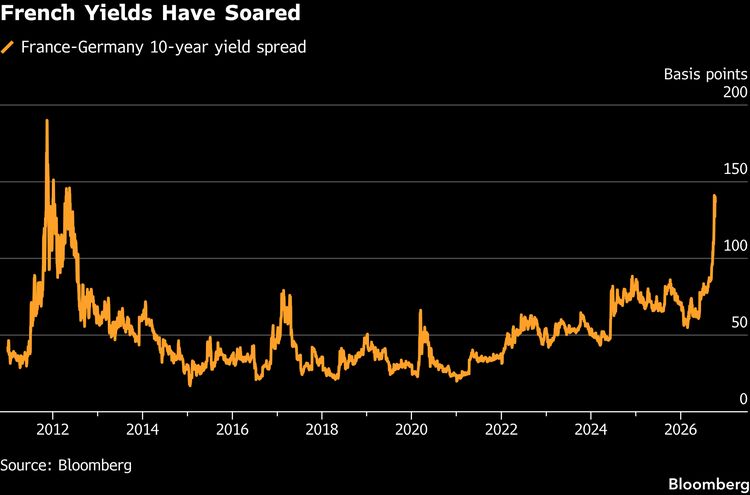
The UK has seen its own bond yields hit multi-decade highs, with pricing that includes what Bloomberg Economics calculates as a 30 basis-point risk premium to reflect in particular the policy missteps of former prime minister Liz Truss.
Such gyrations have sparked alarm in Europe’s corridors of power.
“What I am emphasizing is the need for fiscal prudence, especially in the light of current bond-market developments,” European Commission finance chief Valdis Dombrovskis said on Thursday , pushing back against proposals from Italy and Greece for additional budget leeway.
Even so, the tentative evidence suggests that, despite the need to woo voters for upcoming tests in key economies, politicians are paying more attention to yields.
“We would expect opposition political parties, particularly in France, Italy, Poland and Spain where elections are due this year and next, to try much harder to reassure markets about their willingness to keep deficits in check,” said Carlo Capuano, deputy head of sovereign & public sector at Scope Ratings.
A senior euro-zone official, speaking on condition of anonymity because of the sensitivity of the matter, observed last week that bond markets are imposing some discipline.
Already on Sept. 24, as the surge in French yields gained momentum, Le Pen sought to avoid being seen as an instigator of trouble. She indicated then that she may refrain from trying to topple the government over the 2027 budget.
“A bond market crisis could erupt overnight,” Le Pen said . “I’m thinking of what’s in the interest of my country and my people.”
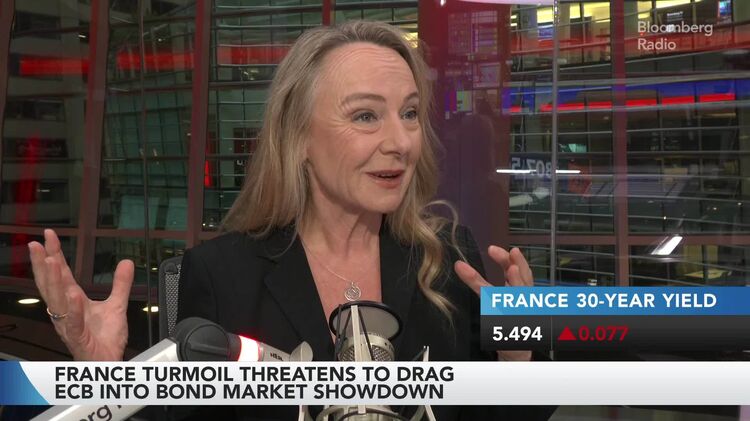
The budget presented a week later featured €43 billion ($48.3 billion) in measures to bring the deficit down to 5% next year from 5.4% — a plan touted by Finance Minister Roland Lescure as a “significant effort.”
Le Pen’s own proposals for a deficit cut to as low as 3.7% in 2027, albeit lacking in detail, similarly amounts to an ostensible concession toward prudence.
‘It has to be recognized that the pressure from financial markets helps us a bit — today, I’ve not heard a party calling for fiscal easing,” Lescure told the AJEF journalist association in Paris this week. “I have the impression that even Le Pen has converted to fiscal discipline.”
In Italy meanwhile, the widening spread last week appeared to have concerned Prime Minister Giorgia Meloni enough to prompt a last-minute cutback in defense borrowing totaling as much as €8 billion. Rome now intends to spend 0.6% of output on more military outlays over two years, down from 0.9%.
UK Fallout
The full fiscal implications of Burnham’s party conference speech on Sept. 29 are unclear, though his pledge for a reform to avoid perpetuating drastic pension increases after years of political prevarication is arguably highly symbolic. He vowed to “project a message of confidence and stability to markets and the world.”
To be sure, Burnham himself previously said that the UK should be less “in hock” to the bond markets, and plenty of European politicians have signaled similar sentiments.
Le Pen’s deficit message was accompanied by a defiant call on the European Central Bank to help out, while her French left-wing rival for the presidency, Jean-Luc Melenchon, wants a cancellation of government debt . Meanwhile Belgium, with bloated borrowings of its own, is still struggling to reach a budget agreement .
To spur action, it falls on central bankers to do the most preaching for prudence, both in private and public.
On Thursday, ECB Chief Economist Philip Lane said that “governments have to be realistic about the fact that the interest rate environment has changed,” while Bank of England Governor Andrew Bailey warned that fiscal policy must “be directed toward stability and be seen by markets as credible.”
Arguably most instructive for governments, though, is the UK’s humbling by bond vigilantes during the “mini crisis” under Truss’s brief leadership.
Meloni took office at the time of that episode, and previously served as a minister when Silvio Berlusconi’s government fell during the market tumult of 2011. Barriga-Salazar at Fitch sees the Truss incident as a parable for Europe’s policymakers.
“It is what happens when you say as a politician, ‘well, we don’t care about the market,’” the analyst said. “I think those lessons have been learned.”