Jes Munk Hansen was on a business trip to Florida in January when his head of communications called to tell him the phones were ringing off the hook back in Denmark.
Munk Hansen is chief executive of Rockwool A/S, which manufactures insulation by melting stone into fibers in factories all over the world. Several of those are in Russia — although Munk Hansen has never visited them or had any contact with their management. When Russian forces launched their full-scale invasion of Ukraine in 2022, the company decided to retain its business there, but carve out the asset and deny the Russian subsidiary access to any form of support from the wider group. Munk Hansen took over as CEO of Rockwool in 2024.
Now, journalists and analysts were calling because news had just hit the wire that the Russian government had essentially seized their factories, under a 2023 presidential decree that allows the authorities to take over businesses owned by companies from “unfriendly countries.” Rockwool’s facilities — and all of the €243 million ($283 million) of cash still in the business were now in state hands. In August, Rockwool’s Russian subsidiary sued its parent company, claiming it took 8.6 billion rubles ($103 million) out of Russia.
“We have never received a letter that officially says our business has been put under state administration. It shows how bizarre the situation is,” Munk Hansen said. “There is not much we can do. If this was in the West, there would be courts and process. We have made it clear we believe this was an illegal act against all international rules around property rights and financial governance. But I and the board have no clue where this will end up over the next few years.”
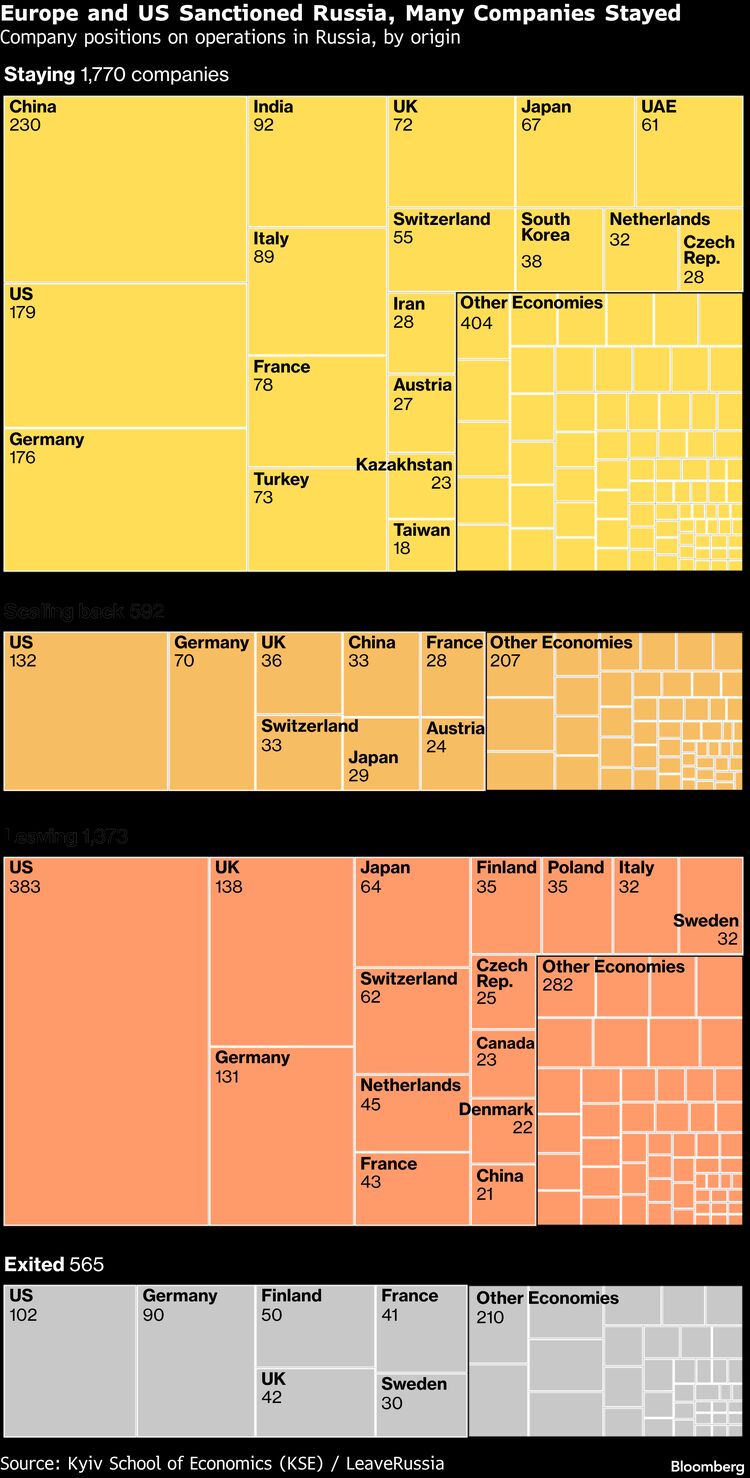
After Russia’s full-scale invasion, many international companies pulled out of the country, worried about sanctions and their reputations. Plenty of others didn’t. As of July there were more than 2,300 international businesses continuing their Russian operations, according to research from the Kyiv School of Economics. Among them are global consumer goods brands, including PepsiCo Inc, Mondelez International Inc and Procter & Gamble Co., and large financial institutions including Austria’s Raiffeisen Bank International AG and Italy’s UniCredit SpA.
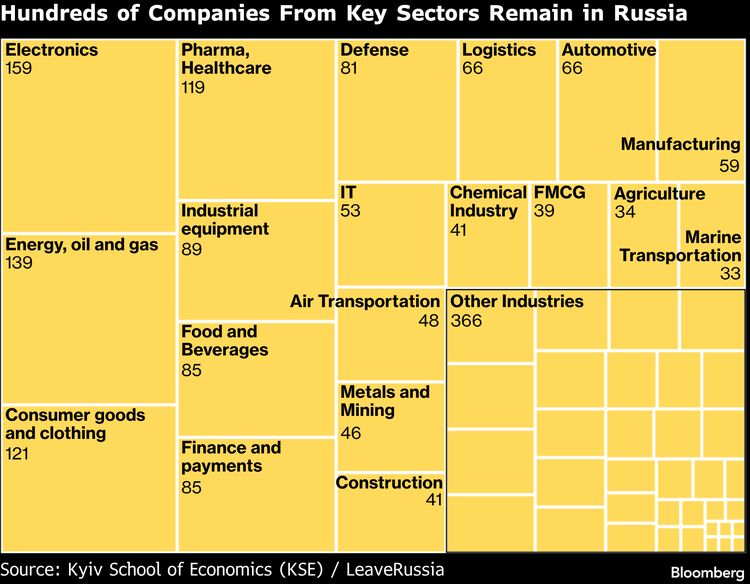
Those that stayed have had to scale back and navigate a Russian economy that’s been stretched by four-and-a-half years of war. They also face a growing risk that control of their businesses will be seized by the authorities, as Russia seeks to redistribute assets toward businesses that are friendly to the government.
In September, the Kremlin announced that it had seized management control of assets belonging to Swiss food giant Nestle SA, French supermarket chain Auchan SpA , and the German retailer Metro AG . But it’s become far harder for companies to voluntarily extricate themselves from the market. There are few buyers willing and legally able to take on Russian subsidiaries, and the authorities have created a perilous tangle of rules, taxes and legal pitfalls that make it incredibly difficult to get any of the proceeds of a sale out of the country.
To try to leave is often to essentially abandon a once-valuable asset. But to cling on in the hope things will change is to risk losing everything anyway.
“If a Western shareholder decides to stay in Russia, the question it also has to ask is, how much may I be required to invest in the business in the short or midterm in order to keep it, and how likely is it that sanctions will become more restrictive and then I can no longer operate and keep my Russia business?” said Björn Paulsen, a partner at the German law firm Noerr and head of its Russia Exits desk. “Western shareholders are worrying that their Russia assets could be taken away in the future, but effectively they have often already been taken away.”
PepsiCo, Mondelez, Auchan and UniCredit did not respond to requests for comment. Procter & Gamble and Raiffeisen Bank declined to comment. Metro said that it is analyzing the impact of the Kremlin’s decision. Nestle said in a statement that it is “committed to taking all necessary steps to protect its rights and ensure continuity of business operations in the interests of all stakeholders, particularly its employees.”
1. Fear or Greed?
There is no blanket ban on American and European firms doing business in Russia, but sanctions against many individuals, institutions and companies makes working there difficult to navigate. Even if a company can figure out how to work legally, there are ethical and reputational considerations. Operating in the country means paying taxes, which fund a war of aggression that’s led to the deaths of thousands of civilians and hundreds of thousands of soldiers.
Mondelez has faced sustained criticism for maintaining its Russian operations, including pressure from shareholders . PepsiCo has been the subject of several boycotts over its food and dairy business in Russia — its third largest market by net revenue. Last year, the company paid the Russian government $237 million in income taxes . Raiffeisen is one of the largest international banks still operating in Russia. Despite several attempts to exit the country since 2022, it is yet to fulfil a commitment made in 2023 to leave and is often the target of campaign groups.
Deciding whether or not to leave Russia has always been a battle between greed and fear, according to Gagik Apkarian, the founder and managing partner of Tetrad Capital Partners, an investment management and advisory firm specializing in corporate turnarounds and growth funding. “Greed is telling you to stick around because one day the war will end, it’s too big a market to ignore so you are going to have to go back anyway, so kick the can down the road and hope for the best,” he said. “Fear comes from one more company getting nationalized. You have a target on your back and you’ll be next.”
The Kremlin is also making it more difficult for international businesses to return to Russia if they leave. In August, President Vladimir Putin signed a law allowing courts to block foreign investors that exited Russia after the 2022 invasion of Ukraine from buying back any local assets they have sold.
Kremlin spokesman Dmitry Peskov did not respond to a request for comment.
Apkarian has more than three decades of experience in complex cross-border deals. Before setting up Tetrad in 2010, he managed the investments of Vulcan Capital, the private investment office of Microsoft co-founder Paul Allen, having previously worked as investment banker at Morgan Stanley and Bear Stearns.
Tetrad was hired in 2023 by the creditors and shareholders of Frigoglass, an Athens-headquartered manufacturer of commercial refrigerators and bottles, which had just completed a major debt restructuring. The company’s Russian subsidiary had been in business for more than a quarter of a century, employed around 700 people, and generated €82 million of sales in Russia in 2024 — around 20% of the group’s total revenue.
When Apkarian asked the team he formed to assess Frigoglass’s Russia operations whether the risk of staying was starting to outweigh the benefit, the answer was clear. The war with Ukraine was dragging on with little sign of ending, and well-run, cash-rich local operations of international businesses offered the Russian government both leverage to push back against Western sanctions and a potential source of financing.
“The view was that the war in Ukraine isn’t going anywhere,” he said. “As the war goes on, Russia is going to be that much more inclined to get a hand on the cash balances of these companies because they’ve got to meet the budget shortfall, fund the war effort.”
They had another motivation too — Frigoglass had to shed its Russia exposure to make it easier to sell a larger business unit. That meant it was worth entering into a transaction that the company knew would return a tiny fraction of what their operations were worth.
“At this juncture, people exit Russia for only a handful of reasons because ultimately you know you are destroying value,” Apkarian said. “That is why there is a lot of hesitation to do it, and people tend not to move until the gun is loaded and pointed at their head.”
2. Find a Buyer
Many of Russia’s most high-profile businesspeople , and those closest to the government, are the subject of sanctions in the US and Europe. Since the full-scale invasion, a handful of players have scooped up companies at steep discounts. Alexey Sagal’s Arnest Group — which mainly manufactures cosmetics and household products — bought Russian subsidiaries of Unilever Plc and Reckitt Benckiser Group Plc, and has expanded into new areas with the purchase of the local brewing operations of Heineken BV and Ball Corp’s packaging business.
Armenian investor David Amaryan’s Balchug Capital has acquired several assets, including the operations of Goldman Sachs Group and machinery manufacturer Caterpillar.
Arnest Group, Balchug Capital, Heineken, Goldman Sachs, Caterpillar and Ball Corp didn’t respond to requests for comment. Unilever and Reckitt Benckiser declined to comment.
Any buyer needs to be acceptable to the Russian government, but not be sanctioned by countries in the sellers’ home jurisdiction. Those two conditions are often mutually exclusive. Bidders also need to have some track record in closing deals to inspire trust in the seller.
“You are left with a very small universe,” Apkarian said. He estimated that there are only half a dozen viable buyers — a figure confirmed by another person who has directly worked on some of the largest Western exits from Russia in recent years, who spoke on condition of anonymity.
Just to design the auction process through which Frigoglass sold its Russian business, Apkarian’s team hired two sets of lawyers — one local, one from an international firm that had worked on similar exits — and a Russian consultant that they trusted to help vet candidates. They relied on the knowledge of Frigoglass's Russian management team to help guide the process. “Once you have the team you need to ask yourself, do I maximize value or do maximize my probability of exiting?” Apkarian said.
In Europe or the US, if a company wants to sell off an asset, it’ll do everything it can to highlight positive performance and to get the opportunity in front of as many buyers as possible. Not so in Russia in 2026.
“If you broadcast too widely that you’ve got $100 million of cash sitting on your books, and a 30% Ebitda margin, and you’re generating a ton of cash all the time, then that puts a massive target on your back,” Apkarian said.
3. Take a Haircut
Based on rules that came into effect in late 2024, transactions involving residents from countries that Russia’s government deems “unfriendly” require the seller to give a discount of at least 60%, based on a valuation set by an independent appraiser, chosen from a list of providers approved by Russia’s Sub-Commission of the Governmental Commission for Control over Foreign Investments, a body set up to review transactions as part of countersanctions measures.
“The value is determined by a Russian appraiser, so it might be a bit lower than Western shareholders expect,” said Noerr’s Paulsen.
Alongside the mandatory 60% discount, an exit tax of 35% must be paid to the Russian government, again based on the valuation agreed by the appraiser.
The American fiber laser manufacturer IPG Photonics sold its Russian operations in 2024 for $51.1 million, less than the $74 million of cash that the local subsidiary had on its balance sheet. In total, IPG Photonics recorded a $197.7 million loss on the sale, according to SEC filings. IPG Photonics didn’t respond to multiple requests for comment.
The discount applied to deals is not uniform. While 60% is the minimum it can be much higher.
“What we have seen is that the government commission turns around and requests an 80% discount rather than a 60% discount,” Paulsen said. “This has happened and then as a seller you have to decide whether you walk away from the deal or not. We’ve seen cases where the seller has said 20% is still better than nothing, and there have been cases where the seller has decided not to proceed.”
The 60% discount tends to be seen in processes where there is significant competition among bidders. The average across all transactions could be as high as 65% or 70% since 2025, Paulsen said.
Other issues can also arise. For example, a competitive bidding process may take place, but the government could refuse to give permission for the sale unless the asset is awarded to a buyer that it deems acceptable, Apkarian said.
Who pays the exit tax is also up for debate. Both Paulsen and Apkarian said that the burden can sometimes be shifted onto the buyer, who is already getting a very cheap deal based on the discount being offered by the seller.
Still, the economic cost of these mechanisms is reason enough to give companies pause for thought. But so are the moral implications. Rockwool’s Munk Hansen said that they could not justify transferring so much value into the pockets of the Russian state and local businessmen. “You would be gifting an oligarch or the state 95% of your assets,” he said. “We could not put ourselves in a place where we felt comfortable giving a gift of that magnitude to Russia.”
4. Do Your Homework
Identifying which buyers and transaction structures are compliant with US and European sanctions — and which stand a chance of receiving consent from Russian authorities — often means negotiating across several jurisdictions.
Where a company’s owners are based ultimately dictates which approvals are needed and each sanctions regime is different. In the case of Frigoglass, the entities that owned the Russian business were Dutch and Cypriot.
Both countries are members of the European Union and governed by the bloc’s sanctions regime. However, the EU itself does not issue licenses, instead delegating that job of approving the sale of Russian subsidiaries to the competent authorities in each member state. This meant Frigoglass’s team had to approach both the Dutch Central Import and Export Office and Cyprus’s National Sanctions Implementation Unit. The ultimate owners of Frigoglass’s European entities are American, so the company also had to obtain a license from the US Office of Foreign Assets Control, the department of the Treasury that enforces economic sanctions.
Because exiting Russia involves a payment being made to a sanctioned entity — the Ministry of Finance — most businesses will likely need an OFAC license if they have any touch points with the US, Bijan Ganji, a partner at Milbank, the law firm that helped Frigoglass get its OFAC license, said.
The due diligence process on buyers can be lengthy too. “The buyer could have business associations with sanctioned parties, or there could just be speculation about them having these associations,” Ganji said. Trust structures are commonly used to hide the ultimate beneficial owner of companies.
“These may look legitimate on the surface,” Ganji said. “But you have to peel the onion, and once you’ve done that, you may learn that the trust’s beneficiaries are family members of a Russian oligarch.”
As well as getting permissions in Europe and the US, a company selling in Russia has to get approval from the country’s Government Commission for Control over Foreign Investment, an opaque process in which various government bodies and local business interests can lobby to disrupt the deal for their own ends.
When the Russian subsidiaries of brewer Carlsberg and yogurt-maker Danone were placed into state administration in 2023, both were in the process of trying to sell the businesses. The companies were eventually allowed to complete sales.
Carlsberg and Danone declined to comment.
Once a company has all the approvals in place, there’s no guarantee that it can ultimately get its money out of Russia. A presidential decree in 2022 created “Type C” accounts, which hold funds paid to foreign companies from countries deemed hostile to Russia.
Other than for exits that require presidential approval, which are bespoke and are determined on a case-by-case basis, the decision determining where proceeds from an asset sale are sent is at the sole discretion of the Sub-Commission of the Governmental Commission for Control over Foreign Investments. Since 2025, the default position of the commission seems to be to direct proceeds of sales into these Type C accounts, according to people familiar with the matter, who spoke on condition of anonymity.
While it is still possible to release the payments to entities outside Russia, it requires great care, precise reasoning and well-connected Russian counterparties, they said.
It is practically impossible for a foreign owner to access the money in a Type C account. The best case scenario is that the money will be made available if and when relations between Russia and the West normalize.
“Then there is the other version where essentially the government is just taking the money,” Apkarian said. “So that is why, if you have money sitting in a Type C account, you should attribute zero value to it.”
Apkarian’s team searched for Russian intermediaries that would buy the money held in a Type C account at a discount, for example, 20 cents on the dollar. “We couldn’t find anyone like that,” he said. In the end, the Frigoglass team managed to avoid having their sale proceeds sent to a Type C account, although Apkarian would not disclose how this was achieved beyond him having “a team on the ground that knew what they were doing.”
It took Frigoglass three months to put together a team, and a year to complete its exit, which was finalized in May 2026.
5. Don’t Get Noticed
The Kyiv School of Economics’ data shows more than 190 businesses leaving Russia in 2023. The annual total for last year dropped to 80. During the first six months of 2026, only 18 exits were recorded. Of those, just eight were assessed as being voluntary sales, the rest made up of liquidations and seizures. “This means that some of the most recent exits are no longer really voluntary exits in the traditional sense,” Andrii Onopriienko, deputy development director at the KSE, said.
In July, stakes in three Russian companies owned by the Dutch firm Akzo Nobel NV were transferred into temporary administration. The company appointed to administer the assets, AO Razvitiye Stroitelnykh Aktivov, is the same firm that took control of Rockwool's factories.
“Russia is increasingly taking control of foreign-owned assets through temporary administration, seizures and other mechanisms,” Onopriienko said.
Akzo Nobel declined to comment. AO Razvitiye Stroitelnykh Aktivov didn’t respond to a request for comment.
Munk Hansen thinks he knows one of the reasons Rockwool’s Russian factories came to the attention of the authorities. Since the start of the war, the company had been able to withdraw 400 million Danish krone ($62 million) from its Russian factories. Over the same period it gave 500 million Danish krone to reconstruction projects in Ukraine, and set up a foundation dedicated to financing these initiatives.
“Our position was that we wouldn’t engage in a transaction that benefits Russia, but we ourselves do not need to benefit from the business,” Munk Hansen said. “Whatever we could pull out, we gave to Ukraine.”
Rockwool has faced considerable criticism in Denmark for staying in Russia. Munk Hansen said he doesn’t regret the decision.
“We kept our assets out of the hands of the Russian oligarchs and the state for four years," he said. “For those four years we managed to move assets out of Russia and into Ukraine, which benefited civilians by building hundreds of apartments and schools. I think we did the right thing, ethically and operationally.”