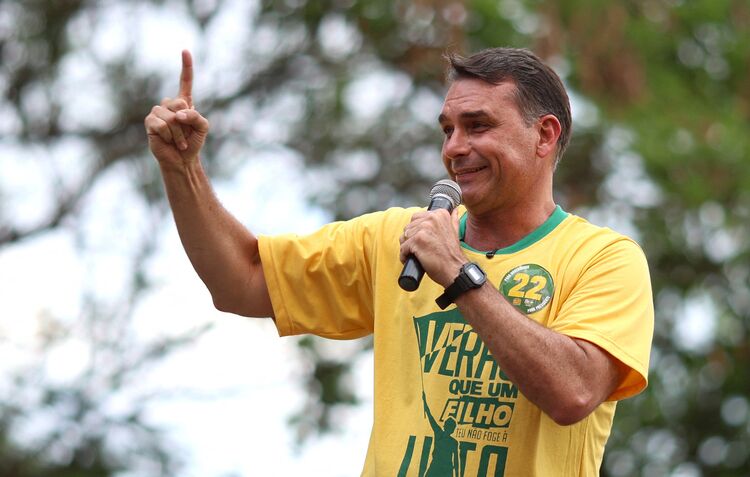
Brazil’s election runoff between conservative Flávio Bolsonaro and leftist President Luiz Inácio Lula da Silva poses a stark choice on the future of the Amazon and the climate. The Oct. 25 vote will follow a first round on Oct. 4 in which Bolsonaro edged ahead of Lula, making him the favorite to win.
Here are the key issues on which Bolsonaro and Lula differ, and a few they agree on.
Climate change, deforestation and Indigenous lands
Flávio Bolsonaro is a senator and a son of Brazil’s former President Jair Bolsonaro. Like his family’s ally, US President Donald Trump, Flávio has repeatedly questioned human-caused climate change, and the issue isn’t part of his election platform. Asked in a recent television interview about his claim that the world was cooling rather than warming, he described extreme weather as cyclical, then pivoted to the need to expand basic sanitation in Brazil.
Flávio’s brother Eduardo Bolsonaro, a former lawmaker who is expected to have a foreign-policy role in the government if his brother is elected, said during the campaign that international climate negotiations are useless.
By contrast, Lula’s reelection platform ties environmental policy to Brazil’s nationally determined contribution, or NDC, under the Paris Agreement. That calls for cutting net greenhouse-gas emissions by 59% to 67% by 2035, from 2005 levels, and renews a pledge for net-zero deforestation by 2030.
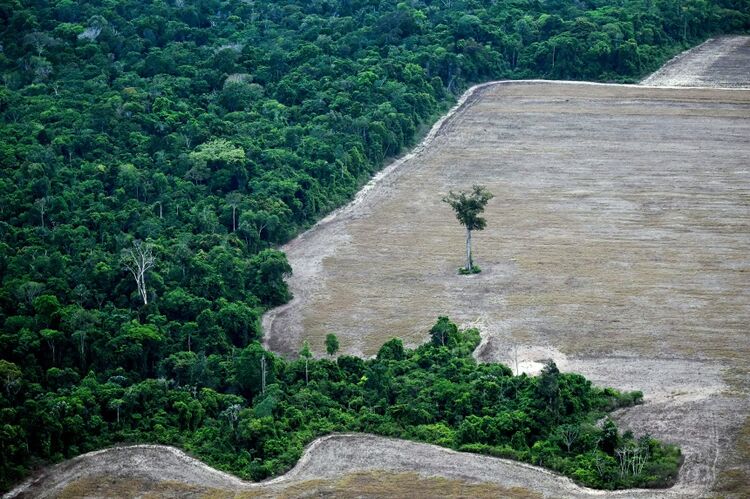
Land-use change, driven largely by deforestation, remains Brazil’s largest source of greenhouse gases, accounting for about 40% of gross emissions.
Read More: How Saving Brazil’s Rainforest Pushed the Crisis Into Bolivia
Last year, Brazil hosted COP30 in the Amazonian city of Belem . Lula has sought to position the country as a global leader on forest protection and climate finance, with efforts to mobilize more funding from rich countries for mitigation and adaptation. His predecessor, Jair Bolsonaro, never attended United Nations climate talks. After Jair Bolsonaro was elected in 2018, Brazil withdrew its offer to host COP25 .
Flávio Bolsonaro has pledged to reach zero illegal deforestation by 2029. But the definition of “illegal” isn’t permanently fixed; laws determine how much land clearing is permitted, and Bolsonaro’s allies in Congress have pushed to make deforestation legal in more cases.
If he wins, his favored policies will be easier to get through Congress, thanks to election gains by his Liberal Party in both houses. Many of the party’s candidates ran and won on pledges to roll back environmental protections.
Lula and Bolsonaro also diverge sharply on the matter of Indigenous territories. Lula has promised to continue demarcating Indigenous lands and conservation areas. Bolsonaro, consistent with his father’s previous policy, has made no such pledge. Instead, his allies have pushed to open Indigenous territories for mining and commercial farming.
Indigenous lands have proved particularly effective at preserving rainforest. Less than 2% of their area in the Amazon was deforested over four decades, compared with 27% of the biome overall, according to official data.
Deforestation spiked during Jair Bolsonaro’s presidency from 2019 through 2022, a trend that Lula’s government has recently reversed .
Energy expansion and development in the Amazon
There are a few points where Flávio Bolsonaro and Lula’s platforms converge.
Bolsonaro backs the expansion of oil production into the mouth of the Amazon River — one of Lula’s more controversial initiatives in the Amazon. Both support paving a federal highway that cuts through hundreds of miles of preserved rainforest. Lula has worked to grow the carbon market, and Bolsonaro has defended carbon credits and the creation of economic value without deforestation.
On the energy transition, both candidates propose expanding renewables, including solar power and biofuels.
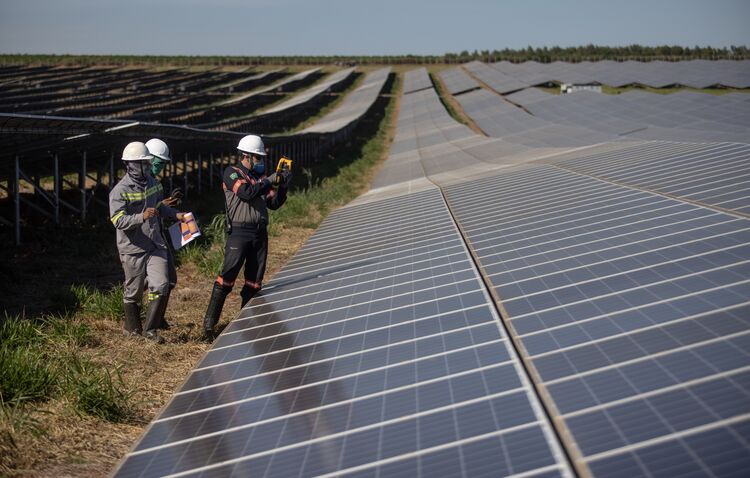
Still, there are differences. Lula calls for the gradual phaseout of fossil fuels and participation in a global roadmap away from them, even as he supports continued oil and gas exploration. Bolsonaro wants more oil and gas development and he explicitly backs fracking, although there are currently no commercial fracking operations in Brazil and it’s subject to a legal review.
The Bolsonaro campaign said his environmental agenda would combine stronger monitoring of and enforcement against illegal deforestation with economic incentives for conservation. The campaign added that proposals would be refined during the transition and in talks with Congress and civil society. It didn’t answer questions about whether Bolsonaro would support measures that reduce existing forest protections or about his position on human-caused climate change.
Lula’s campaign said the president remains committed to ending deforestation by 2030 and meeting Brazil’s NDC even if he has to govern with a Congress more hostile to his environmental agenda next year.
Environmental groups in the country have raised alarm at the prospect of a Bolsonaro win. “It’s hard to imagine anyone worse to lead Brazil in the coming years, as the world surpasses 1.5C of warming,” Climate Observatory, Brazil’s leading umbrella organization on climate change, said in a statement.
Brazil holds two-thirds of the Amazon, the world’s most biodiverse forest and a crucial global carbon sink . If it were totally deforested, average temperatures worldwide would rise 0.25C beyond the expected warming, according to one study.
Ana Yang, director of the Environment and Society Centre at the UK-based think tank Chatham House, wrote that the Amazon would be at risk under a Flávio Bolsonaro presidency, particularly if he were to follow the approach taken by his father. Bolsonaro could weaken enforcement of rules and, with support from Congress, would have greater scope to loosen environmental licensing requirements and protections.
Yang argued, however, that a Bolsonaro administration would have far less room to alter Brazil’s renewable-energy trajectory. Hydropower, wind, solar and biofuels benefit from structural advantages including competitive costs, rising electricity demand, established infrastructure, private investment and powerful domestic industries.