President Donald Trump has long viewed the stock market as a referendum on his performance. Although the S&P 500 Index closed at an all-time high this week, it did so on the strength of a handful of companies focused on the booming artificial intelligence sector, papering over signs of growing vulnerabilities in the economy and financial markets. With the midterm elections less than a month away, what Trump sees as an asset for Republicans may in fact be a liability.
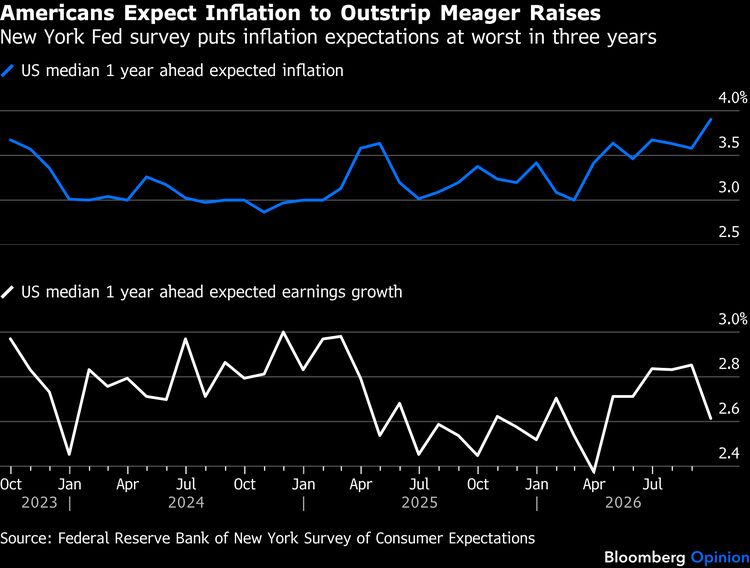
Most everyone knows this is an economy reeling from inflation that remains stubbornly high and unchecked fiscal budget deficits. But less well known broadly — though felt individually — is that average hourly earnings adjusted for inflation have been losing ground for five months. Also, a Federal Reserve Bank of New York report this week showed Americans expect their earnings growth to lag even further behind consumer inflation in the next 12 months, due in part to the surge in gasoline and diesel prices caused by the US-Israel war with Iran. That’s in addition to efforts underway by the White House to find workarounds to reinstate the inflationary tariffs deemed illegal by the Supreme Court.
A budget deficit of around 6% of gross domestic product exacerbates the challenges facing Americans. Yields on benchmark 10-year Treasury notes, which are used to help set borrowing costs for businesses and households, touched a two-decade high of 5.36% this week. Since mid-September, the term premium — the extra yield investors demand to hold longer-maturity bonds rather than shorter-term notes — has risen in a sign of deteriorating faith in the administration’s ability to rein in the deficit or government borrowing that now totals some $40 trillion. As a result, would-be homebuyers and small businesses reliant on variable-rate loans are being punished. No wonder consumer confidence is the lowest in 12 years, and delinquent credit card balances are near the highest since 2010 .
The upshot is that stocks of companies in the consumer, travel, transportation, real estate and financial sectors have been falling, with the median S&P 500 stock down around 4.3% in the past month. The poor performance infecting much of the stock market is being overshadowed by the seeming strength of the AI sector, from Meta Platforms Inc. and Microsoft Corp. to chipmaker Nvidia Corp. and the broad universe of semiconductor stocks. The thing to understand about this is that the hundreds of billions of dollars that AI hyperscalers are spending to build data centers are helping line the pockets of suppliers, with the continued strength of the entire industry depending on success in monetizing AI in short order — not to mention overcoming community opposition to data centers that is growing across the country.
How unusual is a market reaching records on such poor breadth? Consider that Tuesday marked the first time that the S&P 500 rose to a new high with just 30% of members above their 50-day moving averages. Although ominous comparisons are often made to the dot-com bubble, the narrowest market high in the 1998-2000 period saw 41% of S&P 500 constituents in an uptrend.
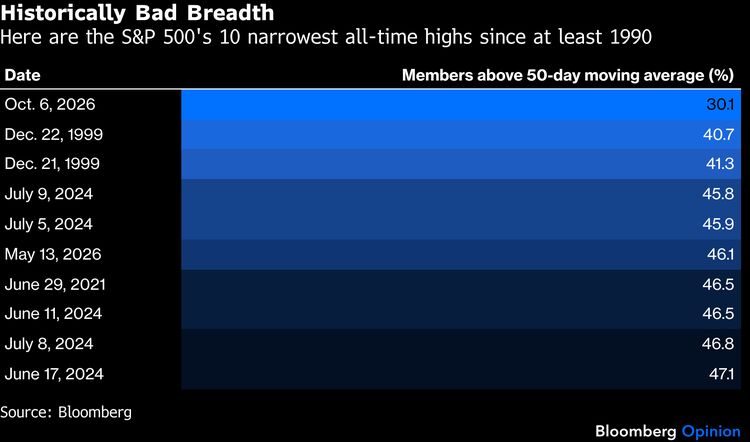
A narrow market rally is not, in and of itself, a predictor of an imminent reversal. Conceivably, the outperformers can sustain their momentum for a while, and the underperformers can catch up — or both. Count Bank of America Corp. strategists among those becoming concerned. “Low breadth is a classic feature of bubbles building and typically doesn’t stop until they pop,” the strategists wrote in a research note this week. They advise investors to consider using equity derivatives to preserve exposure to gains while limiting potential losses.
What has billionaire Michael Novogratz worried is AI, which he described on Wednesday as the “biggest bubble of our lifetime,” but said it would probably keep on inflating for now. “I know how bubbles end, and they end spectacularly, and this isn’t spectacular enough,” he said. His comments echoed those of another billionaire, Bridgewater hedge fund founder Ray Dalio, who said hours earlier that AI is a “classic bubble” that is nearing a bursting point thanks to rising interest rates and the need to turn wealth into cash.
It’s impossible to know when exactly a bubble will burst, but what is certain is that the market will crumble, and probably spectacularly, if investor sentiment turns against AI. The problem is that the risks are borne not just by those making concentrated bets on AI stocks, but by 401k investors and everyday Americans. As of 2025, around $23 trillion in assets were indexed or benchmarked to the S&P 500 (call it $27 trillion adjusting for the year-to-date runup in the index in 2026). Also leveraged to the index’s fragile value is wealth-driven consumption and, ultimately, millions of jobs.
So should the record high in stocks be viewed as the market’s stamp of approval on the Trump administration? Hardly. It’s more luck than a sign of effective policy.
More From Bloomberg Opinion:
- Earnings Will Be Spectacular. It May Not Be Enough: John Authers
- The Bond Market’s Balancing Act Is Perfectly Normal : Nir Kaissar
- AI Giants Face a Terrible Case of Chip Indigestion: Chris Bryant
Want more Bloomberg Opinion? OPIN <GO>. Or subscribe to our daily newsletter .