By Andreas Kluth | Updated on Oct 09, 2026 at 04:19 PM
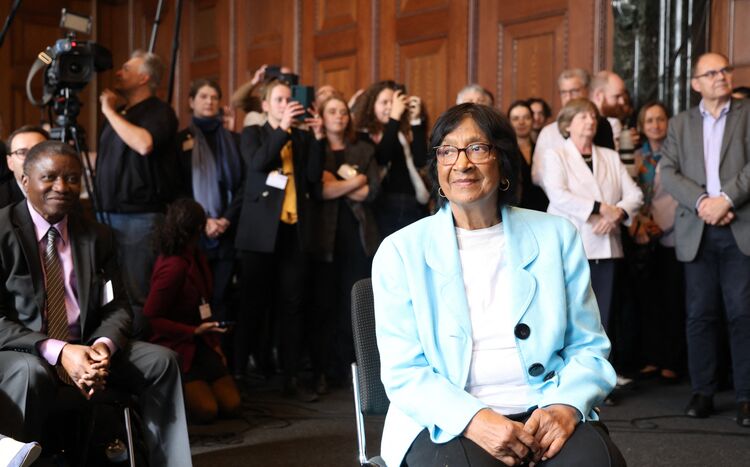
The world is watching a split screen: In one panel, humanity sees jurists such as Navi Pillay of South Africa, who just won the Nobel Peace Prize for her decades of struggling for international law, in roles such as high commissioner for human rights at the United Nations, judge at the International Criminal Court in The Hague, and president of the tribunal adjudicating the atrocities in Rwanda.
In the other panel, US President Donald Trump continues waging his full-bore assault on international law, on several fronts at once.
One attack is aimed at the International Criminal Court, the same tribunal where Pillay adjudicated war-crimes trials in the aughts. Trump is now escalating his campaign to destroy that court altogether.
Another front, not unrelated, runs through Central America, where the Trump administration continues to blow up boats carrying civilians, killing more than 230 so far. The dubious legal justifications for this campaign, as contained in one secret and controversial memo, are now being examined in a federal court. Whatever the blowback for the administration turns out to be, it will also affect its attack against the ICC.
The American bombings of boats began more than a year ago and might expand to attacks on land targets. In announcing each “lethal, kinetic strike” (of more than 70 so far), US Southern Command has asserted that it killed “narco-terrorists.”
But the government has produced scant evidence to support those claims. Much suggests that the casualties have included fishermen and people who were themselves victims of human trafficking.
These strikes violate international law many times over. The appropriate policy would be to intercept suspect boats and hand them over to the legal system, which used to be American practice. The argument that the unarmed individuals on board are combatants in some sort of non-state war is preposterous.
Lawyers outside the government are clear: “The boat bombing campaign is completely lawless,” Brian Finucane told me. He spent a decade in the Office of the Legal Adviser at the State Department, during the Obama and the first Trump administrations, and is now at the International Crisis Group. “In the absence of an armed conflict,” Finucane said, “the term for premeditated killing is generally murder.”
A new report by the rapporteur to the United Nations Human Rights Council (which Pillay used to oversee) goes through the legal arguments. It finds that the strikes “amount to serial extrajudicial killings in violation of the right to life, being unjustified in international law of the sea, narcotics suppression conventions, or international counter-terrorism law.” It also says that they “plausibly constitute crimes against humanity.”
How, then, does the Trump administration justify its campaign? It relies on an internal memo written in September 2025 in the Office of Legal Counsel, which sits inside the Department of Justice. Its text has not been made public, but members of Congress who have seen it found its reasoning, as one senator put it , “broad enough to authorize just about anything.”
In response to a lawsuit under the Freedom of Information Act, a federal judge in New York has ruled that the government must show him that memo by next week, and also tell him who has already seen it, so he can decide who else should be able to read it.
The risks to the Trump administration, so close to midterm elections that could hand Congress to Democrats who have already vowed to investigate the boat strikes, are obvious. If “these embarrassingly bad legal arguments” become “subject to public ridicule,” Finucane told me, it would remove the “legal permission slip for them to be killing people.”
The timeline of the boat strikes overlaps with the administration’s attack against the ICC. Trump disdains that tribunal, like other organs of international law including the United Nations (even though the US was the driving force in bringing both into existence). His secretary of state, Marco Rubio, has said that America intends to dismantle the court “brick by brick.”
To do that, the US (which is not a party to the court) is pressuring the ICC’s member states to exit its treaty and abandon the ICC. Six have given notice to do that.
The administration has also expanded its sanctions against individual judges, prosecutors and others working for the tribunal, to intimidate them and all jurists even contemplating a career in The Hague.
The targets include current jurists such as Tomoko Akane from Japan, an ICC judge since 2018 and now the tribunal’s president; Kimberly Prost from Canada, whose long career includes time at the Yugoslavia tribunal; and others. If Pillay were still there, she’d be on the list.
Owing to these sanctions, those ICC jurists have now been frozen out of everything from bank accounts to VISA and Mastercard credit cards and Amazon subscriptions. Three of the judges have sued the Trump administration, arguing that the sanctions are “tantamount to the financial death penalty.”
Nine of the court’s 18 judges and several prosecutors are now on America’s list of “specially designated nationals,” alongside Mexican drug-cartel bosses, Hamas terrorists and Russian mercenary leaders. Again, Pillay would have been on it too.
Just after Pillay got her call from the Nobel committee, moreover, the Trump administration escalated again, with sanctions against the court as a whole. That could prevent it from banking, paying employees, getting insurance, using America software — in short, from operating.
The court would presumably have to release the six men currently in detention, several of them on accusations of crimes against humanity. That would delight not only them, but also others against whom the ICC has issued arrest warrants, including the Russian president, who is wanted for his role in the abductions of Ukrainian children.
They also include two Israelis, Prime Minister Benjamin “Bibi” Netanyahu and his former defense minister, for their roles in the Israeli destruction of the Gaza Strip. (The court also issued warrants against Hamas terrorists, who have since been killed.)
That is relevant because Netanyahu is usually cited as the main motivation for the American attack on the whole court. “There’s no information that they’re after me,” Trump was heard saying this summer; “It could happen, but just so you know ... he (Rubio) is not trying to defend me. He’s trying to defend Bibi.”
Netanyahu can’t be the only reason, though. He’s hardly riding high in the administration since nudging Trump to attack Iran in February, and he may be voted out of office soon anyway.
As Trump’s aside (“it could happen…”) suggests, he and his administration are also anxious about how a future tribunal may view their own actions. In August, Pete Hegseth, the defense secretary, warned that the ICC could investigate the boat strikes in particular.
The court is unlikely to have jurisdiction, because most of the strikes took place outside the territorial waters of its member states, Alex Whiting told me. He’s a professor at Harvard Law School who used to work at the ICC.
It also seems paranoid to worry that the court would focus on American leaders, commanders or soldiers at all. In its entire history since 2002, it has charged fewer than 80 people and convicted about a dozen — all of them Africans, none of them American. The only investigation that involved Americans (about the treatment of prisoners in Afghanistan) was shelved in 2021.
Yet the Trump administration, as well as many American service members, clearly don’t believe their own memo from the Office of Legal Counsel and are worried. Safer, it seems, to wreck the court while they have the power.
The collateral damage, of course, is undermining, and perhaps toppling, the system of international law that America helped build since the Nuremburg Trials. (As it happens, Pillay was attending a human-rights conference in Nuremberg when she received the news from the Nobel committee.)
Last month, Rob Jetten, the prime minister of the Netherlands, which hosts the ICC, told the United Nations that the assault against the court “undermines the international legal order as a whole. And that affects us all.” And he wondered: “How can you possibly be opposed to prosecuting the very worst crimes?”
How indeed? Eight decades after the Nuremberg Trials, the world is again at a historic juncture. One path leads to the ideals of Pillay; the other to the world as Trump would have it.
More From Bloomberg Opinion:
Want more Bloomberg Opinion? OPIN <GO>. Or subscribe to our daily newsletter