
Six years ago, the European Union’s ambitious €800 billion post-Covid recovery program was hailed by some as the bloc’s “ Hamiltonian moment .” As the money runs out, a humbler verdict makes more sense.
The core of the program, the Recovery and Resilience Facility, provided €573 billion in grants and loans, disbursed in stages to national governments. The money came with strings attached: Member states had to meet “milestones” (say, passing pension reforms) and quantitative “targets” (a certain number of workers trained or homes insulated, for example). Some €440 billion had been paid out by the end of August, with final payments due by year-end.
So how has the program fared?
Its macroeconomic effects were real, but modest. The common borrowing supported the European Central Bank’s Pandemic Emergency Purchase Program by showing that the EU collectively stood by its bond-buying efforts with fiscal risk-sharing. The International Monetary Fund reckons the facility added 0.3 percentage points to EU growth last year, and more than a full point in Greece and Croatia.
The bigger story is reform. Deadlines attached to large checks gave finance ministries leverage over constituencies that had blocked reform for years. Spain passed long-promised labor reform. In Italy, not known for its efficient public service, an ECB study found “ robust and economically meaningful ” improvements after overhauls of courts and public procurement.
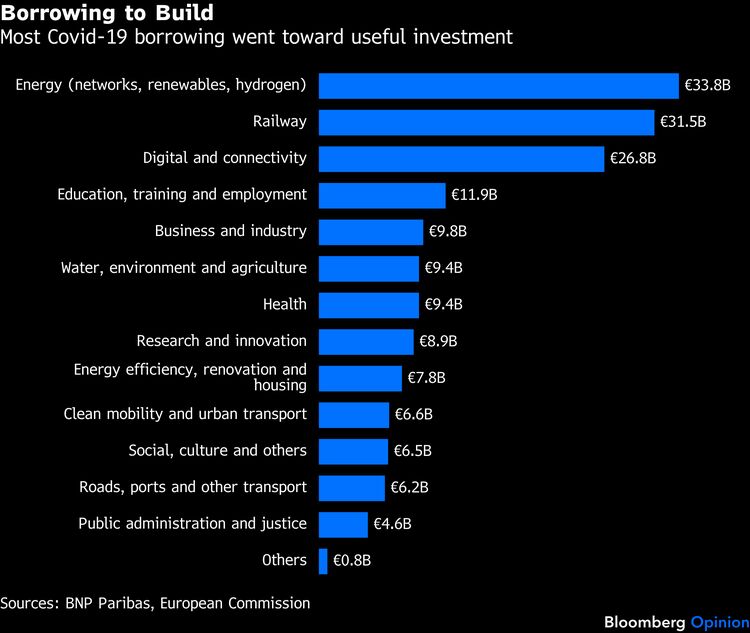
There were also positives in the investment ledger. Of €310 billion in cofinanced spending through 2025, 74% went toward capital projects, especially in transportation, energy and digital infrastructure. An average of 41% of measures in each country supported the green transition. Greece financed hospital renovations and digital upgrades for schools. Poland expanded renewables and grid capacity. About 80% of the facility’s spending was used for new projects — as planned — rather than for backfilling budgets.
It wasn’t perfect, of course. Some plans seemed to run below their budgeted cost, suggesting estimates were padded (under the rules, governments kept the difference). Others shifted spending toward previously planned projects. Ambitions sometimes outran capacity, forcing plan revisions. And cost-tracking efforts, as the European Court of Auditors has repeatedly found, left much to be desired.
All told, though, the effort was more successful than many had expected. Perhaps most important, it showed the EU can borrow at scale and use common funds to get governments to do hard things. For policymakers, the challenge now is to build on this progress with a bigger EU budget spent on ensuring the public goods that the bloc is best placed to provide, not turn a crisis fund into a standing subsidy for national budgets.
In fact, the RRF model is already spreading. It has been incorporated into other EU spending projects, such as the Social Climate Fund and the Ukraine facility. The same principles look set to govern much of the European Commission’s next budget, with more than a dozen existing funds likely to be streamlined into a single €865 billion grant-making vehicle, using the same framework of national “milestones and targets.”
The existing stock of recovery bonds should be refinanced as they mature, with the goal of creating a true European safe asset . New borrowing can be reserved for public goods that (for example) encourage private investment or enhance the bloc’s security. Where money flows to governments, it should reward reforms that dismantle barriers to capital, services and business formation, giving Brussels leverage against the national protectionism that continues to obstruct the single market.
Perhaps it wasn’t a Hamiltonian moment, but Europe’s ambitious response to the Covid-19 crisis has nonetheless laid the groundwork for a more durable union. At an otherwise perilous moment, it’s a step in the right direction.
More From Bloomberg Opinion:
- AI Giants Are Facing a Case of Financial Indigestion : Chris Bryant
- British Anti-Semitism Has Made a Distressing Return: Rosa Prince
- Healthcare’s Risk to the US Economy Is Too Big to Ignore: Jonathan Levin
Want more Bloomberg Opinion? OPIN <GO>. Web readers, click here . Or you can subscribe to our daily newsletter.