To get John Authers’ newsletter delivered directly to your inbox, sign up here .
“In what alternate universe is $5.6 trillion (17.5% of GDP) a ‘very low tax burden’?” So asked a reader in an email after I wrote in an essay in this space last month that the US wasn’t heavily burdened by taxes and could easily raise them to deal with fiscal problems.
It’s worth quoting that letter at length:
All those federal receipts front-run heavy state (exclude Florida and Tennessee) local, property, sales, gas, cell-phone, hotel, rental-car return, and any other Special Purpose Local Option Sales Tax you might want to throw at a working American citizen. The idea that our populace is taxed at a low rate versus its global, deficit-funded peers fails to acknowledge our vertically integrated tax system. It literally touches and extracts from everything. Consumption; taxed. Investment; taxed. Production; taxed. Property; taxed. Income; thoroughly taxed.
All true. But in this universe (not an alternate one) it still makes sense to say that the US bears a low tax load.
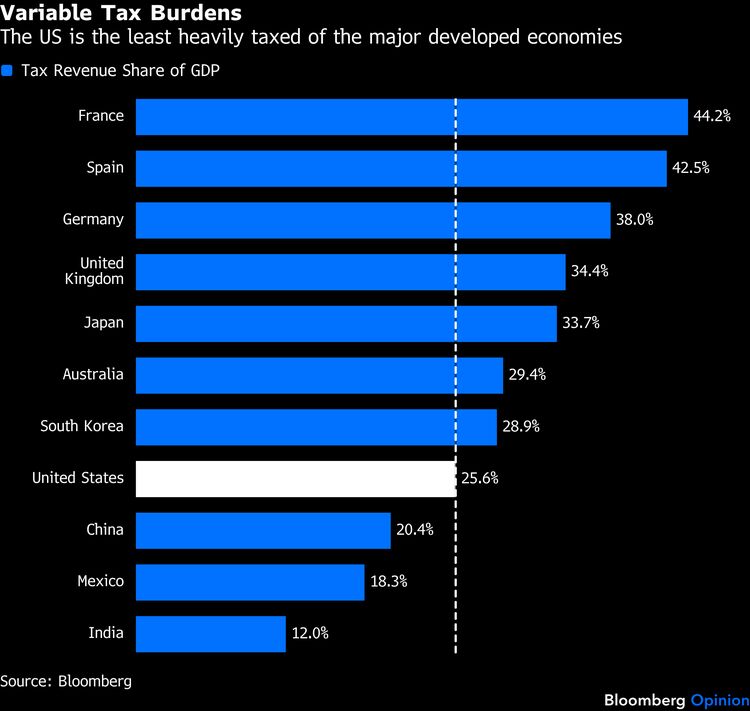
It’s more lightly taxed than any other leading developed economy, by far. And while Uncle Sam does collect a much higher share of gross domestic product than some big economies, such as Brazil, India and Mexico, all of them would dearly like to find a way to raise more revenue from their citizenry.
A League Table of Tax Burdens
There are many definitional problems in measuring tax take. Bloomberg data — using numbers from the Organization for Economic Cooperation and Development — suggests that the US pays more like 25% of GDP. This is the ranking:
What to make of this? Presenting the Institute of International Finance ’s global debt monitor earlier this month, the Financial Times chief economic commentator Martin Wolf put the argument strongly:
The US has a very simple problem. It’s ludicrously under-taxed. It would be very simple to close the deficit through higher taxes. The American problem would be trivial if American politics weren’t so weird, from my point of view.
He drew a distinction with the big European countries — particularly France — which fund expensive welfare systems, and whose high tax burdens make it difficult to raise revenues further. After effectively free-riding on US defense spending for decades, they now have little choice but to make painful cuts.
Contrary to Wolf, it’s possible to argue that France, in particular, is ludicrously over-taxed — even if those revenues bought the country an impressive health service and public transport. After decades of US political orthodoxy, lampooned by Wolf, that no politician can ever raise taxes and survive, would American hikes really be possible, or even helpful?
America and the Laffer Curve
The US debate centers on a famous lunch in Washington in 1974 that included two officials in the White House of Gerald Ford, Donald Rumsfeld and Dick Cheney . Arthur Laffer drew the curve that bears his name on a napkin , so the story goes, to show what tax cuts could achieve.
On the horizontal scale was the tax rate, from 0% to 100%; on the vertical scale was the total revenue from taxation. Laffer argued that it would be an inverted “U.” Rates of 100% (leaving no point in working) or 0% would result in zero tax take. The maximum would lie somewhere in between — and the highest revenue might come with a rate lower than it was at the time.
Theoretically, it’s hard to argue with this. Few people would want to live in a society with 0% or 100% tax rates. But empirically, it’s far harder to work out exactly what rates would maximize returns. President Ronald Reagan’s tax cuts, driven by Laffer’s ideas, stimulated the economy. The deficit widened.
Apart from a few adherents of the libertarian Ayn Rand or the communist Karl Marx (who opposed all taxes in a capitalist society), most can agree that taxes are a necessary evil. Other countries provide examples where the Laffer idea worked. Notably in Britain, the top marginal rate reached 95% in the 1960s and 1970s (George Harrison bitterly complained that “It’s one for you, 19 for me” in The Beatles’ Taxman ). Public finances were stronger, and the economy much more vibrant, once the era of punitive taxation was over.
Other countries are blatantly under-taxed. For at least 30 years, Mexican governments have tried to widen the tax base, but successive attempts to levy sales taxes on medicine and food have been rebuffed. Despite decades of macroeconomic stability, the country’s huge informal sector remains beyond the government’s reach (and often, tragically, firmly within the grasp of narco cartels), while efforts by banks to coax people away from using cash have largely failed. The administration of Claudia Sheinbaum is now making yet another attempt to lift the tax take above 20% of GDP through digitalizing payments for services that can currently be paid with cash .
With its acute infrastructure problems, it’s clear that Mexico is under-taxed, just as 1960s Britain was over-taxed. In the US, with fraying public works and a growing deficit, it’s hard to say that taxes are too high.
The Politics of Tax
This raises the question of whether the US’ “weird” politics would permit tax hikes. This century, which started with the budget in surplus, tax rates have fallen consistently — and the deficit, for this and other reasons, has persistently deepened.
Received wisdom is that proposing a tax hike is political suicide. Walter Mondale famously promised to raise taxes during the 1984 election campaign — and Reagan went on to win 49 states in a landslide. George H.W. Bush won in 1988 by promising “no new taxes” — and lost to Clinton four years later in large part because he reneged.
Since then, the Republicans George W. Bush and Donald Trump have both put big tax cuts at the core of their agenda — but in rather less eye-catching fashion, the Democrat Barack Obama did so as well. His American Recovery and Reinvestment Act (ARRA), the big stimulus bill with which he attempted to fight the effects of the Global Financial Crisis in 2009, reduced federal taxes by an estimated $287 billion over 10 years . Little remembered now, the administration decided that 38% of the stimulus should be devoted to tax cuts in a failed attempt to persuade Congressional Republicans to support it .
Joe Biden, who pursued a very liberal economic agenda, did enact $600 billion in tax rises — balanced by $600 billion in cuts .
But the political (and economic) case against tax increases isn’t as clear as it appears. The country eliminated its deficit in the early 1990s, after the fateful Bush tax hike, and Bill Clinton’s OBRA (Omnibus Budget Reconciliation Act) of 1993, which raised the top marginal rate from 31% to 39.6%. It even achieved some corporate support , and Clinton did persuade a chunk of the population to back it on patriotic grounds. For example, the baseball pitcher Chuck Finley, then on a $5 million salary, told a reporter: “Personally, I know you've got to pay your taxes to live in a good country like this.”
A historic economic boom ensued — so it’s hard to argue that the hike did much harm, and the circumstantial evidence suggests that the US had started from too low a tax rate on the Laffer Curve.
Combine that episode with the emerging evidence from opinion polls, and it needn’t be that hard for a politician to win approval for a tax hike. They might not even need Clinton-level skills. Younger voters attracted to progressive or even socialist candidates say they are motivated by inequality and what they see as an unfair tax system . Many on the populist right similarly have little inhibition about tax hikes aimed at attacking inequality.
Marko Papic, chief investment strategist at BCA Research, says the Democratic party is growing far more competitive (as shown by the midterm polls). “It is also laser-focused on redistribution, which means higher taxes and a more onerous corporate regulatory environment.” He argues:
Neither the bond market nor voters want to see higher deficits. Which means that Democrats will campaign — starting as early as the summer of 2027 — on budget discipline and tax hikes. US tax rates — across individual, corporate and capital gains — have bottomed.
Whether the Democrats can find someone like Clinton to sell higher taxes is another question. And they would be lucky indeed if conditions combine as well as they did in the 1990s to allow them to end the deficit altogether. It’s plenty possible that the US will find it’s too far down on the Laffer Curve.
But at present, in this universe, the US tax burden does look low, and the country’s politics do indeed appear to be shifting toward allowing it to rise. It’s an underappreciated risk, and those who dislike such a prospect need to start making their case now.
More From Bloomberg Opinion:
- Healthcare’s Risk to the Economy Is Now Too Big to Ignore: Jonathan Levin
- Trump’s Trouble Is the Message and the Messenger: David M. Drucker
- It’s a Depressing Time to Care About Free Markets : Allison Schrager
Want more Bloomberg Opinion? OPIN. Or you can subscribe to our daily newsletter .