History can be hard to get your head around. One helpful practice, the writer Nicholson Baker has observed, is to organize the flow of time into blocks of years — whether big chunks like the Renaissance or tidy ones like the 1960s — to tease out a narrative thread. “Without named periods, however clumsy or imprecise, past time would be no more than a mound of glittering granules in a darkened silo,” Baker wrote in 2008.
This insight appeared during a brief few weeks when Baker, a National Book Critics Circle Award-winning novelist, dropped everything. He “all but disappeared into my screen,” as he described it in a memorable essay , to become a devoted editor of Wikipedia, a volunteer like all Wikipedia editors, with the handle “Wageless.”
Good luck finding Baker’s musings on unorganized time today. Once a crucial part of the Wikipedia page on “ Periodization ,” they vanished in 2010, when an editor named Geekdiva decided to wring out the vivid imagery , replacing it with plain language about “scattered events” and the “frameworks” needed to understand them. By that point, Baker had returned to professional writing, a practice radically different from contributing to Wikipedia, where, as he explained in the same essay, “It had to be a little flat — a little generic — fair-minded — compressed — unpromotional — neutral.”
Even if you know the ways of Wikipedia, seeing Baker’s delicate prose smashed for parts can make you wince. Wikipedia, the product of an abundance of computers and innovative software that allowed large-scale collaborative writing, was simply too powerful for one man to defeat.
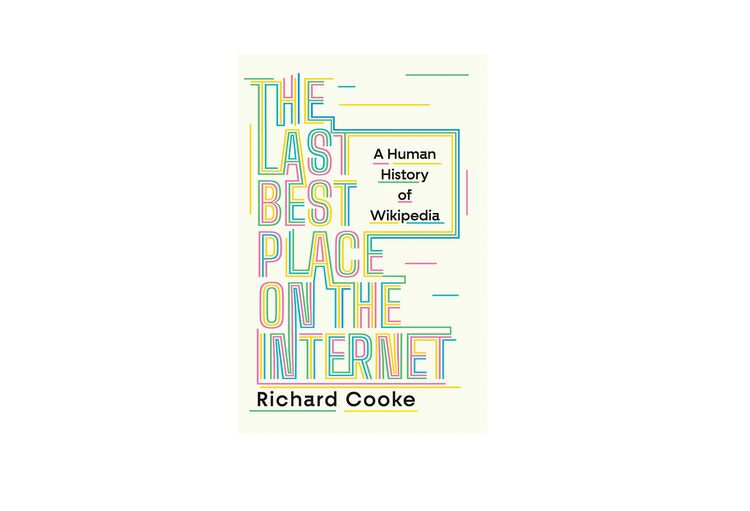
This transition from writing with an individual personality to detached, legible communication is the subtext of Richard Cooke’s new, sweeping history of Wikipedia, The Last Best Place on the Internet . The book comes at an opportune time, amid the rise of AI chatbots that explain the world. What does it mean to accept the chatbots’ judgments? Is surrendering our understanding of the world to machines the reason we believe they eventually will destroy humanity? Does it mean they already have?
In Cooke’s telling, Wikipedia served as a stepping stone to our current moment, and not because its 7 million articles in English, containing 5 billion words are a critical source of training materials for large language models like ChatGPT and Claude. Instead, he points to Wikipedia’s comprehensive rejection of experts and tradition. The site ditched the normal signifiers of trust — signed scholarly articles; a board of advisers; a team of fact-checkers; leather-bound volumes with gold-trimmed pages — to focus only on the words and the sources that back them up. In just a few years, Wikipedia became the unexpected, undisputed arbiter of truth online. Blindly and suddenly accepting the word of a chatbot doesn’t seem like much of a leap.
There were few signs at the start, around the year 2000, that Wikipedia would become so meaningful. Its founders, Jimmy Wales and Larry Sanger, were philosophy enthusiasts from Alabama and Alaska, respectively, who asked big questions. Cooke traces their interest in building an online encyclopedia back to Voltaire and Diderot, the creators of the French Encyclopédie, who believed “that a published collection of truths could remake the world.”
Early on, Wales offered a succinct, idealistic mission statement: “Imagine a world in which everyone on the planet is given free access to all human knowledge.” But he was far from Silicon Valley and lacked the connections to turn that dream into a reality. What Wales did have was a small-time online media company, Bomis (an acronym for Bitter Old Men in Suits), which was growing an audience through soft-core pornography, among other areas of interest. The original plan was to publish an encyclopedia, Nupedia, as part of its varied offerings.
Wales brought in Sanger, who in turn recruited voluntary academic contributors for the project; together they established a seven-stage review process so daunting that in the first five months only one piece, about atonality in music, reached publication. “Had it failed less badly,” Cooke writes, “Nupedia might have limped along for years, but this was not a time of plenty where loss leaders could be indulged.”
To save money during the dot-com crash, Nupedia dropped the strictures in favor of a user-generated model. This was 2001, during the rise of Web 2.0, which shifted much of the work of paid employees to unpaid users. (The next year Sanger was laid off as editor-in-chief.) LinkedIn arrived that same year; MySpace in 2003; Facebook in 2004; YouTube in 2005. Wikipedia’s approach to user-generated content would be unique. Rather than individuals sharing their work, it consisted of collaborators building something together with software.
That software, called WikiWikiWeb, from the Hawaiian word for fast, was notable at the time for allowing anyone with access to a web page to change it, no approval necessary. In the words of the software’s creator, Ward Cunningham, a wiki “closely emulates a real verbal discussion,” but “with the added feature of being persistent.” Persistent as a text until it is changed again, that is. Because a wiki records every edit as its own link, reversing vandalism, or flowery prose, is as simple as clicking on an earlier, preferred version. Creating a new article is only a click away too. English Wikipedia reached 500,000 articles by early 2004 and later that year had doubled to 1 million.
The loving attention Cooke gives to Cunningham and the thinkers who influenced him is one of many examples of the book productively following unexpected tangents. Cooke recounts how the wiki idea emerged from discussions among a group of friends convinced, in the words of one of them, that computers “shouldn’t just be for this priest class of programmers. We were thinking, ‘How can this benefit teachers, nurses, the people who need it?’”
Another influence was HyperCard, an Apple application whose creator had a vision while tripping on LSD. “In this acid haze I thought about the relationship between wisdom and knowledge,” the software developer recalled. Cooke continues: “Why, he wanted to know, did human knowledge so often remain sparse and separated like the star light, when it should pool like the streetlight instead?”
But Wikipedia’s rapid growth was not simply a question of software. The timing was perfect. In those early days, Google needed results, and Wikipedia offered nothing but. “Sometime in 2002, the quantity of digital information in existence overtook the quantity of analog information in existence,” Cooke writes.
There were mighty stumbles, including the chilling story of vandalism that caused the Wikipedia article about John Seigenthaler to falsely state for months in 2005 that he was somehow connected to the assassinations of his close friend Robert F. Kennedy, as well as John F. Kennedy. This ushered in a new era of accountability and insistence on listing sources, including the frequent use of the label “citation needed” when an article didn’t offer evidence for its statements.
From 2001 to 2008, Cooke writes, Wikipedia’s growth was exponential. These days, the audience is actually shrinking, a development assumed to be connected to AI chatbots. As Wikipedia enables chatbot answers to become increasingly comprehensive, fewer and fewer people leave the LLM to read the pages themselves. Cooke and others have said they fear the public might well forget there even is a Wikipedia.
This worry relates to one of the great innovations of wiki software: It hides the people who do the work, offering a kind of oracular wisdom. Wikipedia entries have no byline; the back-and-forth of the writing process is typically conducted via pseudonym on separate Talk pages that few people visit. This division has been invaluable, isolating the polemicists from the creators to keep the focus on what matters — the article, not the bluster. But it also keeps the process obscure. One early critic labeled Wikipedia an “exercise in digital Maoism” in the way that it rejected individual identity.
Cooke works mightily to correct that perception, shining a light on Wikipedia contributors. One pseudonymous editor, Ttocserp (Prescott backwards), wrote 17,000 words on the history of the Thames River embankment, which Cooke praises as a genuine historical epic. “Who is this person? Why are they doing this?” Cooke asks. “Hidden inside Ttocserp’s work on the Thames walls is a line that hints at motive: ‘There may never be a comprehensive history of the Thames walls.’ Well there is now.”
Cooke also spotlights a Barnard Ph.D. who in the early days served as a de facto chief copy editor; a photographer whose work has been uploaded to more than 5,000 articles; and an engineer from Tennessee who posted self-portraits of his “micro-penis.” This cauldron of humanity would seem unfazed by the changing traffic patterns at Wikipedia. People contribute because they want to tell stories of this human life and Wikipedia offers a chance to memorialize them. They hold Wikipedia to a high standard because they want what they write to be taken seriously.
So, while you may be hard-pressed to find any of Nicholson Baker’s prose on Wikipedia, it still glitters with his humanity. On Talk pages and elsewhere, he championed obscure writers whom other Wikipedians dismissed as unworthy of an article: the formalist poet A.M. Juster; the Cape Verdean writer Yolanda Morazzo; and Richard Denner, belittled by some for mainly writing chapbooks. Perhaps because of Baker’s literary stature, those articles not only remain but have grown in depth.
In the rare cases when he was on the losing end of a “notability” argument, like the one involving a 16th-century English farmer, Simon Dodsworth, Baker offered a vision for the project that is the precise opposite of an efficient-thinking AI chatbot. “One of the notable things about Dodsworth to a historian is that he isn’t notable,” Baker wrote. “He’s just a man in a certain walk of life who fought in a battle. Keep and nurture this sort of work.”
Noam Cohen is the author of The Know-It-Alls: The Rise of Silicon Valley as a Political Powerhouse and Social Wrecking Ball .