Prediction markets built their business by letting users trade on everything from Federal Reserve decisions to pop culture. This year’s football season is showing just how much their growth hinges on something more familiar to bettors: sports.
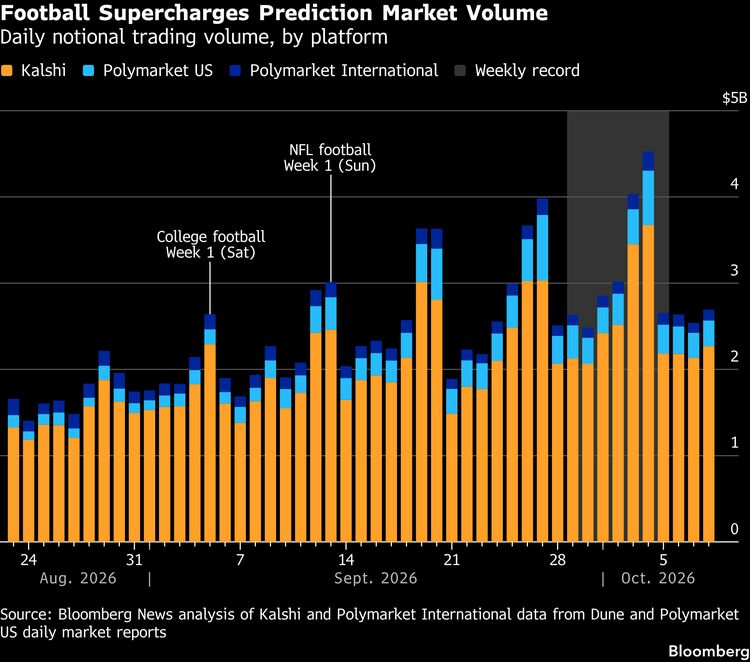
Last weekend, games in the National Football League and the NCAA boosted trading volumes at Kalshi Inc. and Polymarket to consecutive daily records for a two-day total of $8.56 billion, according to data compiled by Dune Analytics. The combined weekly volume for both companies reached a record $22.2 billion.
Their new mainstream popularity puts prediction markets on a collision course with traditional sportsbooks, state regulators and the NFL, which has raised concerns about the effect of the trades on game integrity. The tensions are raising the stakes for the industry, just as a potential Supreme Court showdown may threaten its business model.
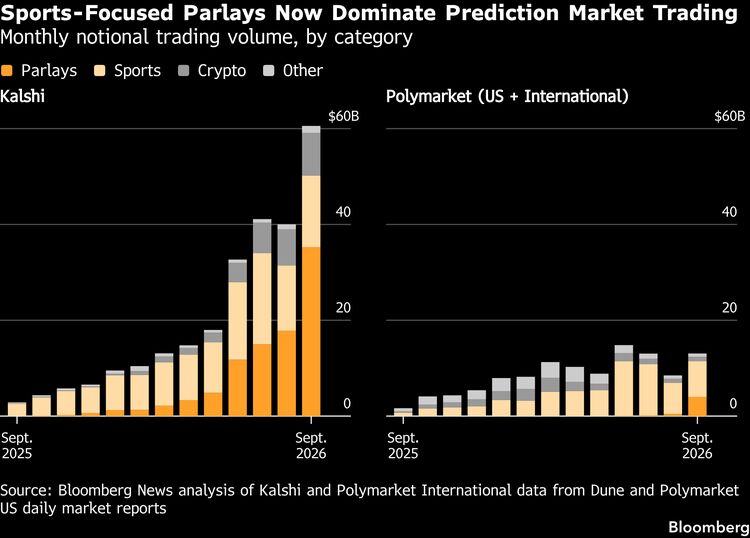
In the first four weeks of the NFL season, the financial impact for the top platforms has surged into view: More than 80% of Kalshi’s volume came from sports trades in September. The company is considering a potential initial public offering after a financing round valued the platform at about $40 billion.
“It’s the same playbook we saw five years ago with online betting apps,” said Jordan Bender, an analyst at Citizens Financial Group. “It looks no different.”
Those betting companies are pushing back as they face a regulatory disadvantage: Prediction markets are federally classified as exchanges, meaning they can avoid state taxes on traditional gambling — like New York’s 51% levy — as well as age and location restrictions on sportsbooks.
That’s pushing betting sites such as DraftKings Inc. and FanDuel to launch their own prediction-market products, giving them access to customers in states where their sportsbooks can’t operate. For now, they’re trailing Kalshi and Polymarket in trading volume and customer adoption.
“In Texas or California, where gambling is not allowed, prediction markets have a leg up,” said Ilya Beylin, an associate law professor at Seton Hall University.
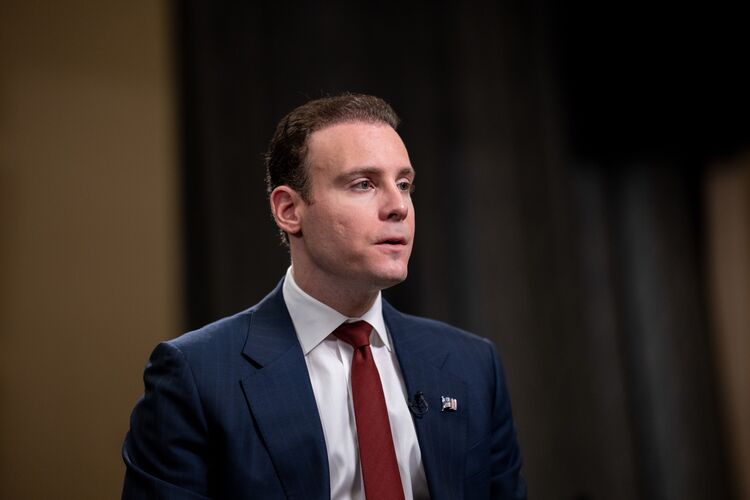
Kalshi says its products shouldn’t be considered gambling because it operates as an exchange and doesn’t take the other side of customers’ trades. “Sports trading on regulated prediction markets offer a fairer choice to consumers, with no ‘house’ that restricts winners and hooks people the more they lose,” said Elisabeth Diana, Kalshi’s head of communications.
Prediction market firms are using aggressive, sportsbook-style marketing to capitalize on the American football season.
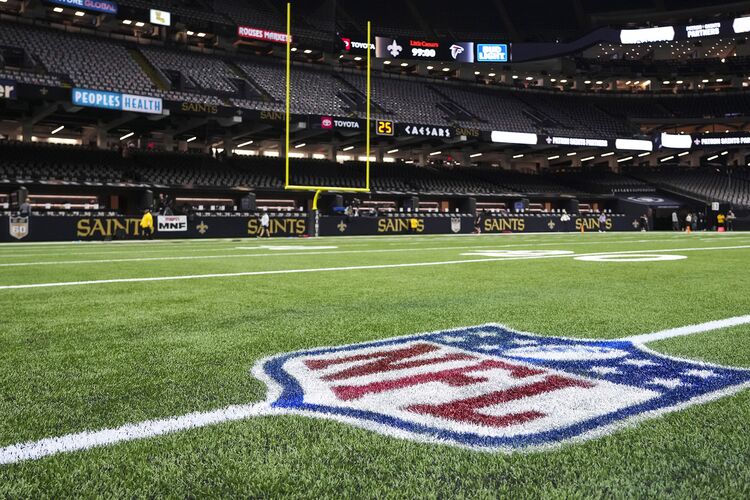
Novig Betting Inc., a sports-only prediction market, began a campaign in the first week of the NFL’s regular season featuring a nude Sydney Sweeney wearing only shoulder pads and holding a football. Polymarket rolled out a multimillion-dollar push featuring the new Philadelphia 76ers player LeBron James, alongside football legends like Eli Manning and Richard Sherman.
Polymarket and Novig didn’t respond to requests for comment.
Football is fueling demand for combos, prediction markets’ version of parlays that bundle multiple outcomes into a single trade. Combos accounted for 65% of Kalshi’s volume and 53% of Polymarket’s US volume last week, with most of those combos involving sports. At least 96% of Kalshi’s combos were sports-related, Diana said.
On days with significant NFL and college football activity, Kalshi’s combo volume averages about $1.36 billion, according to Piper Sandler estimates, more than twice the level of non-football days. That compares with about $900 million in combo volume for Kalshi over the entire previous NFL regular season.
Bettors on Kalshi and Polymarket often gravitate toward longshot contracts with potentially huge payouts, but the returns have generally been poor. A Bloomberg News analysis released Wednesday tallying wins and losses since early 2025 showed that money staked on “yes” longshots lost 15% by settlement on Kalshi and 27% on Polymarket. Those losses can deepen further after platform fees, which can reach 7%.
The surge has stirred criticism from lawmakers, including Democratic Senator Elizabeth Warren and Republican Senator John Curtis, who have asked Commodity Futures Trading Commission Chairman Michael Selig for records related to the agency’s supervision of prediction markets and crypto, alleging the regulator had become too influenced by the industries it oversees. The CFTC didn’t respond to requests for comment.
The senators also raised conflict-of-interest questions about the industry’s ties to President Donald Trump’s family. Donald Trump Jr. advises Kalshi, and his venture firm is leading a funding round in Polymarket.
Another challenge comes from states that argue prediction markets offer gambling under the guise of federally regulated financial products.
At least 44 states, including New York , Arizona and Connecticut , argue the sports contracts are illegal gambling subject to state law. The CFTC has taken the unusual step of suing states seeking to enforce their gambling laws against federally regulated exchanges.
The NFL joined the push for Supreme Court intervention to allow states to regulate sports prediction markets, warning that the CFTC’s “laissez-faire” approach could leave room for insider trading, manipulation and threats to game integrity.
Read More: NFL Asks Supreme Court to Let States Regulate Event Markets
Federal appeals courts have split over the response, increasing the likelihood that the Supreme Court will step in.
A ruling for the states could force prediction markets to comply with state licensing, taxes and gambling restrictions, while an outcome favoring Kalshi and the federal framework could preserve their ability to operate nationally under CFTC oversight.
“If prediction markets are successful at the Supreme Court, then basically the sports betting regulatory regime as it exists could basically cease to exist,” said John Holden, an associate professor in business law at Indiana University.