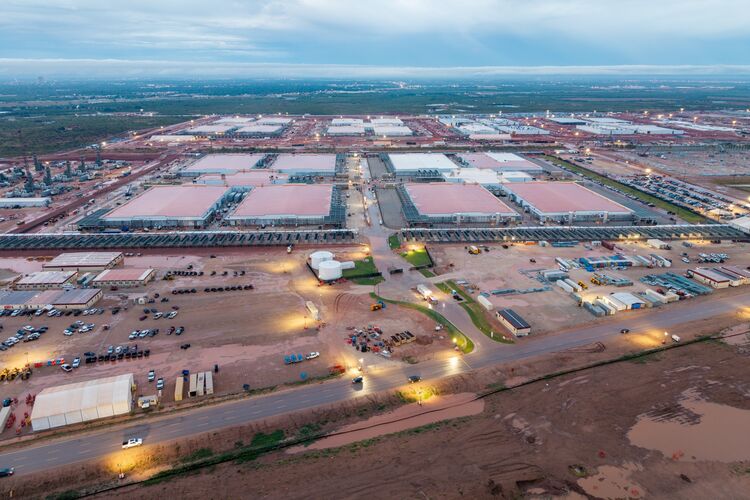
Data center developers have started touting new technologies that slash the amount of water needed to cool hot-running servers in drought-stressed places like Arizona. Those efforts, though, are not addressing the vast majority of the water consumed by the AI buildout.
Miles away from multiplying data centers, power plants are now consuming enormous volumes of water to generate the electricity required to run artificial intelligence, including those more efficient cooling systems.
New research indicates that such indirect water consumption is rapidly growing. In a recent paper , University of Michigan researchers estimated water used offsite would boost the total annual consumption of three large AI data centers planned for the state by 14 billion gallons.
“There has been much less attention to this indirect water usage, even though that oftentimes is significantly higher than the direct water usage and has impacts on watersheds and regional water resources,” said Shaolei Ren , a professor at the University of California at Riverside who studies data center water consumption .
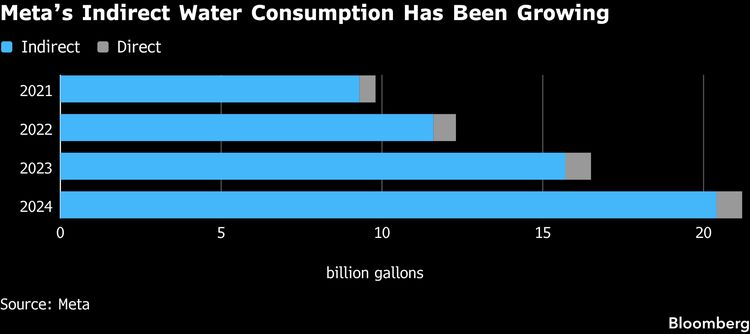
At Meta Platforms Inc. , one of the only developers to publicly divulge indirect water consumption, such use accounted for about 96% of the 21 billion gallons (80 billion liters) of water the company consumed in 2024 — nearly a 120% increase from 2021 — according to its latest sustainability report .
The remaining 4% was used on site, mostly at data centers, which also account for nearly all of Meta’s electricity consumption. “Transparency is a key pillar of Meta’s water stewardship program,” a spokesperson said in an email.
Computing-intensive AI data centers can consume 10 times as much electricity as conventional facilities, with most of that energy needed to power servers, according to researchers. To generate that electricity, fossil-fueled and nuclear power plants need large amounts of water to produce steam to run turbines.
Across the US, a growing backlash has emphasized concerns about local environmental impacts and rising electricity bills. That opposition has prompted moratoriums and other restrictions. At least 45 projects valued at nearly $68 billion were blocked or delayed between April and June, according to research firm Data Center Watch.
There’s a risk data centers’ rapid growth will intensify the impact of climate-driven droughts and heat waves, which are already stressing water supplies in many places.
“Demand for data centers is just skyrocketing and the truth of the matter is that the power and water facilities won’t be able to keep up,” said Kerri Hickenbottom , an associate professor of engineering at the University of Arizona who researches data center water use.
Read more: Why Do Data Centers Use So Much Fresh Water?
Estimates of US data centers’ annual indirect water use range from 211 billion gallons (800 billion liters) in a 2024 Lawrence Berkeley National Laboratory study to as much as 4 trillion gallons based on a recent analysis from environmental nonprofit Ceres . That’s enough to supply between 2 million and nearly 37 million average US households per year.
Developers said one reason for the lack of disclosure is that there’s no standard protocol for calculating data centers’ indirect water use. “We need industry alignment on one if we’re going to collectively report indirect water consumption,” said Brandon Oyer, head of energy and water for Amazon Web Services.
Amazon.com Inc. said water efficiency at its data centers has improved by 52% since 2021, in part from deploying cooling systems that require less of it and through technology that reduces heat inside the facilities. “That is keeping both the onsite and the offsite water use as low as possible,” said Will Hewes, Amazon Web Services’ water sustainability lead.
Ben Townsend, head of infrastructure strategy and sustainability at Google, said the company currently doesn’t report indirect water use but has concentrated on powering data centers with renewable energy. “With wind, solar, storage, these projects have effectively zero water footprint,” he said.
Such solutions are being put to the test in drought-stressed data center hotspots such as Arizona, where water is a flash point as the Colorado River and its reservoirs dry up . The federal government in August announced a 27% cut to Arizona’s water allocation, with far more severe cuts possible if conditions continue to deteriorate. The state’s data centers are concentrated in the Phoenix area, where cities depend on the river for 20% to 50% of their water supply .
AI data center projects currently being built in Arizona could spike onsite water demand to 5 billion gallons annually in coming years, Bloomberg Intelligence predicts, or 4.5% of Phoenix’s current annual water production. But the indirect water use would be orders of magnitude more, according to researchers.
Michael Gertzman, a spokesperson for the Phoenix Water Services Department, said a large data center applicant must disclose its estimated onsite water consumption. Indirect water use isn’t part of the evaluation.
With the southwest US suffering a record 26-year drought, and Phoenix’s summer temperatures hitting an average daily high of 108F (42C) in recent years, data center developers are turning to technology that relies on little or no onsite water, such as air-chilled coolers. There are tradeoffs, however, as removing that heat requires electricity.
A 2025 study that Hickenbottom co-authored noted that in the Phoenix area, the indirect water consumption of systems using air-cooled chillers can be more than 2.5 times that of water-cooled chillers, which use more water on site.
Microsoft Corp., which operates several data centers in Arizona, didn’t provide data on its indirect water use or indicate whether it calculates that consumption. The company said it has reduced the amount of water needed onsite per kilowatt-hour used at its data centers by 90% since the early 2000s. It expects to save 33 million gallons (125 million liters) annually at each of its facilities thanks to liquid cooling designs.
“Our focus is on minimizing the water we use directly in the communities where we operate while maintaining highly efficient data center designs and working with utilities to help meet our power needs responsibly,” a Microsoft spokesperson said in an email.